






1. Introduction for Design Qualification for AHU:
The Design Qualification (DQ) of the Heating, Ventilation and Air Conditioning (HVAC) system provides documented evidence that the proposed system design meets user requirements, functional specifications, cGMP expectations, and applicable safety standards. It evaluates key components, including the air-handling unit, filters, blowers, coils, ducting, controls, instrumentation, materials of construction, and utilities. The qualification also verifies airflow, air changes, temperature, relative humidity, pressure differentials, filtration, accessibility, alarms, and operational safety. This document establishes an approved design basis for procurement, fabrication, installation, commissioning, and subsequent qualification, ensuring the HVAC system consistently maintains the required environmental conditions in designated pharmaceutical areas and facilities.
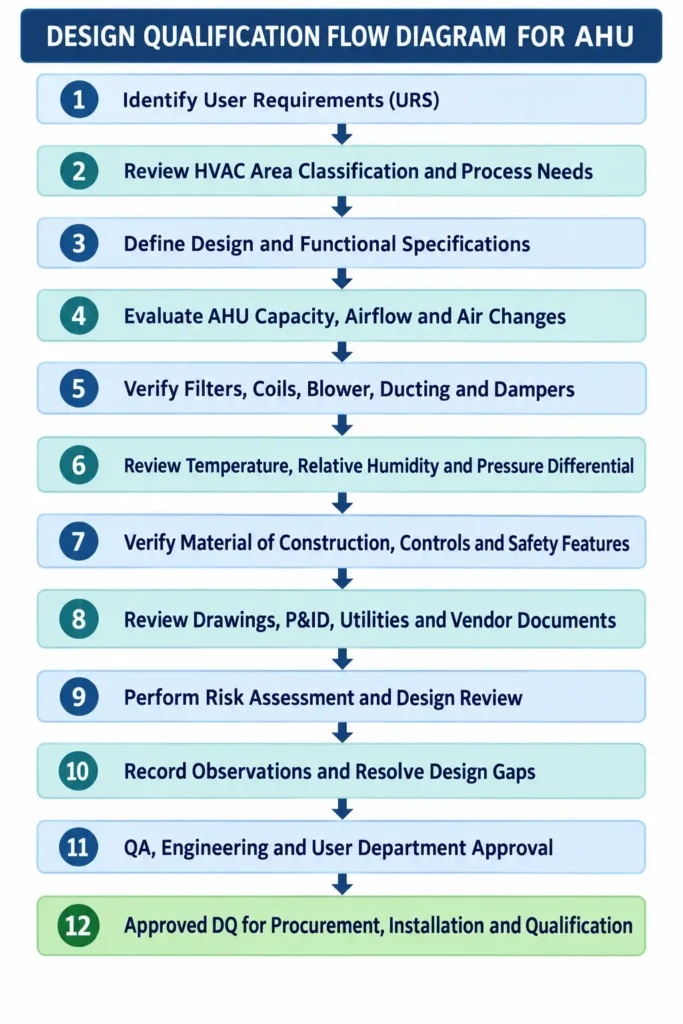
Skip to PDF content2. Flow Diagram for Design Qualification for an AHU:
The flow diagram presents the systematic Design Qualification process for an Air Handling Unit (AHU). It begins with identifying the User Requirement Specification and reviewing area classification and process needs. Design and functional specifications are then defined, followed by evaluation of AHU capacity, airflow, air changes, filters, coils, blowers, ducting, and dampers. Environmental parameters, construction materials, controls, safety features, drawings, utilities, and vendor documents are reviewed. A documented risk assessment identifies design gaps requiring resolution. Finally, Quality Assurance, Engineering, and the User Department review and approve the design before procurement, installation, commissioning, and subsequent qualification activities commence in controlled facilities.
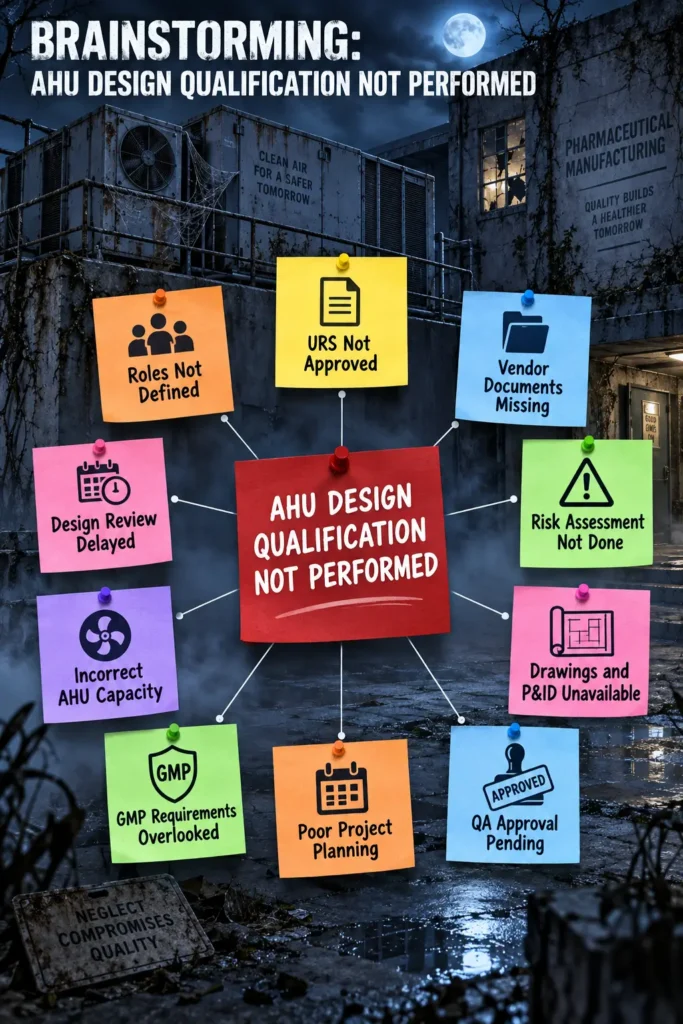
3. Brainstorming Diagram for Design Qualification of an AHU not performed:
The brainstorming diagram illustrates the potential causes for not performing Design Qualification of the Air Handling Unit (AHU). The haunted, neglected pharmaceutical building symbolizes poor planning, delayed decisions, weak ownership, and uncontrolled project conditions. Color-coded sticky notes identify major concerns, including an unapproved URS, undefined responsibilities, missing vendor documents, delayed design review, incomplete risk assessment, incorrect AHU capacity, unavailable drawings and P&IDs, overlooked GMP requirements, poor project planning, and pending QA approval. The diagram encourages a cross-functional investigation involving Quality Assurance, Engineering, Validation, User Department, and the vendor to identify gaps, assign actions, and complete the DQ systematically before procurement.
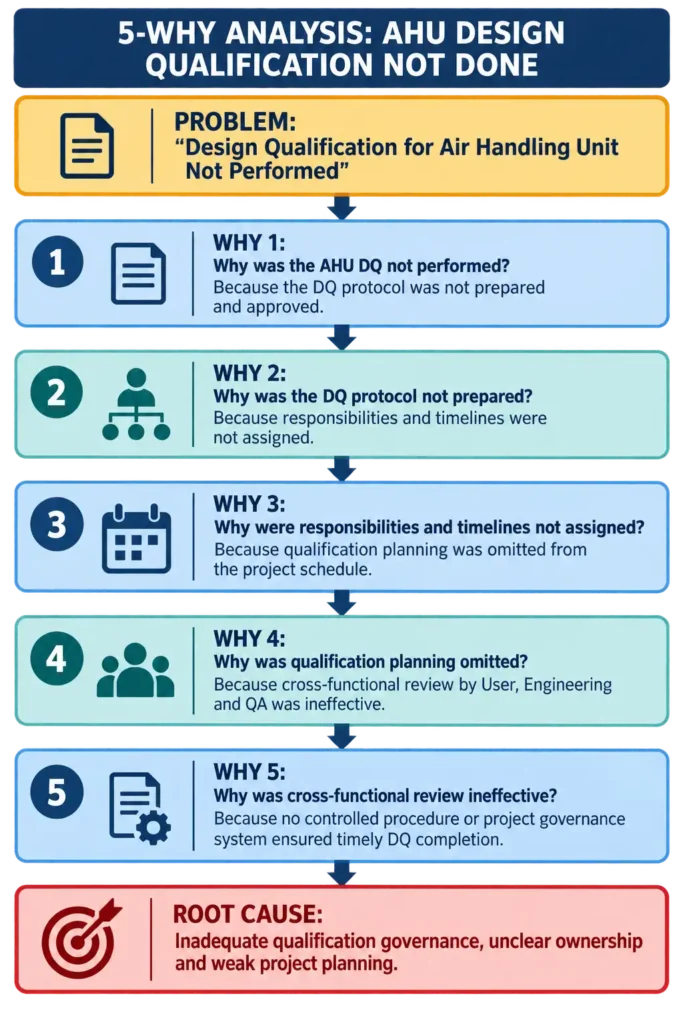
4. 5-Why Analysis for Design Qualification of AHU not performed:
The 5-Why analysis identifies the underlying reasons why Design Qualification of the Air Handling Unit was not performed. The immediate cause was the absence of a prepared and approved DQ protocol. Further investigation shows that responsibilities and completion timelines were not assigned because qualification activities were excluded from the project schedule. This occurred due to ineffective coordination among the User Department, Engineering, Validation, and Quality Assurance. The final root cause is inadequate qualification governance, unclear ownership, and weak project planning. Corrective action should include preparing and approving the DQ, assigning responsibilities, establishing timelines, strengthening cross-functional review, and implementing a procedure.
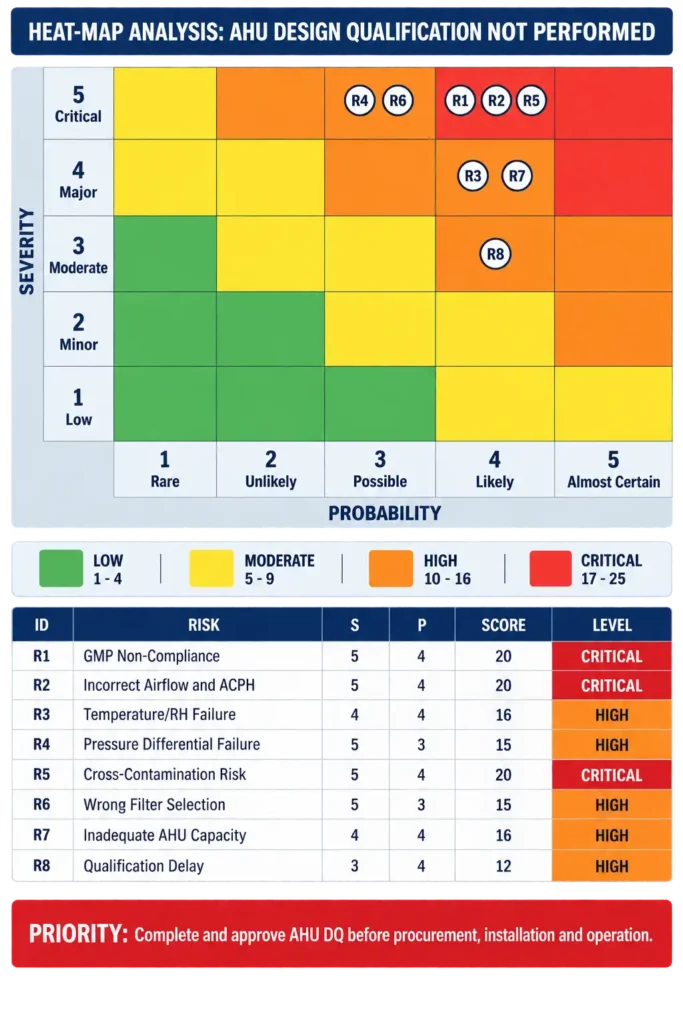
5. Heat-Map Analysis for Design Qualification of AHU not performed:
The heat-map analysis evaluates risks arising from failure to perform Design Qualification for the Air Handling Unit. Risks are ranked according to severity and probability using green, yellow, orange, and red zones. GMP non-compliance, incorrect airflow or air changes, and cross-contamination are classified as critical risks. Temperature and relative humidity failure, pressure differential failure, unsuitable filter selection, inadequate AHU capacity, and qualification delays are categorized as high risks. The assessment demonstrates that operating or installing the AHU without approved DQ may compromise product quality, environmental control, and regulatory compliance. Therefore, complete and approve the DQ before procurement, installation, and operation.
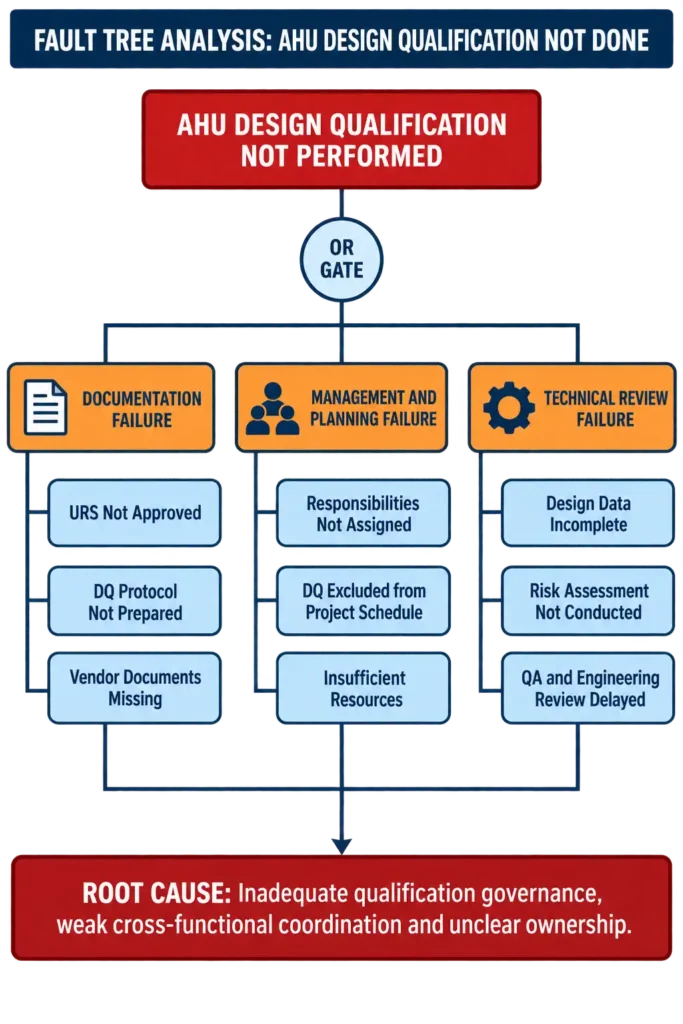
6. Fault Tree Analysis for Design Qualification of AHU not performed:
The fault tree analysis identifies the combination of failures leading to the Air Handling Unit Design Qualification not being performed. The top event is linked through an OR gate to three major branches: documentation failure, management and planning failure, and technical review failure. Contributing causes include an unapproved URS, missing DQ protocol, unavailable vendor documents, unclear responsibilities, exclusion of DQ activities from the project schedule, insufficient resources, incomplete design data, absent risk assessment, and delayed QA and Engineering review. The analysis establishes inadequate qualification governance, weak cross-functional coordination, and unclear ownership as the primary root causes requiring immediate corrective action.
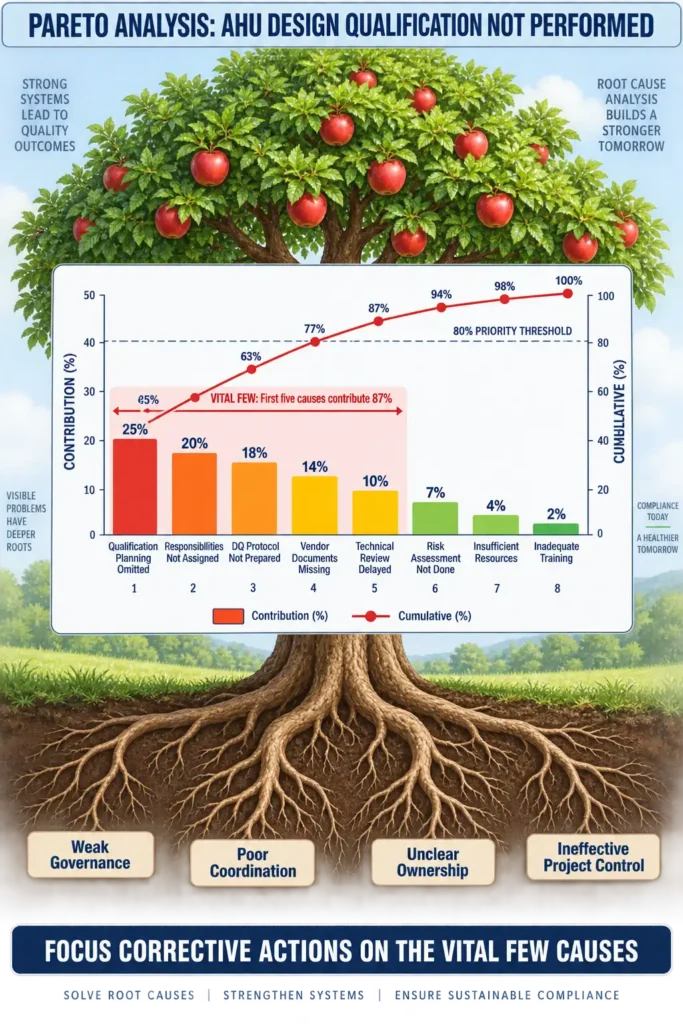
7. Pareto Chart Analysis for Air Handling Unit Design Qualification not being performed:
The Pareto chart prioritizes the major causes responsible for the Air Handling Unit Design Qualification not being performed. Qualification planning omitted, responsibilities not assigned, DQ protocol not prepared, missing vendor documents, and delayed technical review together contribute 87% of the problem. These vital few causes should receive immediate corrective attention before addressing lower contributors, including incomplete risk assessment, insufficient resources, and inadequate training. The apple tree illustrates visible failures, while its roots represent weak governance, poor coordination, unclear ownership, and ineffective project control. Focusing actions on these systemic causes will support timely DQ completion, regulatory compliance, and sustainable improvement outcomes.
8. Corrective Action and Preventive Action with Effectiveness Review:
Correction
Stop AHU procurement, installation, commissioning, or routine use until a documented quality-risk assessment is completed and approved by Quality Assurance.
Corrective Actions
- Initiate a deviation for failure to perform AHU Design Qualification.
- Conduct a documented root-cause investigation involving QA, Engineering, Validation, Purchase, and the User Department.
- Collect and review the approved URS, technical specifications, airflow calculations, P&ID, layout, filter details, utilities, control philosophy, and vendor documents.
- Prepare, review, approve, and execute the AHU DQ protocol.
- Verify AHU capacity, airflow, ACPH, temperature, relative humidity, pressure differential, filtration, materials, controls, alarms, and safety features against the URS.
- Record all design gaps and implement modifications through approved change control.
- Prepare and approve the final DQ report before proceeding with IQ, OQ, and PQ.
- For an already-installed AHU, perform a retrospective design-gap assessment supported by quality-risk management.
Preventive Actions
- Revise the qualification SOP to mandate approved DQ before equipment purchase or installation.
- Introduce a project stage-gate checklist covering URS, DQ, FAT, SAT, IQ, OQ, and PQ.
- Assign responsibilities and target dates through an approved RACI matrix and qualification schedule.
- Establish a document tracker with automatic escalation for overdue qualification activities.
- Train QA, Engineering, Validation, Purchase, and User Department personnel.
- Include qualification status in monthly project-review and management-review meetings.
- Conduct periodic QA audits of ongoing equipment and utility projects.
Effectiveness Review
Effectiveness shall be evaluated after DQ closure and again after three months. The CAPA will be considered effective when:
- The DQ protocol and report are approved without unresolved critical gaps.
- All DQ observations and related change controls are closed.
- IQ, OQ, and PQ proceed without design-related deviations.
- Airflow, ACPH, temperature, relative humidity, pressure differential, and filtration meet approved criteria.
- Training assessment scores are at least 80%.
- No equipment is purchased or installed without approved URS and DQ.
- No similar omission occurs during the three-month monitoring period.
Any recurrence shall require CAPA re-investigation and management escalation.
9. Questions and Answers: Design Qualification of Air Handling Unit:
1. What is Design Qualification for an AHU?
Design Qualification is documented verification that the proposed AHU design meets the approved URS, GMP requirements, process needs, and safety standards.
2. Why must AHU DQ be performed?
It confirms that the system is appropriately designed to maintain airflow, cleanliness, temperature, relative humidity, pressure differentials, and contamination control.
3. When should AHU DQ be completed?
DQ should be completed and approved before procurement, fabrication, installation, or major modification of the AHU.
4. Which departments participate in AHU DQ?
Engineering, Quality Assurance, Validation, the User Department, EHS, Purchase, and the equipment supplier participate as applicable.
5. Which documents are required for AHU DQ?
The URS, technical specifications, design drawings, P&ID, layouts, airflow calculations, component details, control philosophy, and vendor documents are required.
6. Which AHU design parameters should be reviewed?
Capacity, CFM, ACPH, airflow pattern, filtration, pressure differential, temperature, relative humidity, fresh-air percentage, and recirculated-air percentage should be reviewed.
7. Which components are evaluated during DQ?
Filters, cooling and heating coils, blowers, motors, dampers, ducts, insulation, control panels, sensors, alarms, and safety devices are evaluated.
8. What happens if AHU DQ is not performed?
The system may have inadequate capacity, unsuitable filtration, uncontrolled environmental conditions, cross-contamination risks, and regulatory non-compliance.
9. Can IQ be started without approved DQ?
Normally, IQ should not begin until DQ is approved and all critical design deficiencies are resolved.
10. What should be done if the AHU is already installed without DQ?
Initiate a deviation, conduct a risk-based retrospective design-gap assessment, verify the installed design against the URS, and close identified gaps through change control.
11. How is AHU capacity verified during DQ?
Capacity is verified using room volume, required air changes, heat load, occupancy, equipment load, leakage, diversity, and required airflow calculations.
12. Why is filter selection important?
Correct filter selection ensures required particulate control, room classification, product protection, and protection of personnel and the surrounding environment.
13. How are design deviations handled?
Design deviations should be documented, scientifically assessed, approved, corrected through change control, and verified before qualification progresses.
14. Who approves the AHU DQ?
The User Department, Engineering, Validation, Quality Assurance, QA Head, and Plant Head approve it according to the company procedure.
15. What is the final output of AHU DQ?
The final output is an approved DQ report confirming that the AHU design is suitable or identifying modifications required before procurement and installation.
10. Reference Guidelines:
- EU Guidelines for Good Manufacturing Practice, Annex 15 – Qualification and Validation
Provides requirements for URS, DQ, FAT/SAT, IQ, OQ, PQ, change control, deviations, and requalification. European Commission Annex 15 - WHO Technical Report Series No. 1019, Annex 3 – Guidelines on Validation
Defines lifecycle qualification requirements, including documented Design Qualification against approved user requirements. WHO TRS 1019, Annex 3 - WHO Technical Report Series No. 1010, Annex 8 – Guidelines on HVAC Systems for Non-Sterile Pharmaceutical Products
Covers airflow, filtration, pressure differentials, temperature, humidity, dust control, system design, and qualification. - EU GMP Annex 1 – Manufacture of Sterile Medicinal Products
Applicable where the AHU serves sterile or aseptic areas; covers cleanroom classification, pressure cascades, airflow visualization, HEPA filtration, monitoring, and contamination-control strategy. - US FDA, 21 CFR Part 211.46 – Ventilation, Air Filtration, Air Heating and Cooling
Requires adequate ventilation and appropriate control of air pressure, microorganisms, dust, humidity, temperature, filtration, and recirculated air. 21 CFR 211.46 - ICH Q9(R1) – Quality Risk Management
Applicable to risk assessment of AHU capacity, filtration, cross-contamination, environmental controls, alarms, utilities, and design deficiencies. ICH Quality Guidelines - ICH Q10 – Pharmaceutical Quality System
Provides expectations for lifecycle management, management responsibility, CAPA, change management, and continual improvement. - ISO 14644-1:2015 – Classification of Air Cleanliness by Particle Concentration
Used for cleanroom and clean-zone airborne-particle classification. ISO 14644-1 - ISO 14644-2:2015 – Monitoring of Cleanroom Performance
Provides minimum requirements for monitoring plans demonstrating continued air-cleanliness performance. ISO 14644-2 - ISO 14644-3 – Test Methods
Covers airflow volume, air velocity, pressure differential, installed-filter leakage, airflow visualization, recovery, temperature, and humidity testing. - ISPE Baseline Guide, Volume 5 – Commissioning and Qualification
Provides a risk-based approach for commissioning, design review, verification, qualification, and system handover. - Indian Drugs and Cosmetics Rules, Schedule M – GMP Requirements
Applicable to pharmaceutical facilities in India, including premises, HVAC, contamination control, qualification, documentation, and maintenance. - Approved company documents
Qualification SOP, Validation Master Plan, approved URS, HVAC drawings, P&ID, room data sheets, risk assessment, vendor specifications, and change-control procedure should also be referenced.