







1. Introduction for Installation Qualification for Air Handling Unit (AHU):
Installation Qualification (IQ) of an Air Handling Unit (AHU) is a documented verification process confirming that the system and its components are installed correctly in accordance with approved design specifications, drawings, User Requirement Specification, and manufacturer recommendations. The qualification verifies equipment identification, construction materials, ducting, filters, cooling and heating coils, blower assembly, dampers, sensors, control panels, utilities, electrical connections, and instrumentation. Calibration status and relevant certificates are also reviewed. Any installation deviations are documented and resolved before approval. Successful completion of IQ provides documented evidence that the AHU installation is suitable for subsequent Operational and Performance Qualification activities.
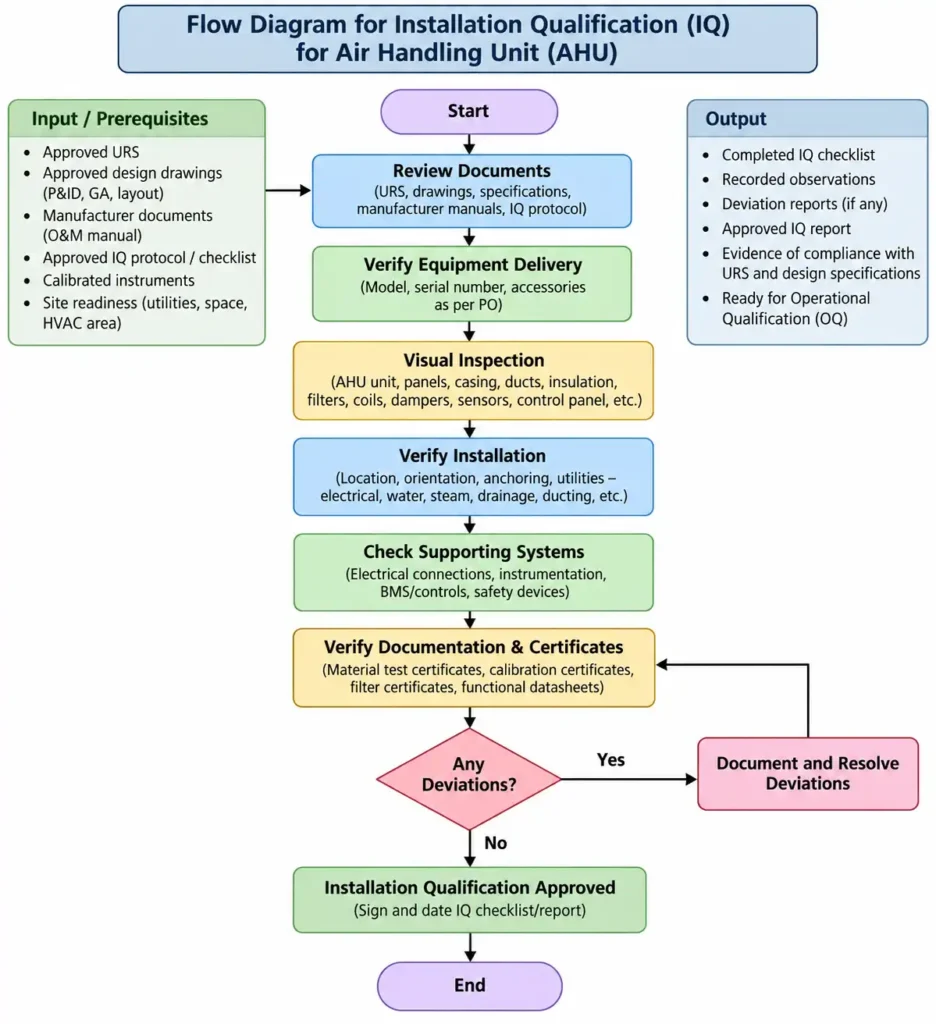
Skip to PDF content2. Flow Diagram for Installation Qualification of Air Handling Unit (AHU):
The flow diagram describes the systematic process for performing Installation Qualification of an Air Handling Unit. It begins with review of approved documents, including URS, drawings, specifications, manuals, and IQ protocol. Equipment delivery details, model, serial number, accessories, and components are verified. Visual inspection confirms the condition of filters, coils, dampers, ducts, sensors, panels, and insulation. Installation, utilities, electrical connections, instrumentation, BMS controls, and safety devices are checked. Relevant certificates and calibration records are reviewed. Any deviations identified are documented and resolved. Successful completion and approval of IQ confirms readiness of the AHU for Operational Qualification.
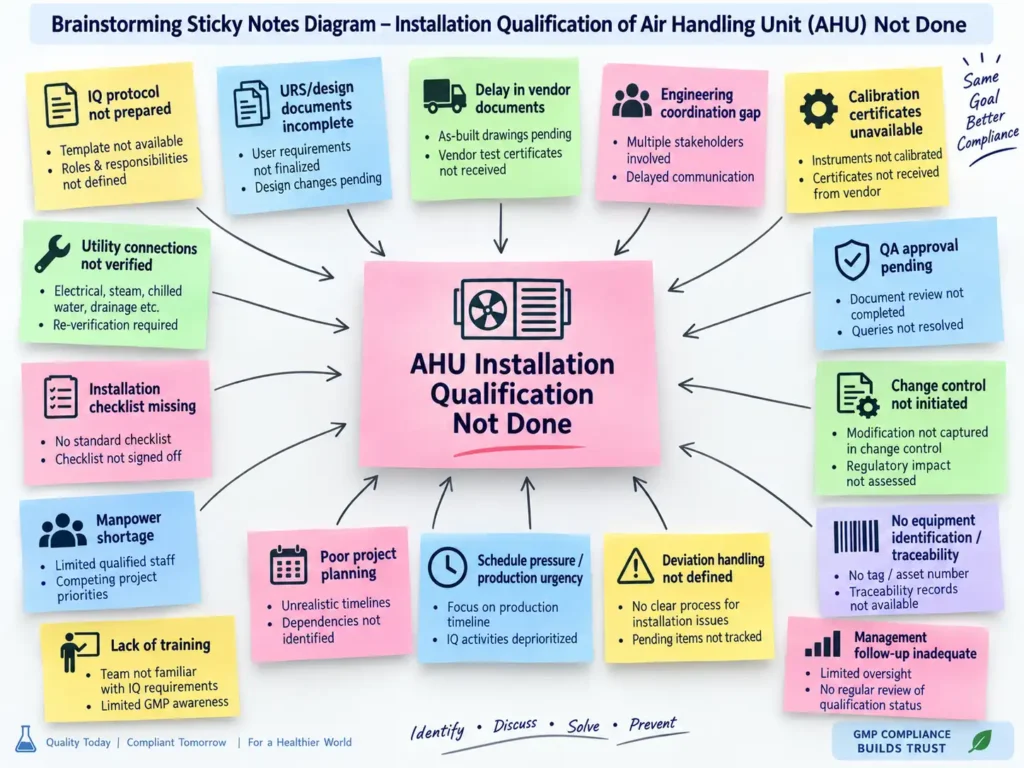
3. Brainstorming for AHU Installation Qualification Not Done:
The brainstorming analysis identifies potential reasons for the Installation Qualification of the Air Handling Unit not being performed. Key causes include an unprepared IQ protocol, incomplete URS and design documents, delayed vendor documentation, missing calibration certificates, and inadequate engineering coordination. Other contributing factors may include unverified utility connections, absence of installation checklists, manpower shortages, poor project planning, production pressure, insufficient training, and weak management follow-up. Pending QA approval, undefined deviation handling, lack of equipment identification, and failure to initiate change control may also delay qualification. This brainstorming exercise helps identify gaps systematically and supports development of corrective and preventive actions.
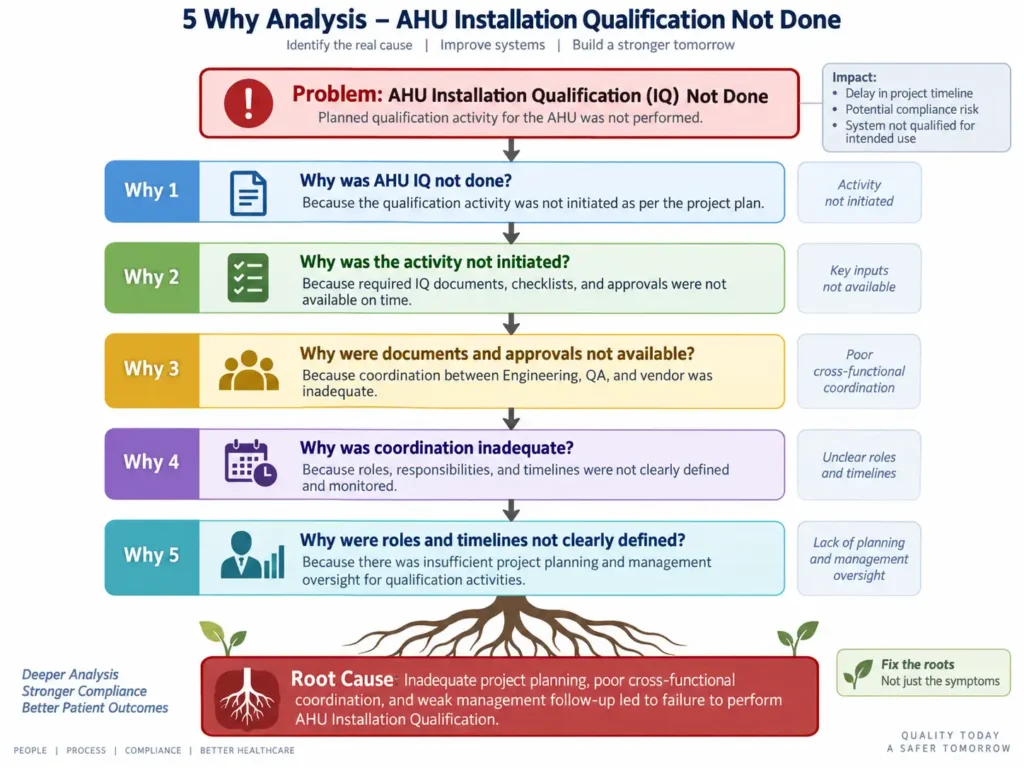
4. 5 Why Analysis for AHU Installation Qualification Not Done:
The 5 Why analysis identifies the underlying reasons for failure to perform Installation Qualification of the Air Handling Unit. The investigation begins with the qualification activity not being initiated as planned. Further analysis shows that required IQ documents, checklists, and approvals were not available on time. This occurred due to poor coordination among Engineering, QA, and the equipment vendor. Roles, responsibilities, and timelines were not clearly defined or monitored. The final root cause points to inadequate project planning, weak cross-functional coordination, and insufficient management oversight. Addressing these causes helps prevent recurrence and ensures timely completion of AHU qualification activities.
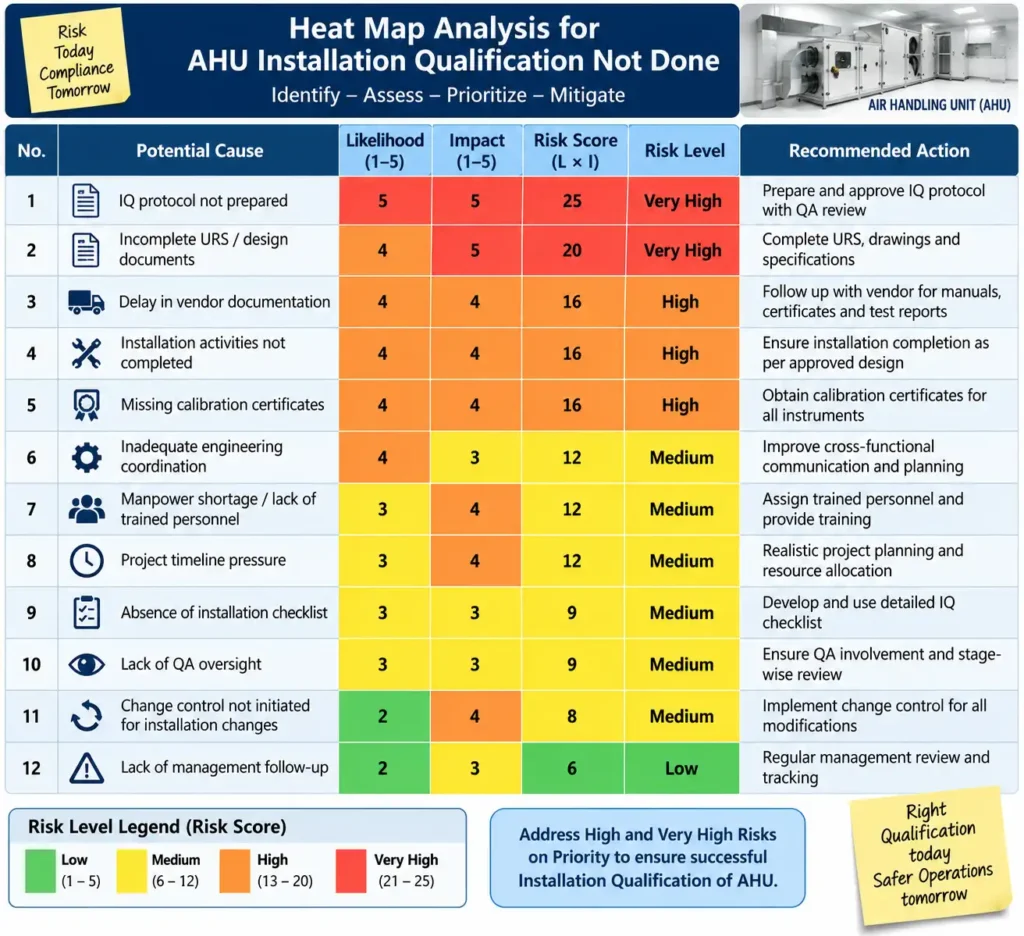
5. Heat Map Analysis for AHU Installation Qualification Not Done:
The Heat Map Analysis evaluates and prioritizes potential risks responsible for the Installation Qualification of the Air Handling Unit not being performed. Each identified cause is assessed based on its likelihood and impact, and a risk score is assigned to classify the issue as low, medium, high, or very high risk. Major concerns include the absence of an approved IQ protocol, incomplete URS and design documents, pending vendor documentation, unfinished installation activities, and missing calibration certificates. Medium-level risks include poor coordination, manpower shortages, project pressure, and insufficient QA oversight. The analysis helps management prioritize corrective actions and ensure timely completion of AHU qualification activities.
6. Pareto Chart Analysis for AHU Installation Qualification Not Done:
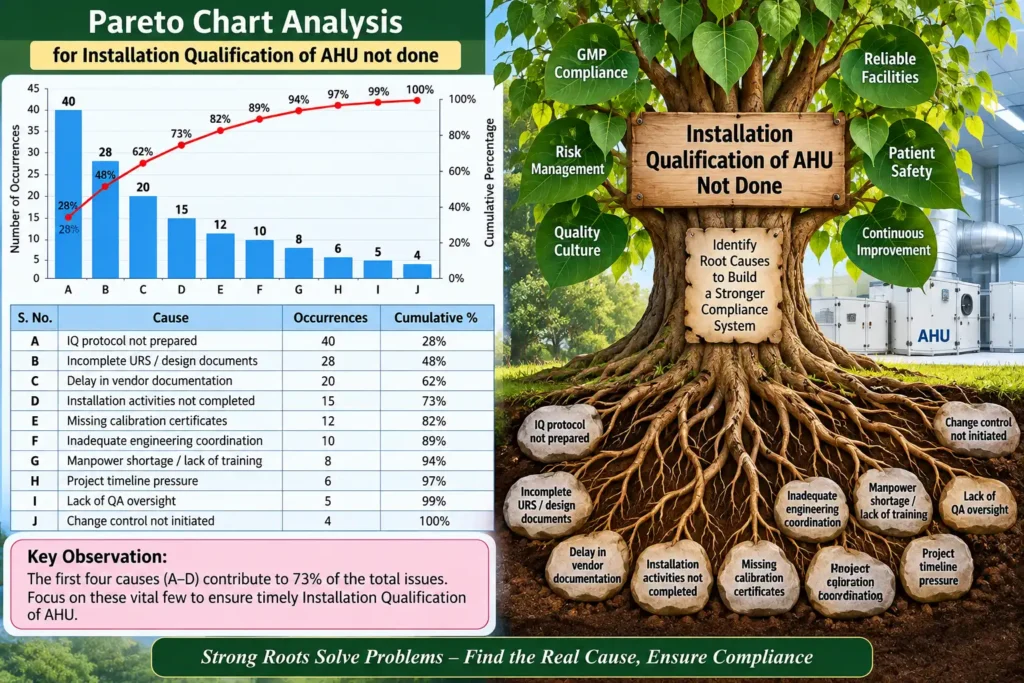
The Pareto Chart Analysis identifies and prioritizes the major causes responsible for the Installation Qualification of the Air Handling Unit not being completed. The analysis shows that a small number of causes contribute to most of the overall problem. Major contributors include an unprepared IQ protocol, incomplete URS and design documents, delayed vendor documentation, and incomplete installation activities. Additional causes include missing calibration certificates, inadequate engineering coordination, manpower shortages, project timeline pressure, insufficient QA oversight, and pending change control. By focusing corrective actions on the highest contributing causes first, the organization can improve qualification planning, strengthen compliance, and ensure timely completion of AHU Installation Qualification.
7. Fault Tree Analysis for AHU Installation Qualification Not Done:
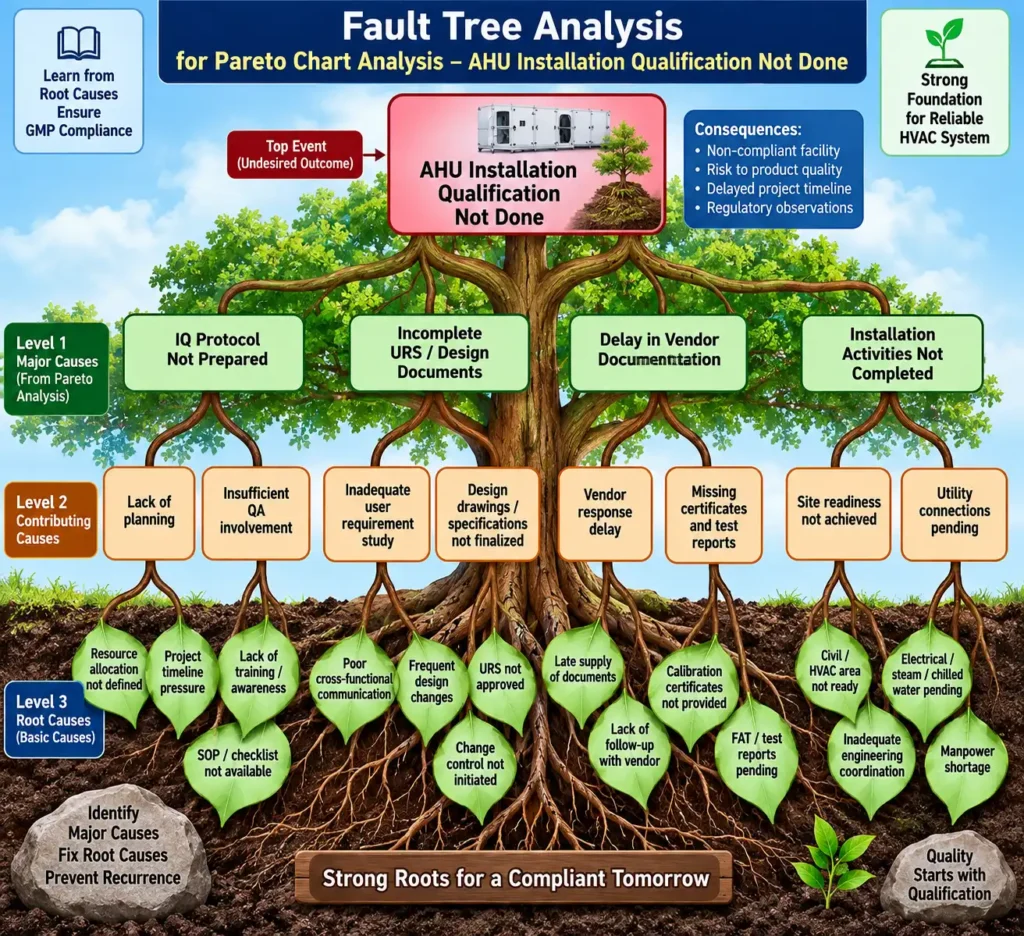
The Fault Tree Analysis identifies the hierarchical causes leading to the failure to perform Installation Qualification of the Air Handling Unit. The top event is “AHU Installation Qualification Not Done.” Major contributing causes include an unprepared IQ protocol, incomplete URS and design documents, delayed vendor documentation, and incomplete installation activities. These are further linked to root causes such as poor planning, inadequate QA involvement, lack of training, weak cross-functional coordination, pending change control, missing certificates, incomplete utility connections, and manpower shortages. The analysis helps trace failures systematically, prioritize corrective actions, eliminate underlying causes, and strengthen GMP compliance and qualification management.
8. Corrective Action, Preventive Action and Effectiveness Review – AHU Installation Qualification Not Done:
| No. | Corrective Action | Preventive Action | Effectiveness Review |
|---|---|---|---|
| 1 | Prepare, review, and approve the AHU Installation Qualification protocol before execution. | Include IQ protocol preparation in the qualification master schedule with defined responsibilities and due dates. | Verify that the approved IQ protocol is available before execution of future AHU qualification activities. |
| 2 | Complete and approve pending URS, design drawings, specifications, and related engineering documents. | Establish a document readiness checklist before starting equipment qualification. | Review qualification files to confirm that all required documents are approved and traceable. |
| 3 | Obtain pending vendor documents, including manuals, certificates, FAT reports, filter certificates, and technical data. | Include mandatory documentation requirements in purchase orders and vendor agreements. | Confirm that 100% of required vendor documents are available before IQ closure. |
| 4 | Complete pending AHU installation, ducting, utility connections, electrical work, drainage, sensors, and control systems. | Introduce stage-wise installation verification by Engineering and QA. | Reinspect installation against approved drawings and confirm closure of all punch points. |
| 5 | Calibrate all applicable instruments and obtain valid calibration certificates. | Maintain instruments under an approved calibration schedule with due-date monitoring. | Verify that no instrument used during qualification has an overdue calibration status. |
| 6 | Resolve all identified deviations through the approved deviation and CAPA system. | Define a formal process for deviation handling during qualification activities. | Confirm closure of deviations within approved timelines and absence of repeated issues. |
| 7 | Provide training to Engineering, QA, Maintenance, and user department personnel on AHU qualification requirements. | Incorporate qualification training into the annual GMP and technical training program. | Assess training effectiveness through questionnaire, practical verification, or qualification audit. |
| 8 | Strengthen coordination among Engineering, QA, Production, Validation, and vendors. | Conduct periodic qualification review meetings with defined responsibilities and action tracking. | Review meeting minutes and action trackers to confirm timely closure of activities. |
| 9 | Perform AHU Installation Qualification as per the approved protocol and document all observations. | Establish a controlled qualification lifecycle covering DQ, IQ, OQ, and PQ. | Confirm successful IQ completion and QA approval before initiation of OQ. |
| 10 | Conduct a retrospective review to identify any impact of operating the AHU before completion of IQ, if applicable. | Prevent equipment or system release for routine use until required qualification stages are completed and approved. | Review subsequent qualification records and internal audit findings to ensure no recurrence. |
Effectiveness Review Criteria
Effectiveness of the CAPA should be reviewed after completion of AHU IQ and during the subsequent qualification cycle. The CAPA may be considered effective when all IQ activities are completed and approved, required documents and certificates are available, deviations are closed, personnel are trained, and no repeat observation related to delayed or missed AHU qualification is identified during internal audit or management review. Successful initiation and completion of OQ without installation-related failures will provide additional evidence that the corrective and preventive measures are functioning effectively.
9. Questions and Answers – AHU Installation Qualification Not Done:
Q1. What is Installation Qualification of an AHU?
Installation Qualification is documented verification that the Air Handling Unit and its associated components are installed correctly according to approved specifications, drawings, manufacturer recommendations, and user requirements.
Q2. Why is AHU Installation Qualification important?
IQ confirms that the AHU installation is suitable, complete, traceable, and ready for subsequent Operational Qualification and Performance Qualification.
Q3. What can cause AHU Installation Qualification not to be performed?
Common causes include an unprepared IQ protocol, incomplete URS or design documents, delayed vendor documentation, incomplete installation, missing calibration certificates, poor coordination, and insufficient QA oversight.
Q4. Which documents should be available before AHU IQ?
Approved URS, design specifications, GA drawings, ducting layouts, P&IDs where applicable, manufacturer manuals, certificates, approved IQ protocol, and calibration records should be available.
Q5. What components are normally verified during AHU IQ?
AHU casing, filters, fan and motor, cooling and heating coils, dampers, ducts, insulation, sensors, control panels, drains, utility connections, and safety features are typically verified.
Q6. What should be done if AHU IQ was missed?
The gap should be documented, its impact assessed, an approved IQ protocol prepared, installation verified, deviations addressed, and the qualification completed before further release, as applicable.
Q7. What is the role of QA in AHU IQ?
QA reviews and approves qualification documents, verifies GMP compliance, reviews deviations, ensures traceability, and approves the completed IQ report.
Q8. How should deviations identified during IQ be handled?
Deviations should be documented, investigated, assessed for impact, corrected, and formally closed through the approved deviation or CAPA system.
Q9. Can Operational Qualification be started before IQ approval?
Normally, IQ should be satisfactorily completed and approved before proceeding to OQ, unless a justified and formally approved qualification strategy permits otherwise.
Q10. How can recurrence of missed AHU IQ be prevented?
Recurrence can be prevented through qualification planning, defined responsibilities, document-readiness checklists, project tracking, training, QA oversight, vendor follow-up, and management review.
Q11. How is CAPA effectiveness verified?
Effectiveness can be verified by confirming successful IQ completion, closure of deviations, availability of documents, completion of OQ without installation-related issues, and absence of repeat observations.
Q12. What is the final outcome of successful AHU IQ?
Successful IQ provides documented evidence that the AHU is installed as intended and is suitable to proceed to the next stage of qualification.
10. Reference Guidelines – Installation Qualification of Air Handling Unit (AHU):
- EU GMP Guidelines – EudraLex Volume 4, Annex 15: Qualification and Validation
Provides GMP expectations for qualification of facilities, utilities, systems, and equipment, including IQ, OQ, PQ, documentation, deviations, and change control. - WHO Technical Report Series No. 1010, Annex 8 (2018) – Guidelines on Heating, Ventilation and Air-Conditioning Systems for Non-Sterile Pharmaceutical Products
Covers HVAC design, installation, qualification, environmental control, filtration, airflow, pressure differentials, temperature, humidity, and lifecycle management. - WHO Technical Report Series No. 1019, Annex 2 (2019) – WHO GMP for HVAC Systems for Non-Sterile Pharmaceutical Products – Part 2: Interpretation of Guidelines
Provides practical interpretation and implementation guidance for pharmaceutical HVAC systems. - WHO TRS 1019, Annex 3 – Good Manufacturing Practices: Guidelines on Validation
Provides general guidance for validation and qualification of facilities, utilities, equipment, and systems. - PIC/S GMP Guide PE 009, Annex 15 – Qualification and Validation
Covers qualification stages and specifically requires qualification of utilities; HVAC systems are included where their failure could affect product quality. - US FDA – 21 CFR Part 211.46: Ventilation, Air Filtration, Air Heating and Cooling
Requires adequate ventilation and, where appropriate, control of air pressure, microorganisms, dust, humidity, temperature, filtration, and exhaust systems. - ISPE Baseline® Guide, Volume 5 – Commissioning and Qualification, Second Edition
Provides a science- and risk-based approach for commissioning and qualification of pharmaceutical facilities, systems, utilities, and equipment. - For Sterile Manufacturing: EU GMP Annex 1 – Manufacture of Sterile Medicinal Products should additionally be considered for AHUs serving classified sterile/aseptic areas. The current EU GMP page identifies Annex 1 as fully applicable since 25 August 2024.