







Facility Qualification is a documented process used to confirm that pharmaceutical manufacturing, packaging, storage, microbiological testing, and supporting areas are properly designed, installed, operated, and maintained according to approved specifications and cGMP requirements. The qualification begins with User Requirement Specification (URS), which defines the intended use, design needs, and performance expectations of the facility. Design Qualification (DQ) verifies that the proposed design meets these requirements. Installation Qualification (IQ) confirms that the facility, utilities, materials, instruments, drawings, and related systems are installed according to approved designs and documents. Operational Qualification (OQ) demonstrates that critical facility parameters function correctly throughout specified operating ranges, with trained personnel and calibrated instruments. Performance Qualification (PQ) provides documented evidence that the facility consistently performs effectively under routine working conditions. The protocol also includes responsibilities, supporting documents, attachments, deviations, recommendations, conclusions, and formal review and approval by concerned departments and quality management before routine pharmaceutical operations begin.
Skip to PDF content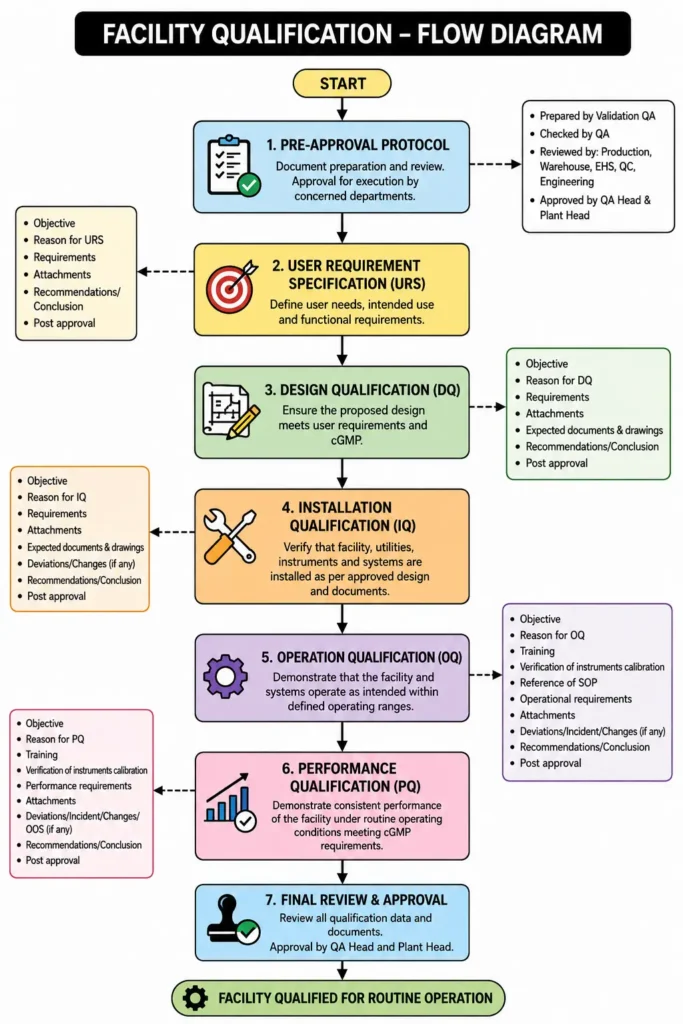
IMPACT ASSESSMENT
Facility qualification has a direct impact on product quality, patient safety, and smooth pharmaceutical operations. It confirms that manufacturing, packaging, storage, microbiology, and support areas are properly designed, installed, and working as intended. If the facility is not qualified, problems such as wrong temperature, poor air flow, contamination, equipment malfunction, or unsafe working conditions may affect the product. The qualification process checks user requirements, design, installation, operation, and performance before routine use. It also ensures that instruments are calibrated, staff are trained, documents are available, and any deviations are reviewed and corrected. Proper qualification reduces the risk of errors, contamination, product rejection, regulatory observations, and production delays. It provides documented evidence that the facility can consistently support safe and reliable manufacturing. Therefore, successful qualification gives confidence that the area is suitable for its intended purpose and meets company, quality, and cGMP requirements during normal operation throughout its planned operating life cycle.
1. Brainstorming:
The brainstorming diagram identifies the major factors that may contribute to a Facility Qualification Failure. Key causes include design not meeting URS requirements, installation not matching approved drawings, HVAC or utility parameters being out of limits, inadequate calibration or maintenance, insufficient personnel training, and unassessed equipment or layout changes. These issues can result in project delays, increased costs, product-quality risks, manufacturing interruptions, and cGMP non-compliance.
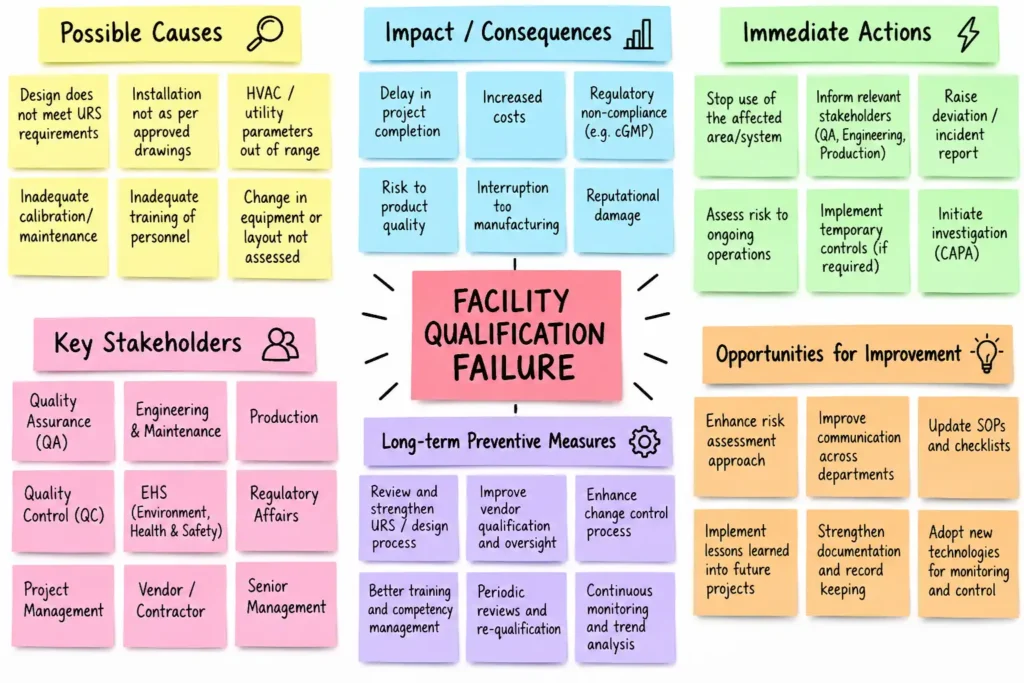
The brainstorming also highlights immediate actions such as stopping use of the affected area, informing QA and Engineering, raising a deviation, performing risk assessment, and initiating investigation and CAPA. Long-term controls include strengthening URS and design review, vendor oversight, training, change control, periodic requalification, and continuous monitoring. These considerations align with the Facility Qualification protocol, which covers URS, DQ, IQ, OQ and PQ and requires the facility to meet specified design, operational and regulatory requirements.
2. 5 Why Analysis:
The 5 Why Analysis identifies the underlying causes of a Facility Qualification Failure by progressively questioning why the facility did not meet its intended requirements. The analysis begins with failure to meet required specifications and traces the problem to incorrect or incomplete installation and operation of critical parameters such as HVAC, utilities, layout, and area requirements. It then identifies inadequate verification during DQ, IQ, and OQ, followed by weak coordination and unclear responsibilities among QA, Engineering, Production, and other departments. The final “Why” points toward deficiencies in project management, personnel training, documentation, and change control.
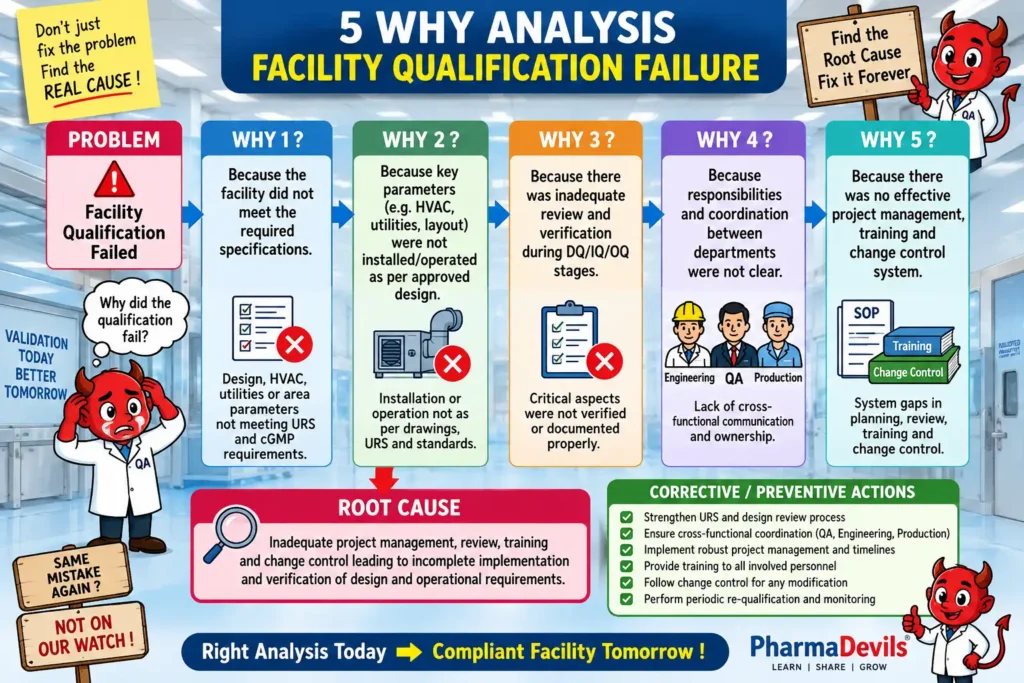
This approach is consistent with the qualification protocol, which requires DQ to verify design against user requirements, IQ to confirm installation against approved design, OQ to verify operation within specified ranges, and PQ to demonstrate consistent performance under normal and worst-case conditions.
The resulting root cause is inadequate planning, review, training, coordination, and change control, requiring CAPA to strengthen the overall facility qualification system.
Facility Qualification – Questions & Answers
Q1. What is Facility Qualification in the pharmaceutical industry?
Answer: Facility Qualification is a documented and systematic process used to demonstrate that pharmaceutical premises, manufacturing areas, laboratories, storage areas, utilities, and associated systems are appropriately designed, installed, operated, and maintained for their intended purpose. WHO specifically states that premises, systems, utilities, and equipment should be appropriately designed, installed, qualified, operated, cleaned, and maintained throughout their lifecycle.
Q2. What are the main stages of Facility Qualification?
Answer: The typical qualification lifecycle consists of URS → DQ → IQ → OQ → PQ. The URS defines what the facility and its systems must achieve; DQ confirms that the proposed design meets the URS and GMP expectations; IQ verifies correct installation; OQ demonstrates operation within defined ranges; and PQ confirms consistent performance under routine operating conditions. WHO specifically identifies URS, DQ, IQ, OQ, and PQ as qualification stages for new premises, systems, utilities, and equipment.
Q3. Why must Facility Qualification be completed before routine pharmaceutical operations?
Answer: Qualification provides documented evidence that the facility and its critical utilities can consistently support product quality, prevent contamination and cross-contamination, maintain required environmental conditions, and operate according to predefined specifications. Qualification should be performed according to approved protocols containing predetermined tests and acceptance criteria, with results documented in qualification reports.
Reference Guidelines
- EU GMP – EudraLex Volume 4, Annex 15: Qualification and Validation
This is one of the primary references for the qualification lifecycle and applies to facilities, equipment, utilities, and processes. The European Commission currently lists Annex 15 as the applicable EU GMP qualification and validation annex. - EU GMP – EudraLex Volume 4, Part I, Chapter 3: Premises and Equipment
Provides GMP expectations for the location, design, construction, maintenance, and suitability of pharmaceutical premises and equipment. - WHO Technical Report Series No. 1019, Annex 3 – GMP: Guidelines on Validation, Appendix 6: Guidelines on Qualification
Covers qualification of premises, systems, utilities and equipment and specifically describes URS, DQ, IQ, OQ and PQ. - US FDA – 21 CFR Parts 210 and 211, Current Good Manufacturing Practice
Particularly relevant are 21 CFR Part 211 Subpart C – Buildings and Facilities, including requirements concerning facility design, HVAC/air handling, sanitation and contamination control. FDA states that CGMP regulations establish minimum requirements for facilities and controls used in drug manufacturing, processing and packing. - EU GMP Annex 1 – Manufacture of Sterile Medicinal Products
Applicable when the facility includes sterile manufacturing, aseptic processing, cleanrooms or clean-air equipment. The current Annex 1 is fully applicable in the EU.