







Brief Description
This Facility Performance Qualification document is used to confirm that a pharmaceutical area performs properly under normal operating conditions. It checks whether the room is clean and whether important environmental conditions remain within defined limits. The qualification includes testing of air changes per hour, particulate matter, temperature, relative humidity, pressure difference, and air flow pattern. These tests are carried out for three consecutive working days, and some readings are taken at defined intervals. Temperature and humidity mapping help identify minimum, maximum, hottest, coldest, and fluctuating points in the area. Air flow is checked by smoke study to confirm proper movement of air and to ensure there are no dead pockets. Microbiological monitoring is also performed using settle plates and air sampling to check viable and fungal counts. Any deviation, incident, change, or OOS is recorded, followed by recommendations, conclusion, and final approval by responsible departments and Quality Assurance before use.
Skip to PDF content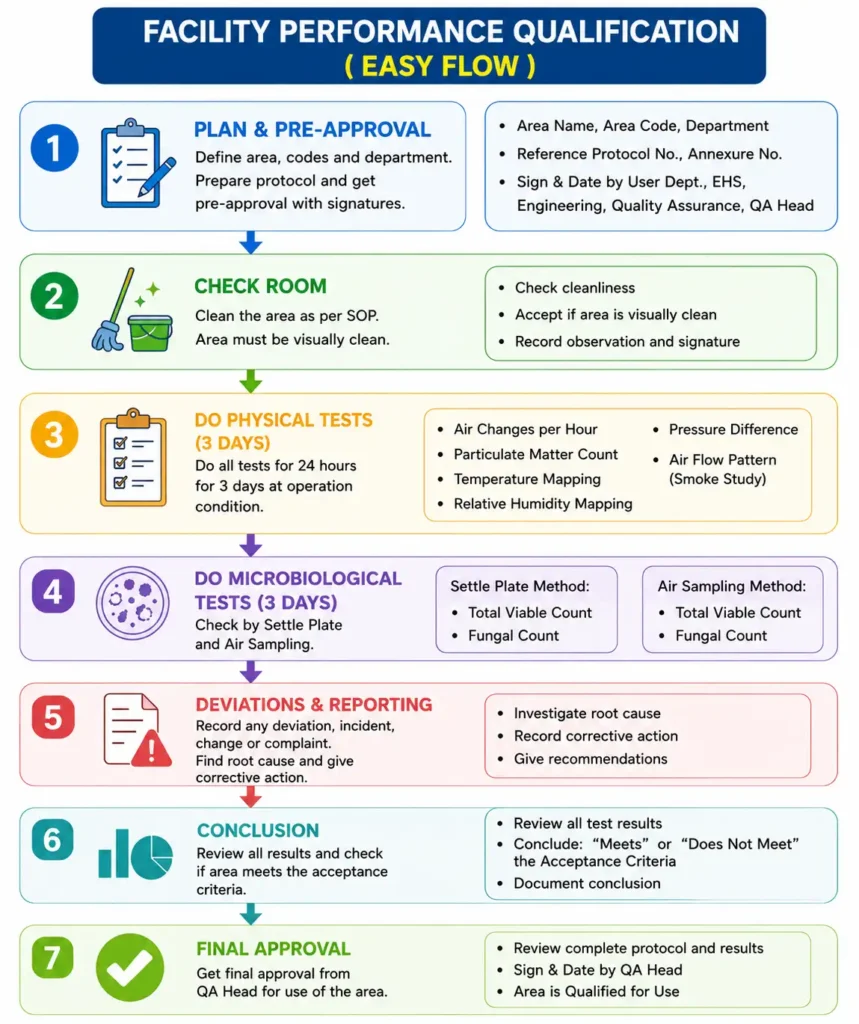
1. Brainstorming:
The brainstorming analysis identifies possible reasons why Performance Qualification (PQ) of the facility was not performed. The causes are grouped into major areas such as People, Process, Documentation, Equipment/Facility, Management, Regulatory Compliance, and External Factors. Key concerns include lack of awareness or training, unclear responsibilities, absence of an approved PQ protocol, inadequate scheduling, incomplete facility readiness, pending calibration or utility qualification, insufficient resources, and delayed management decisions. These factors may prevent documented demonstration that the facility performs consistently under actual operating conditions. The facility PQ protocol requires verification of parameters such as air changes per hour, particulate count, temperature and relative-humidity mapping, pressure differential, airflow pattern, and environmental microbiological monitoring under operating conditions.
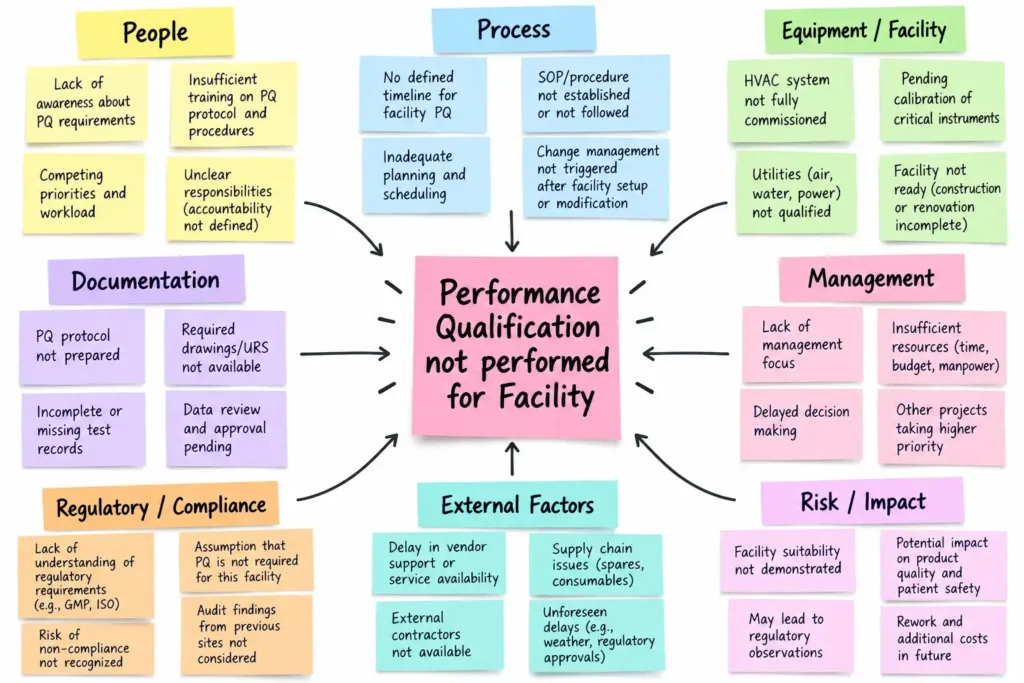
The brainstorming exercise helps the investigation team identify potential gaps, prioritize probable causes, assign responsibilities, and develop appropriate CAPA before completing and approving the facility PQ.
2. 5 Why Analysis:
The 5 Why Analysis was performed to identify the underlying cause for Facility Performance Qualification (PQ) not being performed. The analysis begins with the immediate issue that the PQ activity was not initiated on time. Further investigation indicates that an approved PQ protocol and execution schedule were not available, while responsibilities and coordination among the User Department, Engineering, and Quality Assurance were not clearly defined. The analysis further identifies incomplete facility readiness, including pending HVAC, utilities, calibration, and supporting qualification documentation. These gaps delayed execution of PQ activities. The final root cause points to inadequate qualification planning, resource allocation, responsibility assignment, and management oversight. Facility PQ is intended to verify performance parameters such as ACPH, particulate count, temperature and humidity mapping, pressure differential, airflow pattern, and microbiological monitoring under operating conditions.
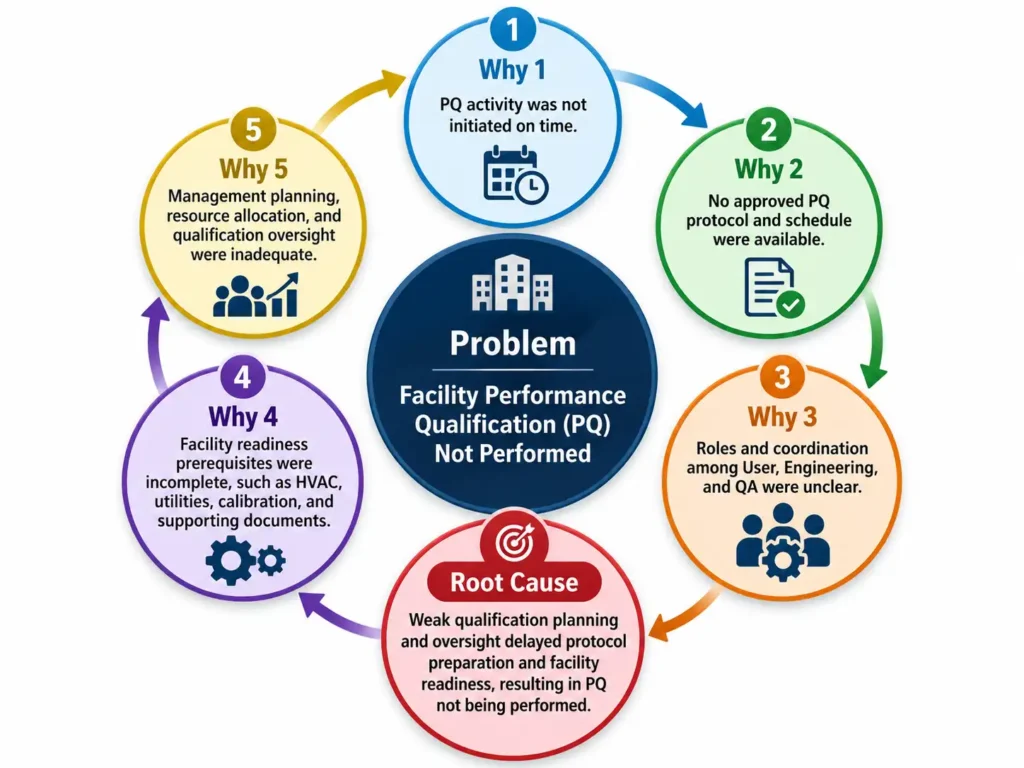
The 5 Why analysis helps establish appropriate CAPA, including preparation of an approved PQ protocol, defined responsibilities, facility-readiness checks, scheduling, and QA oversight before PQ execution.
3. Heat Map:
The Heat Map Risk Assessment visually evaluates the potential consequences of Facility Performance Qualification (PQ) not being performed by considering severity/impact against probability/likelihood. Risks are categorized from low to critical, allowing the investigation team to quickly identify issues requiring immediate attention.
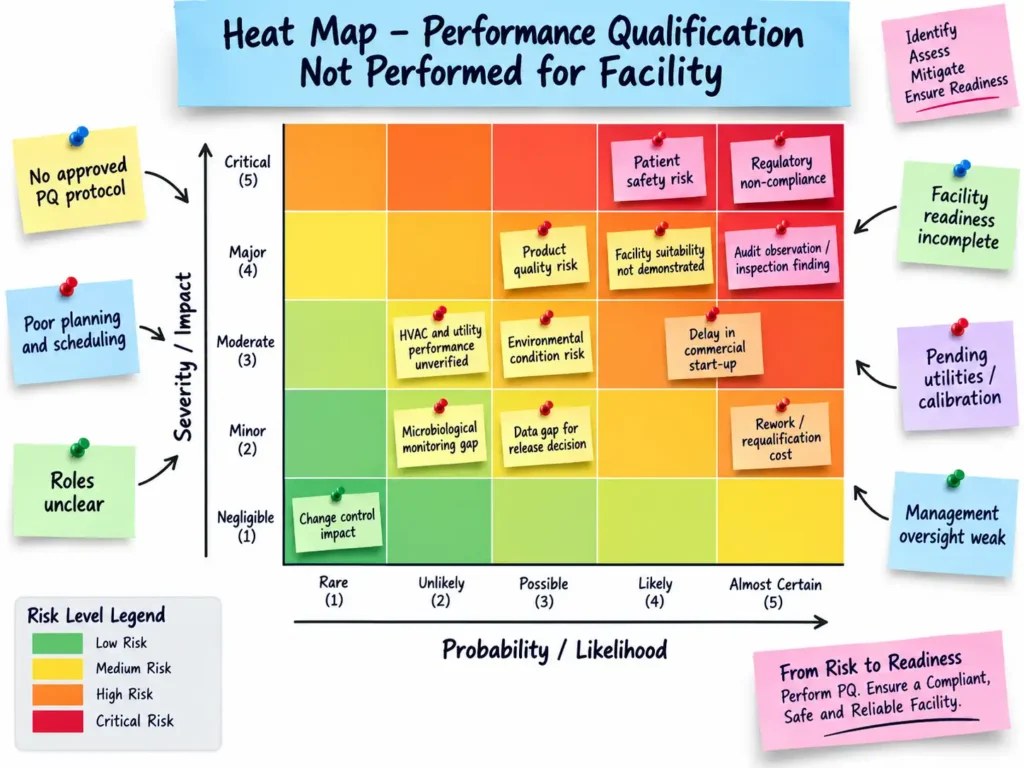
High and critical risks include regulatory non-compliance, patient-safety concerns, inability to demonstrate facility suitability, product-quality risk, and potential audit observations. Moderate risks include unverified HVAC and utility performance, environmental-condition failures, microbiological monitoring gaps, and delays in operational or commercial start-up. Contributing factors such as an unavailable PQ protocol, poor planning, incomplete facility readiness, pending calibration/utilities, unclear responsibilities, and inadequate management oversight can increase the overall risk level. The Facility PQ document specifically requires verification of parameters such as ACPH, particulate levels, temperature/RH, pressure differential, airflow pattern, and microbiological conditions under operating conditions. The heat map therefore supports risk prioritization, CAPA planning, resource allocation, and timely completion of facility PQ before routine GMP operations.
4. Impact Assessment:
The Facility Performance Qualification will have a positive impact on the controlled pharmaceutical area because it confirms that the facility works properly under normal operating conditions. It checks important conditions such as cleanliness, air changes, particle count, temperature, relative humidity, pressure difference, and air flow pattern. These checks help ensure that the environment remains suitable for routine operations. Microbiological monitoring by settle plate and air sampling also helps control viable and fungal contamination. The tests are performed for three consecutive working days so that the performance of the area can be confirmed consistently. Any deviation, incident, change, or OOS is recorded and reviewed before final conclusion and approval. This improves documentation, traceability, and control. Overall, this qualification reduces the risk of environmental failure, supports product quality, improves compliance, and confirms that the area is suitable for its intended use.
Questions & Answers
- What is Facility Performance Qualification?
Facility Performance Qualification is a documented check to confirm that an area performs properly under normal operating conditions. - Why is room cleanliness checked?
Cleanliness is checked to ensure that the area is visually clean and maintained as per the applicable SOP. - How long are the performance tests carried out?
The tests are carried out for 24 hours for three consecutive working days under operating conditions. - What is checked under Air Changes per Hour (ACPH)?
The number of air changes provided in the room per hour is checked against the specified acceptance limit. - Why is particulate matter count performed?
It is performed to confirm that the area meets the required ISO cleanliness class. - Why are temperature and relative humidity mapping performed?
These studies confirm that temperature and humidity remain within specified limits throughout the area and help identify minimum, maximum, hot, cold, and fluctuating points. - Why is pressure difference checked?
Pressure difference is monitored between the qualified area and adjacent areas to confirm that the required pressure conditions are maintained. - What is checked during the air flow pattern test?
Smoke is used to check that air moves properly from supply to return locations, without dead pockets, and follows the required pressure direction. - How is microbiological monitoring performed?
Microbiological monitoring is performed for three consecutive days using settle plate and air sampling methods. - What microbiological parameters are checked?
Total viable count and fungal count are checked by both settle plate and air sampling methods. - What happens if a deviation or OOS occurs?
Any deviation, incident, change, or OOS is documented in the qualification record for evaluation. - Who gives final approval for the qualification?
After review by the concerned departments and Quality Assurance, final approval is given by the QA Head.
Reference Guidelines:
| Reference Guideline | Relevance to Facility PQ |
|---|---|
| WHO TRS No. 1019, Annex 3 – GMP: Guidelines on Validation, Appendix 6: Guidelines on Qualification | Provides principles for qualification of premises, systems, utilities and equipment, including risk-based qualification. |
| EU GMP Annex 15 – Qualification and Validation | Requires qualification/validation activities to demonstrate that critical aspects of facilities, equipment and processes are controlled. |
| EU GMP Annex 1 – Manufacture of Sterile Medicinal Products | Particularly important for sterile facilities. Cleanroom qualification includes filter integrity, airflow volume/velocity, pressure differential, airflow visualization, microbial contamination, temperature and RH. |
| Revised Schedule M – Drugs Rules, India | Requires appropriately designed and implemented pharmaceutical quality systems and GMP requirements for premises, plant and equipment; directly relevant for Indian pharmaceutical facilities. |
| ISO 14644-1:2015 | Reference for cleanroom classification based on airborne particle concentration. |
| ISO 14644-2:2015 | Covers monitoring plans to demonstrate continued cleanroom performance, including consideration of pressure differential, airborne particles and airflow. |
| FDA – Sterile Drug Products Produced by Aseptic Processing—CGMP | Applicable to sterile/aseptic facilities and covers cleanroom design, environmental monitoring, contamination control and qualification expectations. FDA also states that ISO 14644 alone is insufficient for pharmaceutical facility qualification. |
| ICH Q9(R1) – Quality Risk Management | Supports a science- and risk-based approach for determining qualification extent, deviations, CAPA and requalification priorities. |
Recommended References:
Primary: WHO TRS 1019 Annex 3 Appendix 6; EU GMP Annex 15; Revised Schedule M.
For sterile/cleanroom facilities: EU GMP Annex 1; ISO 14644-1 and ISO 14644-2; FDA Aseptic Processing Guidance.
WHO TRS 1019 Annex 3 – Validation
EU GMP Annex 15 – Qualification and Validation
EU GMP Annex 1 – Sterile Medicinal Products
CDSCO Revised Schedule M
FDA Aseptic Processing Guidance