







Facility User Requirement Specification (URS) is a structured document used to define what a pharmaceutical room or area must provide before design, construction, or qualification begins. It records important details such as room purpose, dimensions, occupancy, wall and floor materials, ceiling, doors, view panels, drainage, electrical points, lighting, and communication facilities. It also covers safety requirements, utilities such as potable water, purified water, WFI, steam, compressed air, nitrogen, vacuum, and dust extraction. Environmental and HVAC needs including room classification, temperature, relative humidity, air changes, pressure differences, filtration, supply and return air are also specified. Access routes, emergency exits, clothing requirements, equipment, furniture, and miscellaneous needs are included as well. The completed URS is reviewed by the user department, EHS, Engineering, Quality Assurance, and approved by the QA Head, ensuring that the proposed facility meets operational, safety, engineering, and quality expectations before further qualification activities begin in a controlled documented manner.
Skip to PDF content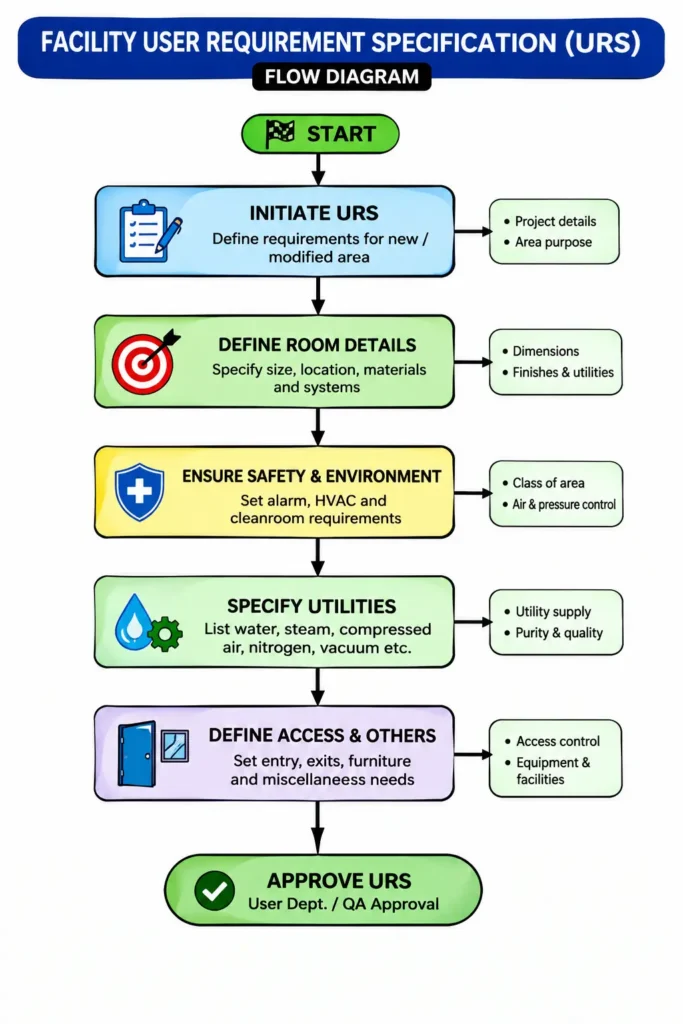
IMPACT ASSESSMENT
The Facility User Requirement Specification (URS) has an important impact on the safe and proper design of a pharmaceutical area. It clearly defines what the room needs before construction or modification starts, such as room size, materials, doors, drainage, lighting, utilities, safety systems, temperature, humidity, air changes, pressure differences, and filtration. This helps Engineering, Production, EHS, and Quality teams understand the same requirements from the beginning. A clear URS reduces mistakes, redesign work, delays, and unnecessary cost during the project. It also helps ensure that important utilities like purified water, WFI, steam, compressed air, nitrogen, vacuum, and exhaust are provided where required. Proper access, emergency exits, equipment space, and cleanroom conditions are also considered. Overall, the URS provides a clear reference for design, qualification, review, and approval, helping the facility meet operational, safety, and quality requirements before routine pharmaceutical work begins and supports smooth future maintenance and changes as well.
1. Brainstorming:
The brainstorming diagram identifies the key reasons why the User Requirement Specification (URS) for Facility Qualification was not prepared and highlights the actions needed to close the gap. The facility URS is intended to define requirements for room description, dimensions, finishes and material of construction, doors, drainage, electrical systems, utilities, environmental conditions, HVAC/air supply, access, equipment, furniture, and other facility-related requirements.
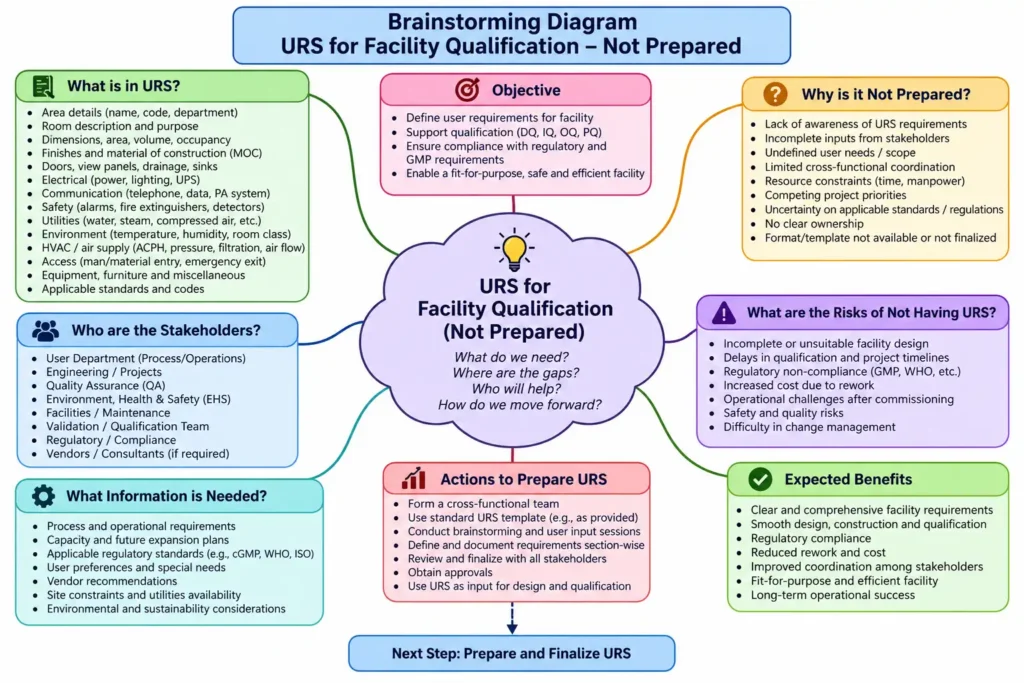
Possible causes for non-preparation include inadequate awareness, incomplete inputs from departments, unclear responsibility, poor cross-functional coordination, resource constraints, and lack of a finalized template. The brainstorming also emphasizes participation from the User Department, Engineering, QA, EHS, and qualification personnel. Required corrective actions include collecting user and regulatory requirements, reviewing facility needs, preparing the URS using an approved format, obtaining stakeholder review, and securing formal approval before facility design and qualification activities proceed.
2. 5 Why Analysis:
The 5 Why Analysis for URS for Facility Qualification Not Prepared identifies the underlying reasons for failure to prepare the User Requirement Specification. The analysis begins with the main problem and progressively examines why it occurred. The first cause is that required facility inputs and requirements were not collected from the user departments. This was linked to insufficient coordination and communication between the User Department, Engineering, QA, and EHS. Responsibilities and timelines for URS preparation were also not clearly defined or assigned. Further analysis indicates inadequate project planning, limited management oversight, and insufficient awareness regarding the importance of the URS in facility qualification.
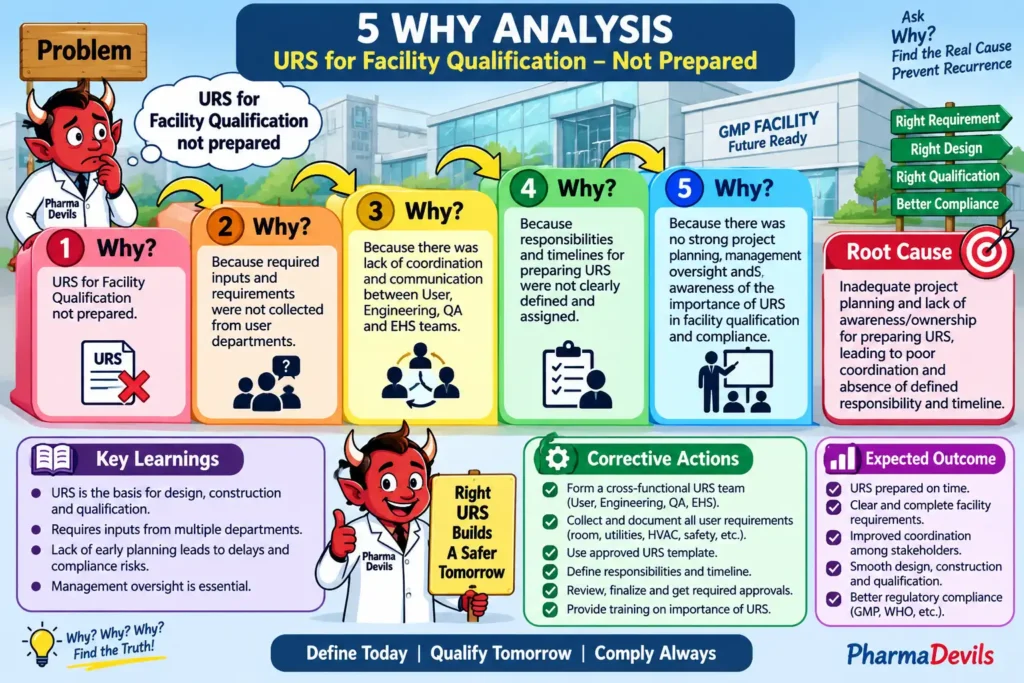
The identified root cause is inadequate planning, awareness, ownership, and cross-functional coordination. Corrective actions include forming a URS team, collecting complete requirements, using an approved template, assigning responsibilities and timelines, providing training, and completing multidisciplinary review and approval before facility qualification activities proceed.
Questions & Answers – URS for Facility Qualification
- What is the purpose of the Facility URS?
The Facility User Requirement Specification defines the user requirements, specifications, and acceptance criteria for the facility area before qualification activities are performed. - What basic room details are included in the URS?
The URS includes project details, room number, location, room purpose, dimensions, area, volume, and manpower occupancy. - What facility finishes are covered in the URS?
It covers wall material, flooring material, epoxy coating, corner and joint finishes, wall treatment, ceiling material, and the condition of walls, ceilings, and floors. - What door-related requirements are specified?
Door requirements include material of construction, dimensions, opening direction, interlocking, and whether the door is flush with the wall. - Does the Facility URS include drainage requirements?
Yes. Drain points and sinks are included as specific facility requirements. - What electrical requirements are considered?
The document includes power outlets, single- or three-phase supply, UPS/auto-trip arrangements, lighting levels, lamps, and related lighting details. - What communication systems are included?
Telephone, data link/cable, digital or analog clocks, and public address systems are included. - What safety requirements are covered?
Safety requirements include alarms, fire extinguishers, noise and vibration considerations, smoke detectors, and manual call points. - Which utilities are addressed in the Facility URS?
Utilities include potable water, purified water, Water for Injection, chilled water, boiler/pure steam, compressed air, nitrogen, vacuum, exhaust/dust extraction, and condensate/trap arrangements. - What environmental conditions are defined?
The URS provides for the applicable standard, room classification, temperature, and relative humidity. - What HVAC or air-supply parameters are included?
Parameters include air changes per hour, forced or natural air supply, pressure gradient, pressure differences with adjacent areas, filtration systems, HEPA filters, recirculation, airflow pattern, and supply/return air cutouts. - What access requirements are included in the URS?
The document addresses personnel entry, material entry, emergency exits, and clothing requirements. - Are equipment and furniture requirements covered?
Yes. The URS includes equipment to be installed and any required furniture or miscellaneous facility items. - Who prepares and reviews the Facility URS?
The document provides for preparation by the User Department, checking by the User Department Head, and review by EHS, Engineering Head, and Quality Assurance. - Who gives final approval to the Facility URS?
The document specifies final approval by the QA Head. - What can happen if the Facility URS is not prepared?
The uploaded URS template does not explicitly describe failure consequences. However, because it is the document used to capture facility requirements and acceptance criteria before qualification, its absence can leave required facility expectations undocumented. - What should be done if the URS has not been prepared?
The source does not provide a corrective-action procedure. Based on the document structure, the required facility information should first be collected under each URS category, then reviewed by the defined stakeholders and approved by the QA Head before being used as the formal facility requirement document.