







Facility Qualification–Operational Qualification (OQ) is the documented process used to confirm that a pharmaceutical facility, utility, or supporting system operates correctly within its approved operating ranges. OQ is performed after successful completion of Installation Qualification (IQ). During OQ, critical functions such as HVAC operation, temperature, humidity, differential pressure, air changes, alarms, interlocks, lighting, utilities, and safety systems are tested under controlled conditions. The tests verify that each system performs consistently according to approved specifications, design requirements, SOPs, and GMP expectations. Instruments used during testing should be calibrated, and all observations, results, deviations, and corrective actions must be properly recorded. Any failure identified during OQ should be investigated and resolved before proceeding further under defined normal and challenge operating conditions. Successful completion of OQ provides documented evidence that the facility and its systems are capable of operating as intended and are ready for Performance Qualification (PQ) and routine pharmaceutical manufacturing activities.
Skip to PDF content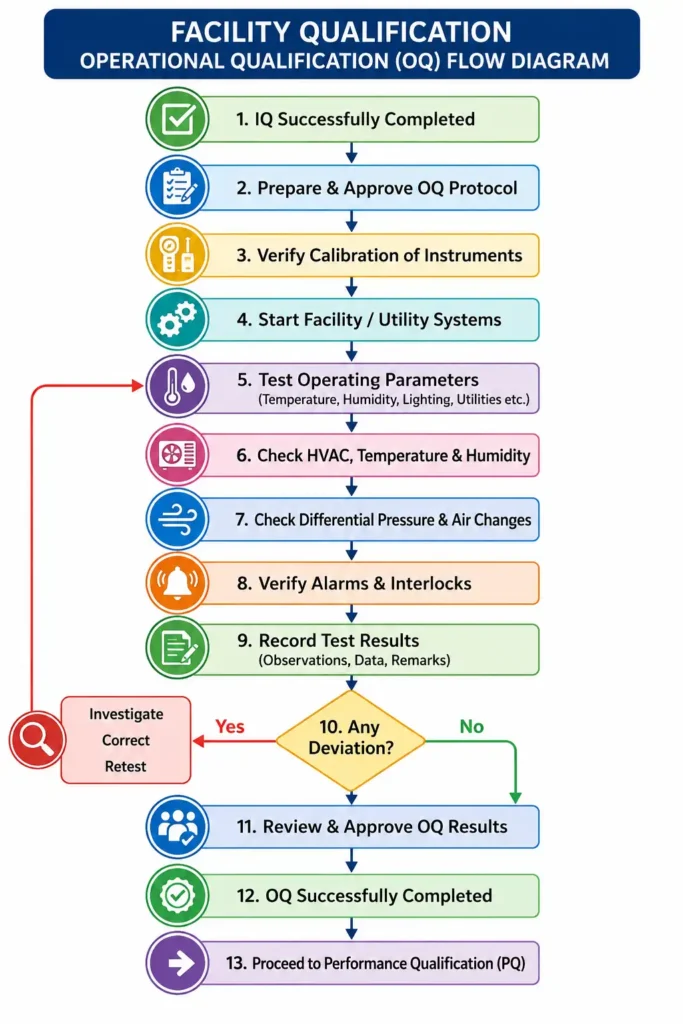
1. Brainstorming for Facility OQ not Performed:
The brainstorming exercise identifies potential reasons why the Operational Qualification (OQ) of the facility was not performed as planned. Possible causes are grouped into key areas such as People, Process, Documentation, Equipment/Facility, Resources, Communication, Management/Governance, and External Factors. The discussion considers issues including inadequate training, unclear responsibility, missing or unapproved OQ protocols, delayed approvals, insufficient manpower, poor departmental coordination, incomplete facility readiness, utility problems, and vendor-related delays.
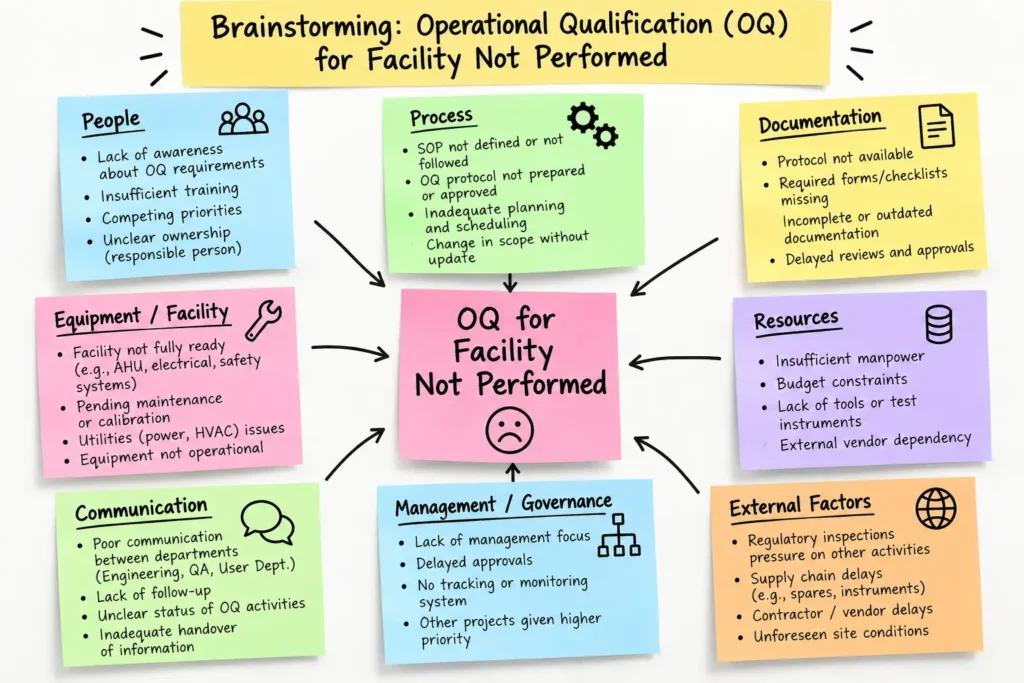
These causes are important because facility OQ is intended to verify operational parameters such as air changes, particulate levels, temperature, relative humidity, differential pressure, and airflow pattern , along with the functionality of electrical points, UPS, AHU, alarms, smoke detectors, and equipment earthing . The brainstorming output can therefore support further root-cause analysis, CAPA development, and timely completion of facility qualification.
2. 5 Why Analysis for Facility OQ not Performed:
The 5 Why Analysis was performed to identify the underlying reason why the Operational Qualification (OQ) of the facility was not completed. The analysis shows that the OQ activity was not initiated as scheduled because the approved protocol and required test arrangements were not ready on time. Further investigation indicated inadequate coordination between the User Department, Engineering, EHS, and Quality Assurance, along with unclear responsibility, timelines, and follow-up.
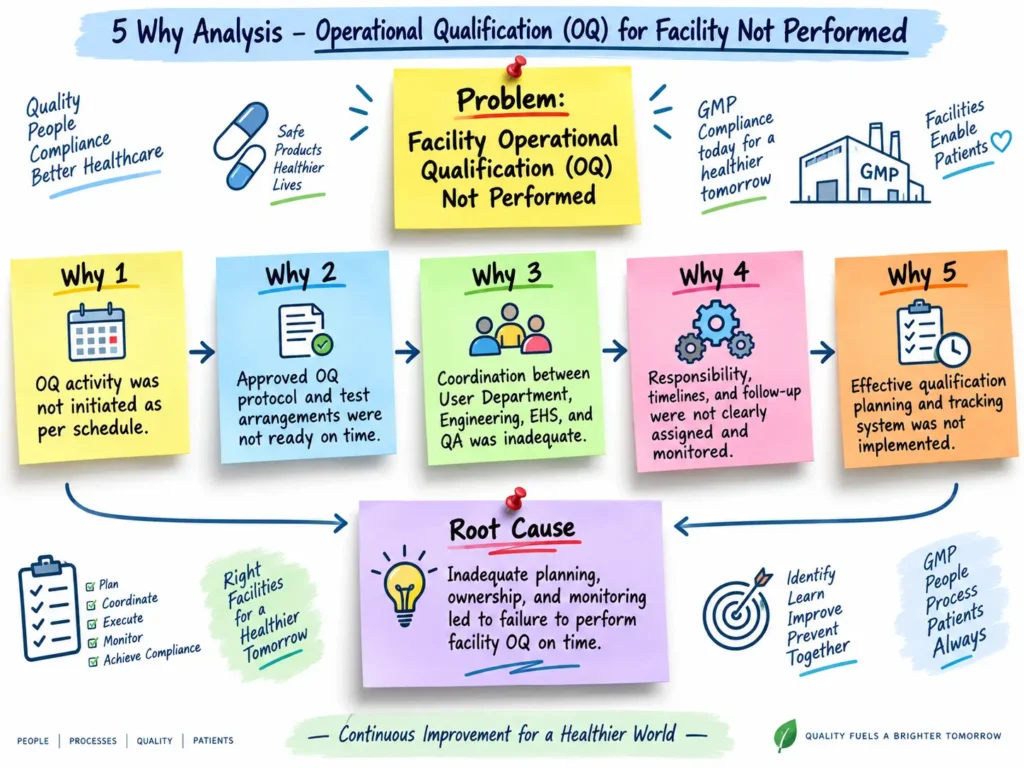
The analysis ultimately identifies the probable root cause as an ineffective qualification planning and tracking system, resulting in insufficient ownership and monitoring of the OQ activity. This is significant because the facility OQ includes verification of critical operational parameters such as air changes, particulate levels, temperature, relative humidity, differential pressure, airflow pattern, electrical systems, AHU operation, alarms, smoke detection, and earthing. The findings can be used to establish suitable CAPA, assign responsibilities, and ensure timely completion of future facility qualification activities.
Questions & Answers – Operational Qualification of Facility
- Q: What is Facility Operational Qualification (OQ)?
A: Facility OQ is documented verification that the facility, utilities, environmental controls, electrical systems, and safety systems operate according to predefined acceptance criteria. - Q: Why is Facility OQ important?
A: It demonstrates that the facility can consistently maintain the operating conditions required for pharmaceutical activities and GMP compliance. - Q: Which general room conditions are checked during Facility OQ?
A: The protocol includes verification of cleanliness, fumigation, and lighting/lux level. - Q: Which environmental parameters are evaluated during Facility OQ?
A: The protocol includes air changes per hour, particulate matter count, temperature, relative humidity, differential pressure, and airflow pattern. - Q: How is differential pressure assessed?
A: Differential pressure is recorded between adjacent areas and checked against the specified pressure limits and required positive or negative pressure gradient. - Q: What is checked during airflow pattern verification?
A: Smoke should move uniformly from supply to return locations, without dead pockets, and should follow the intended pressure direction. - Q: Which electrical systems are verified during Facility OQ?
A: Electrical points, UPS supply, AHU operation, and AHU indication/alarm functionality are checked for proper operation. - Q: Which safety systems are verified?
A: The protocol includes smoke detector operation, AHU annunciation system operation, and availability of equipment earthing. - Q: What can happen if Facility OQ is not performed?
A: There may be inadequate documented evidence that environmental, utility, electrical, and safety systems operate as intended, creating compliance and operational risks. - Q: What is the probable root cause when Facility OQ is not performed?
A: A likely root cause is inadequate qualification planning, unclear ownership, delayed protocol readiness, weak departmental coordination, and insufficient tracking of qualification activities. - Q: Which departments are involved in Facility OQ approval?
A: The protocol includes involvement of the User Department, User Department Head, EHS, Engineering, Quality Assurance, and QA Head. - Q: What should be done if deviations occur during Facility OQ?
A: Deviations, incidents, changes, or OOS events should be documented, investigated where applicable, and addressed before final recommendations and conclusion. - Q: What CAPA may be considered when Facility OQ was not performed?
A: Prepare and approve the OQ protocol, assign responsible persons and timelines, complete required testing, document deviations, and introduce a qualification tracking mechanism. - Q: When can Facility OQ be considered complete?
A: After the required tests have been executed, results assessed against acceptance criteria, deviations addressed, conclusions documented, and post-approval completed by the designated departments. - Q: What is the objective of corrective action after missed Facility OQ?
A: To ensure the facility is formally demonstrated to operate within established requirements and to prevent recurrence of missed qualification activities.
IMPACT ASSESSMENT
Facility Operational Qualification (OQ) has an important impact on the safety, quality, and reliability of a pharmaceutical facility. It confirms that facility systems and utilities operate properly within their approved limits before routine manufacturing starts. During OQ, important parameters such as temperature, humidity, air pressure, air changes, HVAC performance, alarms, interlocks, and utility functions are checked. If these systems do not work correctly, they may affect product quality, cause contamination, create unsafe working conditions, or lead to GMP non-compliance. OQ helps identify such problems before products are manufactured. Any deviation found during testing is investigated, corrected, and tested again. Proper OQ also provides documented evidence that the facility is suitable for its intended use. Successful completion of OQ reduces operational risks, improves process control, supports regulatory compliance, and gives confidence that the facility can consistently provide the required environmental and operating conditions for safe pharmaceutical manufacturing.
Regulatory Guidelines – Facility Operational Qualification
The following references are most relevant for Facility Operational Qualification (OQ):
| Guideline / Regulation | Relevance to Facility OQ |
|---|---|
| WHO TRS 1019, Annex 3 – GMP: Guidelines on Validation | Requires premises, systems, utilities, and equipment to be appropriately qualified. OQ should normally follow successful IQ, be executed against an approved protocol, include predefined acceptance criteria, and verify operation across anticipated operating ranges. |
| EU GMP Annex 15 – Qualification and Validation | States that OQ should follow IQ and should include tests based on knowledge of the facility/system, including upper and lower operating limits or worst-case conditions. Successful OQ supports formal release of facilities and systems. |
| India – Revised Schedule M, G.S.R. 922(E), 28 December 2023 | Establishes GMP requirements for premises, plant, equipment, pharmaceutical quality systems, qualification, and validation. CDSCO requires manufacturers to comply with revised Schedule M and applicable WHO guidance. |
| US FDA – 21 CFR Part 211.42 | Requires pharmaceutical buildings to be suitably designed, constructed, maintained, and arranged to prevent contamination and mix-ups. For aseptic areas, environmental controls and monitoring systems are required. |
| US FDA – 21 CFR 211.46 | Requires adequate ventilation and appropriate control of air pressure, microorganisms, dust, humidity, temperature, and air filtration. |
| ISO 14644-1 / ISO 14644-3 | Supporting technical standards commonly used for cleanroom classification and testing of airflow, particle concentration, pressure differential, and other cleanroom performance parameters. These are technical standards rather than GMP regulations. |
Recommended primary references for your document:
WHO TRS 1019 Annex 3 + EU GMP Annex 15 + Revised Schedule M (G.S.R. 922(E)).
WHO TRS 1019 Annex 3 – Official WHO Guidance
EU GMP Annex 15 – Qualification and Validation
Revised Schedule M – CDSCO G.S.R. 922(E)