




1. Brief Description:
The Post Risk Assessment for Compression Machine evaluates possible risks related to the design, installation, operation, performance, and safety of the compression machine used for tablet and slug manufacturing. The machine performs feeding, dosing, compaction, and ejection of lubricated granules, and tablet compression mainly depends on compaction force. The assessment is carried out using the Failure Mode and Effects Analysis (FMEA) method. Risks are rated based on Severity, Occurrence, and Detection, and the Risk Priority Number (RPN) is calculated to decide the level of action required. The assessment covers risks such as inadequate qualification documents, missing calibration, material-of-construction verification, safety-system failure, improper cleaning, auto-rejection malfunction, lubrication failure, and equipment operating problems. Appropriate controls include SOPs, trained personnel, qualification checks, alarms, cleaning procedures, and change control. The overall purpose is to ensure safe equipment operation and consistent product quality throughout its lifecycle.
Skip to PDF content2. Flow Diagram:
The Compression Machine Process Flow Diagram shows the main steps involved in converting lubricated granules into tablets or slugs. The process starts with feeding, where granules are supplied from the hopper into the machine. Next, during dosing, a measured quantity of granules is filled into the die cavity. In the compaction stage, the upper and lower punches apply compression force to form the tablet or slug. The formed tablet is then ejected from the die and may pass through an automatic rejection system to remove defective tablets. Finally, acceptable tablets are discharged and collected for further processing or packing.
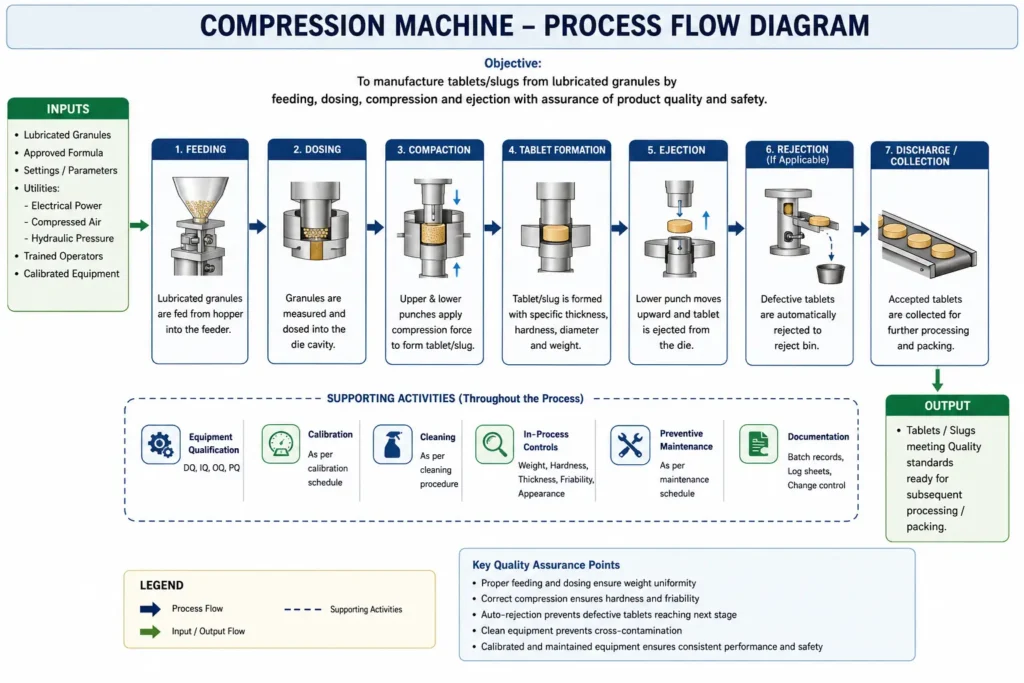
Supporting activities such as equipment qualification, calibration, cleaning, in-process checks, preventive maintenance, and documentation help maintain consistent machine performance and product quality. The document also emphasizes that feeding, dosing, compaction, and ejection are the key operating functions of the compression machine.
3. Critical Process Parameters (CPPs) & Critical Quality Attributes (CQAs):
The risk assessment does not provide a separate CPP/CQA list. However, based on the equipment functions, qualification checks, operational controls, and failure modes identified in the document, the following parameters can be considered relevant for the compression machine. The machine performs feeding, dosing, compaction, and tablet/slug ejection, with tablet compression dependent on compaction force.
| S.No. | Critical Process Parameter (CPP) | Critical Quality Attribute (CQA) / Impact |
|---|---|---|
| 1 | Compaction / Compression Force | Proper tablet compression and consistent tablet characteristics |
| 2 | Feeding of Lubricated Granules | Consistent tablet production and uniform processing |
| 3 | Dosing of Granules | Consistency of tablet quantity/weight |
| 4 | Main Motor / Feeder Motor / Hydraulic Motor Functioning | Proper and continuous machine operation |
| 5 | Hydraulic Pressure / Main Set Pressure | Prevents excessive machine vibration and improper operation |
| 6 | Compressed Air Pressure | Proper functioning of the auto-rejection mechanism |
| 7 | Auto-Rejection System | Prevents unacceptable tablets from affecting product quality |
| 8 | Lubrication System | Prevents wear, machine stoppage, and improper machine functioning |
| 9 | Dozer Assembly Position | Ensures correct machine start-up and operation |
| 10 | Equipment Cleaning | Prevents product contamination |
| 11 | Material of Construction (MOC) of Contact Parts | Prevents potential product contamination |
| 12 | Safety Interlocks / Safety Features | Protects operator and ensures safe equipment operation |
Key CQAs
From the risks described in the document, the main quality outcomes requiring protection are product quality, prevention of contamination, consistent equipment performance, correct rejection of defective output, proper compression, and safe operation. The document specifically identifies product quality impact from equipment changes, inadequate equipment capability, improper cleaning, and auto-rejection failure.
4. Questions & Answers:
Q1. What is the purpose of the Compression Machine?
Answer: The compression machine is used to manufacture tablets or slugs from lubricated granules through feeding, dosing, compaction, and ejection.
Q2. What is the objective of this risk assessment?
Answer: The objective is to assess risks associated with the compression machine during post-assessment in the manufacturing facility, in line with Quality Risk Management principles and ICH Q9.
Q3. What is the scope of the risk assessment?
Answer: It covers the design, installation, operation, performance, safety, and possible failure modes of the compression machine.
Q4. Which risk assessment method is used?
Answer: The document uses FMEA – Failure Mode and Effects Analysis.
Q5. What factors are used to calculate the RPN?
Answer: RPN is calculated using Severity × Occurrence × Detection.
Q6. What are the FMEA risk categories?
Answer: RPN ≥76 is Critical, 51–75 is Major, 26–50 is Moderate, and up to 25 is Minor. CAPA is required for Critical, Major, and Moderate risks.
Q7. What risk is associated with improper MOC verification?
Answer: If the Material of Construction of contact and non-contact parts is not verified, the product may become contaminated.
Q8. Why are calibrated measuring instruments important during IQ?
Answer: Without calibrated instruments such as a multimeter, spirit level, tachometer, or clamp meter, installation may be improper and the equipment may not perform as intended.
Q9. Why should IQ be completed before OQ?
Answer: OQ cannot proceed properly if IQ is incomplete or the installation is not completed.
Q10. What can happen if machine safety features are bypassed?
Answer: Bypassing or failure of safety features may result in an accident. The document recommends trained personnel and proper safety training.
Q11. What is the impact of improper equipment cleaning?
Answer: Improper cleaning can lead to product contamination. Cleaning procedures and line clearance are identified as existing controls.
Q12. What happens if the auto-rejection mechanism does not function?
Answer: Product quality may be affected. Low compressed-air pressure or bypassing the auto-rejection system are identified as possible causes.
Q13. What happens if the lubrication mechanism fails?
Answer: The machine may not function properly, wear and tear may occur, and the machine may stop.
Q14. Why is preventive maintenance important?
Answer: The document requires proper equipment assembly after cleaning, preventive maintenance, breakdown work, and calibration to avoid accidents and improper machine functioning.
Q15. Which departments are involved in this risk assessment?
Answer: Quality Assurance, Engineering, Production, Quality Control, and Store are identified as responsible functions.
Q16. What is checked during final report approval?
Answer: Final approval confirms that risks and critical control parameters have been identified and that control measures are documented, reviewed, and found acceptable.