







1. Introduction for Post Risk Assessment for Auto-Coater:
The Post Risk Assessment for the Auto-Coater evaluates potential risks associated with its design, installation, operation, performance, cleaning, and safety using the FMEA methodology. The assessment considers failure modes, their potential effects and causes, existing controls, severity, occurrence, detectability, and Risk Priority Number (RPN). Key risks include inadequate qualification, calibration failures, improper atomization, malfunctioning spray guns, airflow problems, ineffective cleaning, and equipment control issues. Appropriate control measures, SOPs, training, preventive maintenance, qualification, and monitoring are used to reduce risks and maintain consistent product quality, equipment reliability, operator safety, and regulatory compliance.
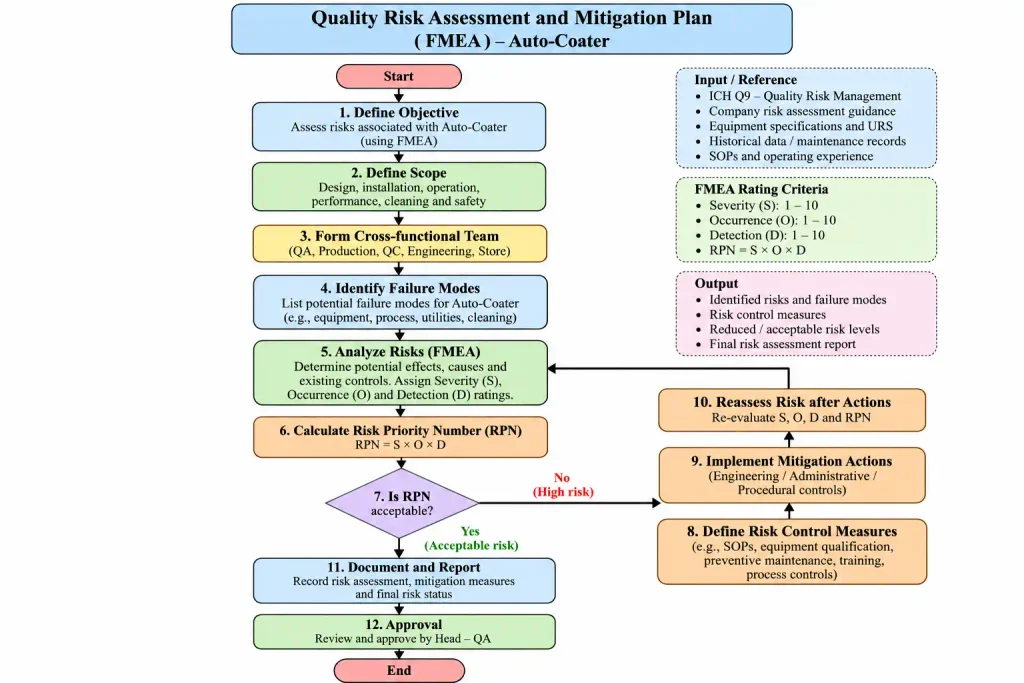
Skip to PDF content2. Flow Diagram for Post Risk Assessment for Auto-Coater:
The flow diagram illustrates the systematic FMEA-based post-risk assessment process for the Auto-Coater. It begins by defining the objective, scope, and cross-functional assessment team, followed by identification of potential failure modes. Each risk is analyzed for its effects, causes, existing controls, severity, occurrence, and detectability. The Risk Priority Number (RPN) is calculated to determine whether the risk is acceptable. Unacceptable risks require defined control measures and mitigation actions, followed by reassessment of the revised RPN. Acceptable risks are documented in the final report, reviewed, and approved by Quality Assurance to ensure effective risk control and continued equipment reliability.
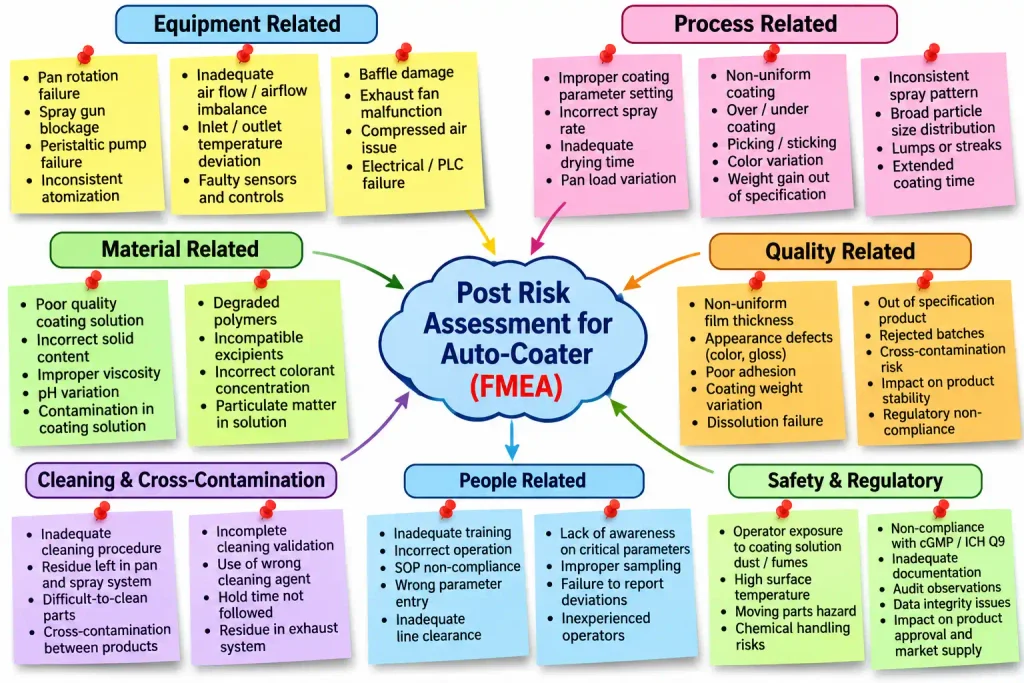
3. Brainstorming – Post Risk Assessment for Auto-Coater:
Brainstorming for the Post Risk Assessment of the Auto-Coater is used to identify potential risks and failure areas before final FMEA evaluation. The discussion covers equipment-related issues such as pan rotation, spray guns, airflow, sensors, and exhaust systems; process-related concerns including spray rate, drying, coating uniformity, and pan loading; and material-related risks such as viscosity, solid content, polymers, and contamination. It also evaluates cleaning, cross-contamination, operator training, line clearance, safety, documentation, and regulatory compliance. These identified risks are then assessed for severity, occurrence, detectability, and appropriate controls to support effective risk mitigation.
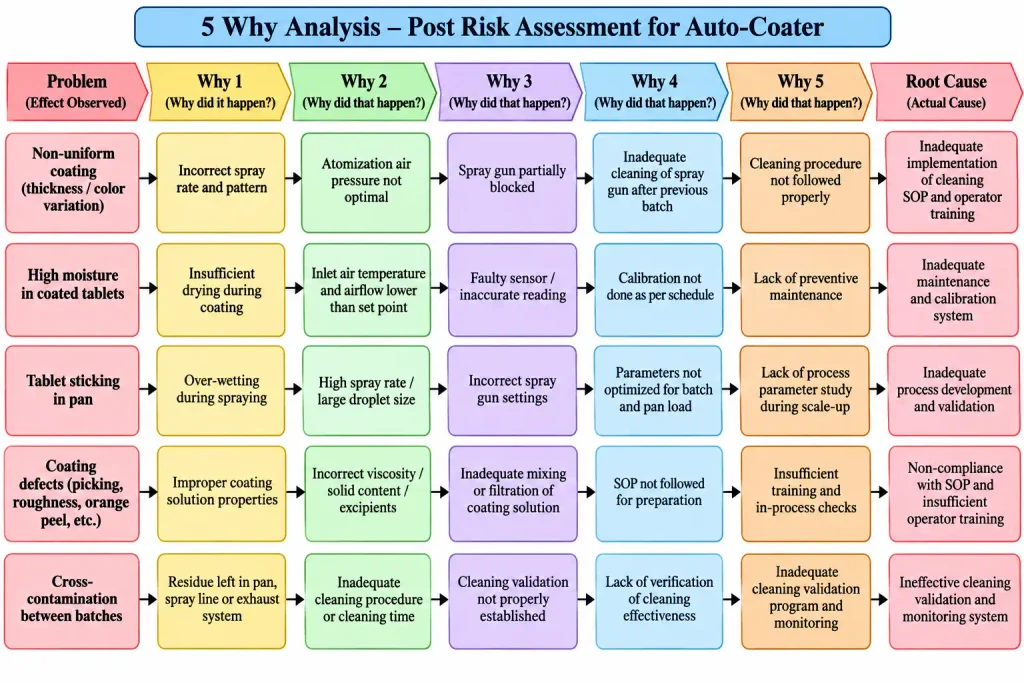
4. 5 Why Analysis – Post Risk Assessment for Auto-Coater:
The 5 Why Analysis for the Auto-Coater identifies the underlying causes of recurring coating-related risks by repeatedly questioning why each failure occurs. The analysis covers problems such as non-uniform coating, high tablet moisture, tablet sticking, coating defects, and cross-contamination. Contributing causes include improper spray rate, poor atomization, blocked spray guns, inadequate airflow, faulty sensors, incorrect coating solution properties, insufficient cleaning, and weak process controls. The final root causes mainly relate to inadequate SOP implementation, insufficient operator training, ineffective preventive maintenance, poor calibration practices, inadequate process validation, and weak cleaning validation and monitoring systems.
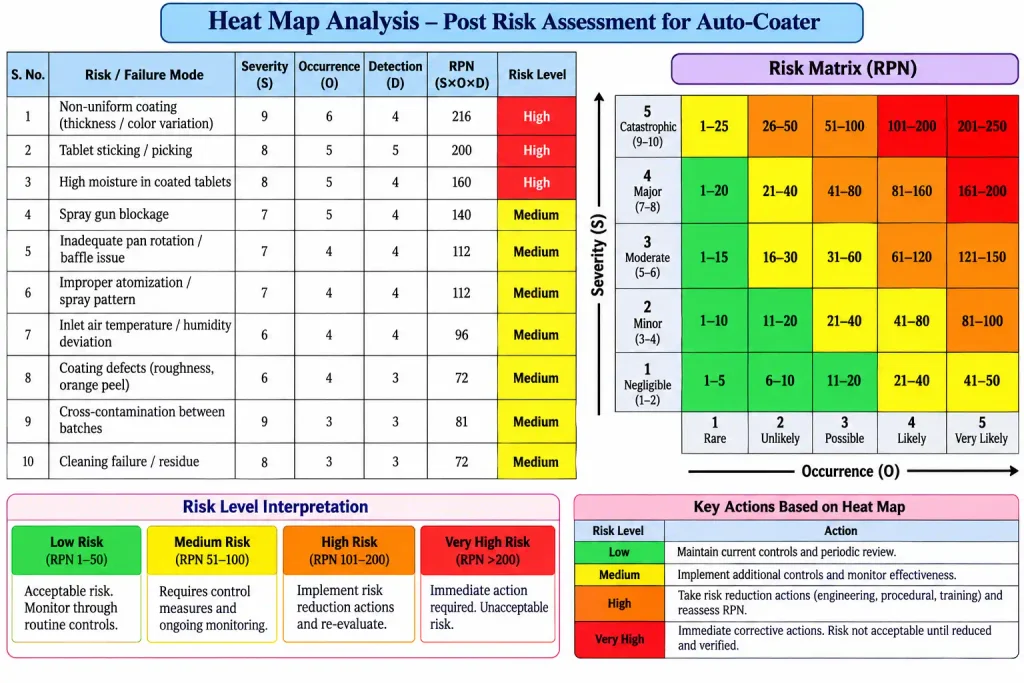
5. Heat Map Analysis – Post Risk Assessment for Auto-Coater:
The Heat Map Analysis for the Auto-Coater visually ranks identified failure modes according to severity, occurrence, detection, and calculated Risk Priority Number (RPN). Higher-risk areas include non-uniform coating, tablet sticking, high moisture, spray gun blockage, atomization issues, airflow deviations, cleaning failures, and cross-contamination. The heat map classifies risks into low, medium, high, and very high categories to support prioritization of corrective and preventive actions. High-risk conditions require immediate mitigation, while medium risks need additional controls and monitoring. The analysis helps ensure effective risk reduction, equipment reliability, consistent coating quality, operator safety, and continued GMP compliance.
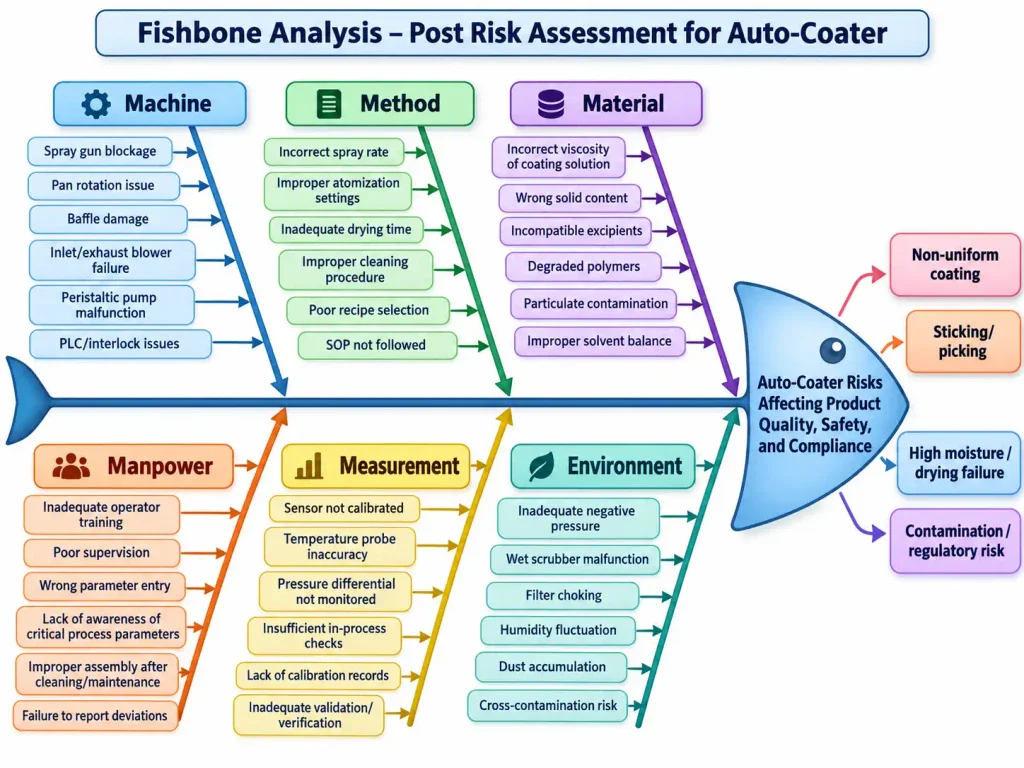
6. Fishbone Analysis – Post Risk Assessment for Auto-Coater:
The Fishbone Analysis for the Auto-Coater identifies possible causes of risks affecting product quality, safety, and GMP compliance. Causes are grouped into six categories: Machine, Method, Material, Manpower, Measurement, and Environment. Machine-related issues include spray gun blockage, blower failure, pan rotation problems, and PLC/interlock failures. Method and material causes include incorrect spray rate, poor cleaning, unsuitable viscosity, and degraded polymers. Manpower and measurement factors cover inadequate training, wrong parameter entry, sensor calibration, and insufficient checks. Environmental causes include negative pressure failure, filter choking, humidity variation, and cross-contamination, which may lead to coating defects and process failures.
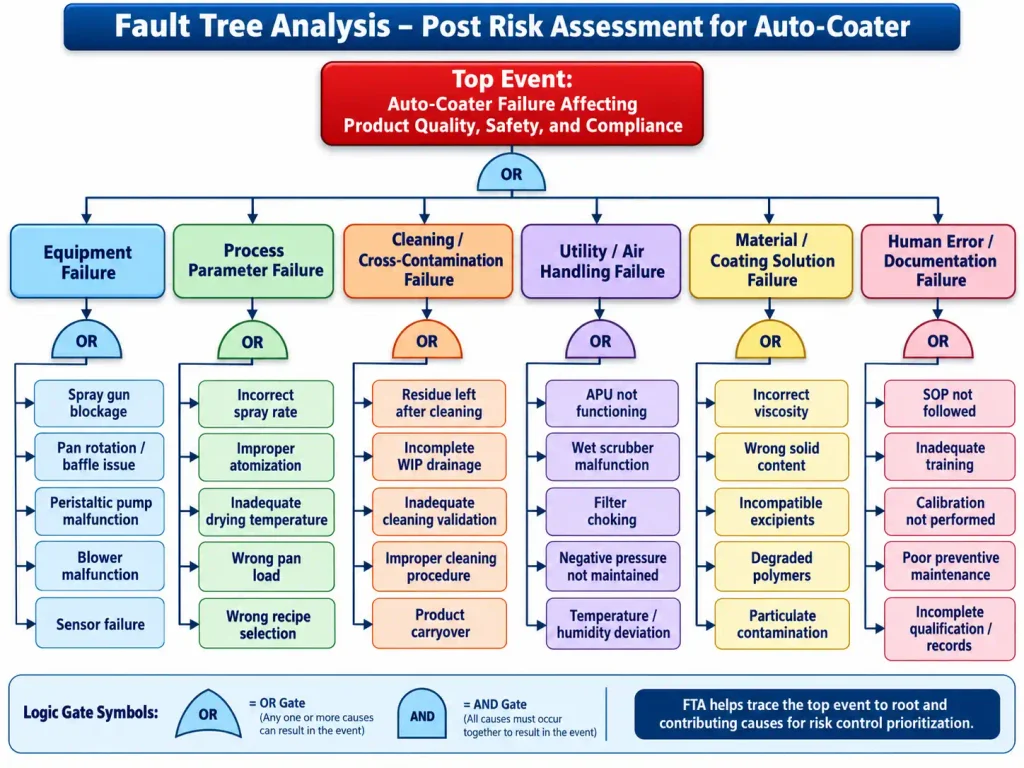
7. Fault Tree Analysis – Post Risk Assessment for Auto-Coater:
The Fault Tree Analysis for the Auto-Coater identifies potential causes that can lead to failures affecting product quality, safety, and GMP compliance. The top event is linked through OR gates to major failure categories including equipment failure, process parameter failure, cleaning and cross-contamination failure, utility or air-handling failure, coating solution failure, and human or documentation errors. Contributing causes include spray gun blockage, improper atomization, blower malfunction, inadequate cleaning, filter choking, pressure deviation, incorrect viscosity, poor training, calibration gaps, and incomplete qualification records. The analysis supports systematic root-cause identification and prioritization of effective risk-control measures.
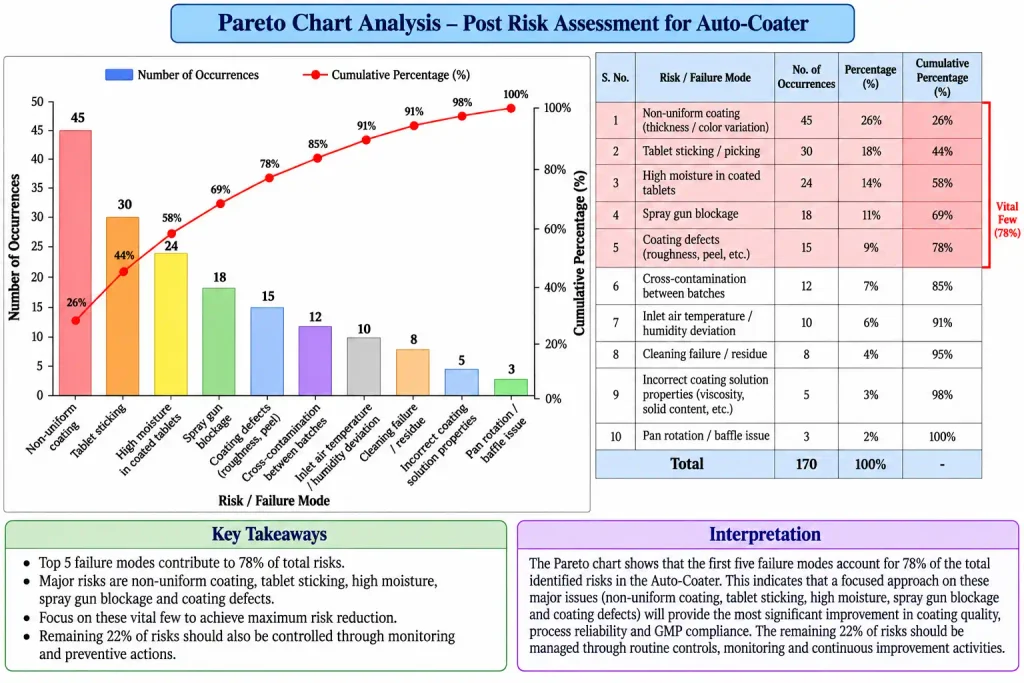
8. Pareto Chart Analysis – Post Risk Assessment for Auto-Coater:
The Pareto Chart Analysis for the Auto-Coater prioritizes failure modes according to their frequency and cumulative contribution to overall risk. The chart shows that non-uniform coating, tablet sticking or picking, high moisture in coated tablets, spray gun blockage, and coating defects represent the major contributors. Together, these top five failure modes account for approximately 78% of the identified occurrences, indicating the “vital few” areas requiring priority attention. Focusing CAPA, preventive maintenance, process optimization, operator training, cleaning controls, and parameter monitoring on these issues can achieve the greatest improvement in coating performance, product quality, equipment reliability, and GMP compliance.
9. Corrective Action and Preventive Action with Effectiveness Review – Post Risk Assessment for Auto-Coater:
Based on the identified Auto-Coater FMEA risks, priority CAPA should focus on qualification, recipe/password controls, atomization, preventive maintenance, cleaning, calibration, utilities, and operator practices. The source specifically calls for actions such as procuring a molybdenum kit for MOC verification, preparing SOPs for recipe/password controls, establishing recipe preparation for product/wash/maintenance cycles, verifying atomization during PQ, and obtaining gasket hardness certificates.
| Risk / Failure | Corrective Action | Preventive Action | Effectiveness Review |
|---|---|---|---|
| Improper atomization | Check atomization air, peristaltic pump and spray gun performance; correct abnormalities before operation. | Include atomization verification in PQ and preventive-maintenance schedule. | Review three consecutive coating batches for spray pattern, coating uniformity and absence of atomization-related deviations. |
| Recipe preparation issues | Prepare and approve required product, wash and maintenance recipes. | Establish controlled SOP for recipe creation, review, approval and modification. | Verify approved recipes are used correctly in three consecutive batches without recipe-related deviation. |
| Password protection not available | Configure appropriate password protection and access levels. | Implement controlled user-access and periodic access review. | Review access logs after implementation and confirm no unauthorized recipe or parameter changes. |
| Calibration deficiencies | Calibrate temperature sensors and other critical instruments before use. | Maintain calibration schedule with due-date monitoring. | Confirm 100% critical instruments remain within calibration status during periodic review. |
| MOC verification not performed | Perform MOC verification using appropriate test certificate/molybdenum kit. | Include MOC verification as a mandatory IQ requirement. | QA verifies completed IQ records and supporting MOC certificates. |
| Spray gun blockage | Clean and inspect spray guns; replace defective components where necessary. | Define cleaning frequency, inspection criteria and preventive maintenance. | No spray-gun blockage or abnormal spray pattern observed during three consecutive batches. |
| APU / blower malfunction | Repair and verify inlet/exhaust blower, airflow and related controls. | Follow preventive maintenance and periodic performance checks. | Review airflow, CFM, temperature and pressure trends for defined monitoring period. |
| Wet scrubber malfunction | Restore scrubber operation, clean filters and verify negative pressure/CFM. | Establish periodic filter cleaning and scrubber maintenance schedule. | Verify stable negative pressure and airflow with no recurring alarms or deviations. |
| Inadequate cleaning / residue | Re-clean equipment and investigate residual contamination. | Strengthen cleaning SOP, WIP drainage checks and cleaning validation monitoring. | Successful visual inspection and cleaning-validation results over consecutive cleaning cycles. |
| Improper gasket hardness | Obtain vendor hardness certificate and replace unsuitable gasket if required. | Include gasket specification and certificate verification during qualification/procurement. | Confirm correct gasket specification and satisfactory sealing/negative-pressure performance. |
Effectiveness Review Conclusion
CAPA effectiveness should be assessed after implementation through document review, equipment performance checks, calibration status, preventive-maintenance compliance, alarm and deviation trends, cleaning results, and consecutive successful production batches. Residual risk should then be reassessed using Severity, Occurrence and Detectability to calculate the revised RPN. The document itself provides for a formal “Review of Risk Assessment as per FMEA after action taken”, including action taken, severity, occurrence, detectability, RPN and remarks.
Acceptance criterion: CAPA may be considered effective when the identified failure does not recur during the defined review period, required controls are consistently followed, and the revised RPN falls within the organization’s acceptable risk category.
10. Questions and Answers – Post Risk Assessment for Auto-Coater:
- What is the purpose of Post Risk Assessment for the Auto-Coater?
The purpose is to evaluate risks associated with the Auto-Coater after considering its design, installation, operation, performance, cleaning, and safety controls, using the FMEA methodology. - Which risk assessment method is used for the Auto-Coater?
The assessment is performed using FMEA – Failure Mode and Effects Analysis. - Which parameters are used to calculate the Risk Priority Number?
RPN is calculated using Severity (S), Occurrence (O), and Detection (D) ratings. - What are the FMEA risk acceptance categories?
RPN ≥76 is Critical, 51–75 is Major, 26–50 is Moderate, and up to 25 is Minor. CAPA is required for Critical, Major, and Moderate risks according to the document. - What risks are associated with inadequate Design Qualification?
Inadequate DQ may result in unclear equipment requirements, incomplete utility requirements, missing components, inadequate safety considerations, and failure to meet cGMP expectations. - Why is MOC verification important during qualification?
MOC verification confirms that product-contact and non-contact parts are made from suitable materials and helps prevent product contamination. The document recommends use of a molybdenum kit where required. - What risk is associated with an uncalibrated temperature sensor?
An uncalibrated sensor can lead to inaccurate temperature measurement, which may affect coating and drying performance. - What may happen if the APU unit does not function properly?
Product and environmental contamination may occur, and the required drying temperature may not be achieved. Performance checks are therefore required during PQ. - Why is recipe control important in an Auto-Coater?
Recipe control ensures consistent equipment operation for product coating, washing, and maintenance cycles. The document identifies inadequate recipe preparation and password protection as significant risks. - What risk is associated with improper atomization?
Improper atomization can cause the coated product to fail specifications. Possible causes include insufficient air, improper dosing, and malfunction of the peristaltic pump. - What happens if the wet scrubber does not function properly?
Negative pressure may not be maintained, dust and coating resin may escape, and the required CFM may not be maintained. - What risks are associated with malfunctioning spray guns?
Improper spray-gun operation can adversely affect product quality and coating uniformity. - Why is proper pan perforation cleaning important?
Choked pan perforations can interfere with airflow and adversely affect drying of tablets. - What is the risk of improper gasket hardness?
Improper gasket hardness may result in poor sealing, inability to maintain negative pressure, and potential product contamination. - How should effectiveness of risk-control actions be reviewed?
After actions are implemented, Severity, Occurrence, and Detectability should be reassessed and a new RPN calculated. The document provides a dedicated review section for action taken, revised ratings, RPN, and remarks. - Who is responsible for Auto-Coater risk assessment activities?
The document identifies Quality Assurance, Engineering, Production, Quality Control, and Store as responsible functions. - What guideline is referenced for this risk assessment?
The assessment references ICH Q9 – Quality Risk Management. - What is the final objective of the Post Risk Assessment?
The final objective is to confirm that identified risks are adequately controlled, residual risks are acceptable, and the Auto-Coater can consistently support product quality, equipment performance, safety, and GMP compliance.
11. Reference Guidelines – Post Risk Assessment for Auto-Coater:
- ICH Q9(R1) – Quality Risk Management — principles and tools for identification, analysis, evaluation, control, communication, and review of quality risks.
- ICH Q10 – Pharmaceutical Quality System — supports lifecycle risk management, CAPA, change management, and continual improvement.
- EU GMP, Part I, Chapter 1 – Pharmaceutical Quality System — requires quality risk management to be integrated into pharmaceutical quality systems.
- EU GMP, Annex 15 – Qualification and Validation — applicable to DQ, IQ, OQ, PQ, equipment qualification, validation, and lifecycle review.
- WHO Good Manufacturing Practices for Pharmaceutical Products — supports equipment qualification, maintenance, calibration, cleaning, documentation, and risk-based controls.
- PIC/S PE 009 – Guide to Good Manufacturing Practice — provides GMP expectations for equipment, qualification, operation, maintenance, documentation, and risk management.
- ISPE Baseline / Good Practice Guides for Commissioning and Qualification — useful for risk-based equipment qualification and verification.
- Company SOP on Quality Risk Management — defines the site-specific FMEA methodology, scoring system, RPN acceptance criteria, responsibilities, and CAPA requirements.
- Equipment URS, DQ, IQ, OQ and PQ documents — primary technical references for confirming Auto-Coater design and performance requirements.
- Auto-Coater Operation, Cleaning, Calibration and Preventive Maintenance SOPs — operational references for controlling equipment and process risks.