






1. Introduction to Povidone-Iodine Ointment USP 5% – Batch Manufacturing Record (BMR):
Overview of Povidone-Iodine Ointment USP 5%
Povidone-Iodine Ointment USP 5% is a topical antiseptic formulation widely used to help prevent and control infections in minor cuts, wounds, abrasions, and burns. Povidone-iodine is an iodophor complex that gradually releases free iodine, providing broad-spectrum antimicrobial activity against various bacteria, fungi, viruses, and other microorganisms. The manufacturing of Povidone-Iodine Ointment USP 5% requires controlled processing conditions to ensure product uniformity, stability, safety, and compliance with established quality specifications.
Importance of the Batch Manufacturing Record (BMR)
The Batch Manufacturing Record (BMR) is an essential Good Manufacturing Practice (GMP) document that provides comprehensive instructions and records for each stage of manufacturing. It includes raw material dispensing, equipment verification, ointment base preparation, mixing, homogenization, in-process quality checks, filling, and packaging-related documentation, as applicable. The BMR ensures traceability, consistency, and accountability throughout the manufacturing process.
Quality Assurance and GMP Compliance
Manufacturing activities must follow approved Standard Operating Procedures (SOPs), validated processes, and applicable USP specifications. Critical Process Parameters (CPPs), including mixing time, temperature, and homogenization conditions, should be monitored according to the validated manufacturing procedure. Critical Quality Attributes (CQAs), such as appearance, homogeneity, available iodine content, microbial quality, and consistency, are essential for maintaining product quality. A properly maintained BMR supports batch review, deviation investigation, regulatory compliance, and final product release by the Quality Assurance department.
Skip to PDF contentManufacturing Flow Diagram of Povidone-Iodine Ointment USP 5% – Description
Overview of the Manufacturing Process
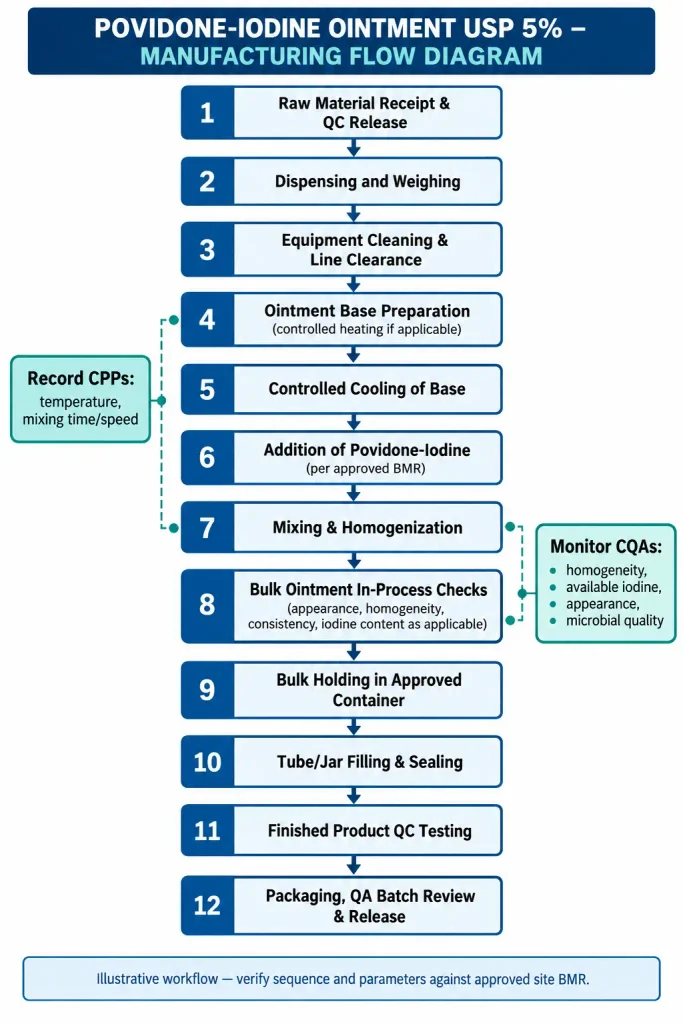
The manufacturing flow diagram of Povidone-Iodine Ointment USP 5% illustrates the systematic sequence of manufacturing operations performed under Good Manufacturing Practice (GMP) conditions. The process ensures consistent product quality, uniformity, stability, and compliance with approved specifications.
Raw Material Dispensing and Ointment Base Preparation
Manufacturing begins with the verification, dispensing, and weighing of approved raw materials according to the Batch Manufacturing Record (BMR). Equipment cleanliness and line clearance are verified before processing. The ointment base is prepared using specified mixing and temperature conditions.
Incorporation and Homogenization
Povidone-Iodine is incorporated into the prepared ointment base under controlled conditions as defined in the approved BMR. Mixing and homogenization ensure uniform distribution of the active ingredient throughout the formulation.
In-Process Quality Control
Critical Process Parameters (CPPs), including mixing speed, mixing time, and temperature, are monitored. In-process checks may include appearance, homogeneity, consistency, and available iodine content, as applicable.
Filling, Packaging, and Batch Release
The prepared ointment is transferred to approved containers and filled into suitable tubes or jars. Filling weight, sealing integrity, and packaging quality are verified. Following satisfactory finished product testing, documentation review, and Quality Assurance approval, the batch is released for distribution.
GMP Note: Actual processing steps and acceptance criteria must follow the approved, validated BMR.
The Critical Process Parameters (CPPs) and Critical Quality Attributes (CQAs) of Povidone-Iodine Ointment USP 5% play an essential role in ensuring consistent product quality, safety, stability, and therapeutic effectiveness during pharmaceutical manufacturing. CPPs are process variables that require appropriate monitoring and control because variations may affect the quality of the finished product. Important process parameters include ointment base preparation temperature, cooling temperature, Povidone-Iodine addition conditions, mixing time, mixing speed, homogenization conditions, and bulk holding time and temperature. Proper control of these parameters helps achieve uniform distribution of the active pharmaceutical ingredient, suitable consistency, and product stability.
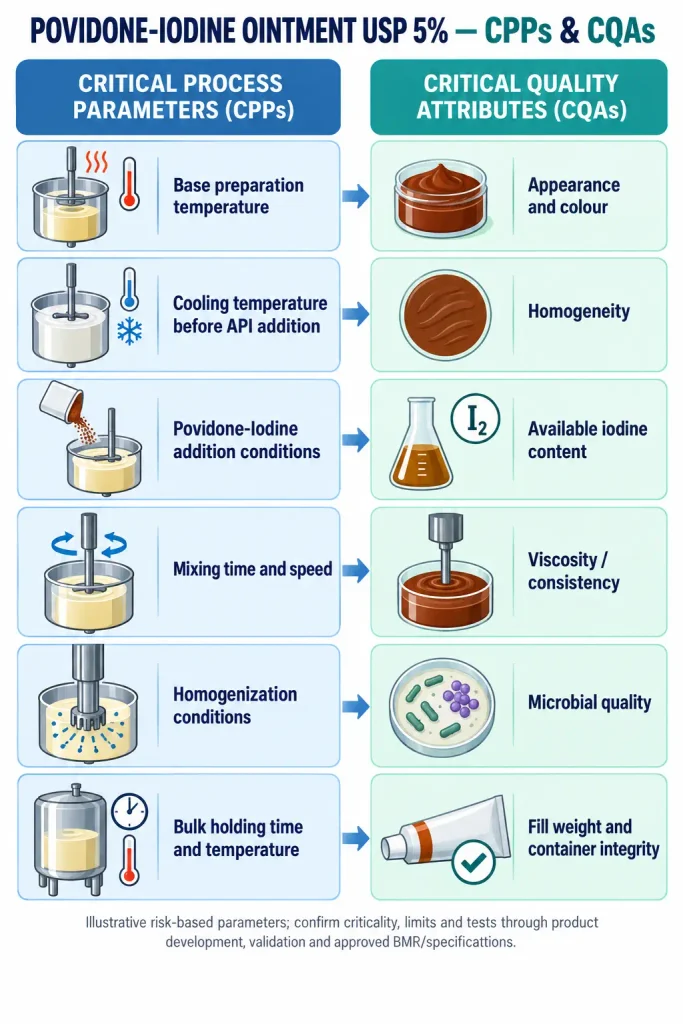
CQAs are measurable physical, chemical, microbiological, and packaging characteristics that must comply with established acceptance criteria. Important CQAs include appearance, colour, homogeneity, available iodine content, viscosity, microbial quality, fill weight, and container closure integrity. Inadequate process control may result in non-uniform mixing, changes in iodine content, unacceptable consistency, or other product quality defects. Monitoring CPPs and evaluating CQAs through approved in-process controls, quality control testing, and validated manufacturing procedures help maintain batch-to-batch consistency. A scientifically justified control strategy, supported by risk assessment, process validation, and Good Manufacturing Practices (GMP), ensures that Povidone-Iodine Ointment USP 5% consistently meets established quality specifications and regulatory requirements.