







1. Introduction to Povidone-Iodine Solution IP – Batch Manufacturing Record (BMR):
Povidone-Iodine Solution IP is a widely used topical antiseptic preparation formulated to provide broad-spectrum antimicrobial activity against bacteria, fungi, viruses, and other susceptible microorganisms. It contains povidone-iodine, an iodine-releasing complex that provides effective antiseptic action while reducing the irritation associated with free iodine. The Batch Manufacturing Record (BMR) for Povidone-Iodine Solution IP provides a systematic and documented approach to manufacturing, processing, filling, and packaging operations in accordance with Good Manufacturing Practices (GMP). The formulation specifies Povidone-Iodine IP 5% w/v, equivalent to 0.5% w/v available iodine, with purified water and other formulation ingredients. The manufacturing process involves raw material dispensing, equipment clearance, material verification, solution preparation, controlled mixing, in-process quality checks, bulk testing, filling, sealing, and final packaging. Critical quality parameters include appearance, pH, available iodine content, uniformity, and compliance with applicable Indian Pharmacopoeia specifications. This BMR ensures complete batch traceability through the documentation of material quantities, equipment identification, processing conditions, personnel responsibilities, quality control results, and manufacturing activities. Proper implementation of the BMR supports product consistency, regulatory compliance, data integrity, deviation management, and quality assurance, helping ensure that every manufactured batch meets established safety, quality, and performance requirements before its final release for distribution.
Skip to PDF content2. Manufacturing Process Flow Diagram of Povidone-Iodine Solution IP:
The manufacturing process flow diagram of Povidone-Iodine Solution IP illustrates the systematic sequence of manufacturing operations performed in accordance with Good Manufacturing Practices (GMP). It provides a clear understanding of the critical processing stages, quality control requirements, and documentation activities involved in producing a consistent and quality-compliant antiseptic solution. The process begins with raw material dispensing, where Povidone-Iodine IP, glycerine, PEG-6000, sodium bicarbonate, and purified water are weighed according to the approved Batch Manufacturing Record (BMR). All materials are verified for identity, quantity, and quality before manufacturing.
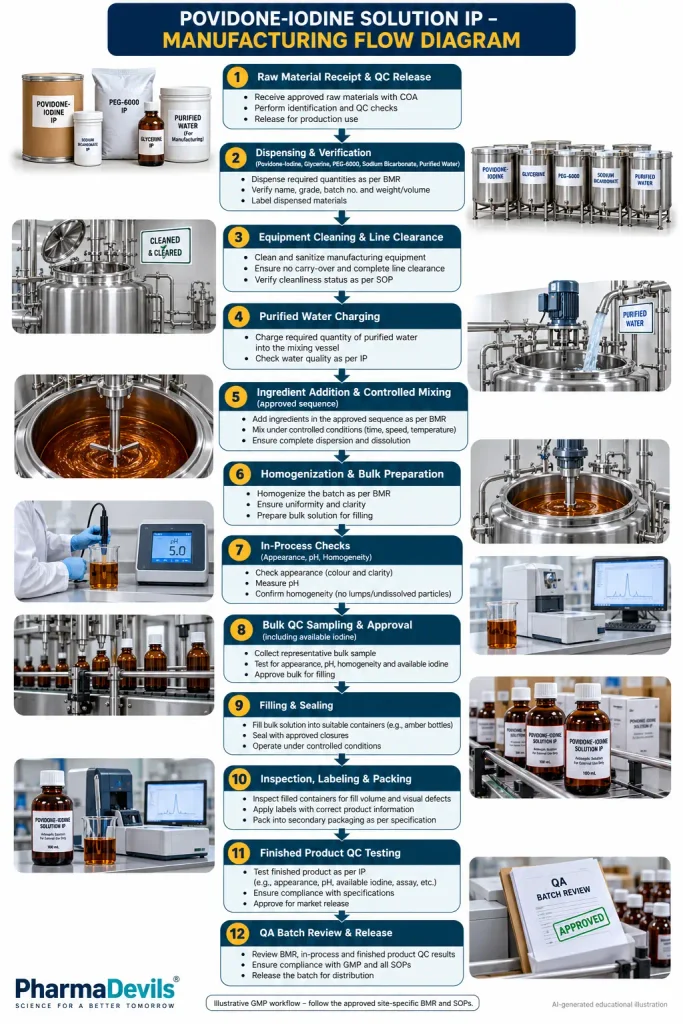
Following equipment cleaning and line clearance, the required quantity of purified water is transferred into the manufacturing vessel. The formulation ingredients are added in the validated sequence under controlled mixing conditions to ensure proper dissolution and uniform distribution. The prepared bulk solution undergoes in-process quality checks, including appearance, pH, homogeneity, and available iodine content, as applicable. After satisfactory bulk quality control approval, the solution proceeds to filling, sealing, labeling, and packaging operations. The finished product undergoes final quality control testing, batch documentation review, and Quality Assurance approval before release. This flow diagram supports process standardization, batch traceability, contamination prevention, regulatory compliance, and consistent product quality throughout manufacturing operations.
3. Critical Process Parameters (CPPs) and Critical Quality Attributes (CQAs) of Povidone-Iodine Solution IP:
Critical Process Parameters (CPPs) and Critical Quality Attributes (CQAs) play an important role in ensuring the consistent quality, safety, and effectiveness of Povidone-Iodine Solution IP during pharmaceutical manufacturing. Critical Process Parameters (CPPs) are manufacturing variables that require appropriate monitoring and control to maintain product quality. Potential CPPs include raw material dispensing accuracy, ingredient addition sequence, mixing speed, mixing time, processing temperature, purified water quality, and bulk solution holding conditions. These parameters help achieve uniform mixing, proper dissolution, and consistent product characteristics.

Critical Quality Attributes (CQAs) are physical, chemical, biological, or microbiological properties that must meet established acceptance criteria to ensure the required product quality. Important quality attributes of Povidone-Iodine Solution IP include available iodine content, appearance, clarity, pH, solution homogeneity, chemical stability, microbial quality, and container-closure integrity, as applicable. The relationship between CPPs and CQAs is established through pharmaceutical development, quality risk assessment, and process validation studies. Effective monitoring, in-process testing, and quality control verification help identify potential manufacturing variations and prevent quality defects. A scientifically justified CPP–CQA control strategy supports Good Manufacturing Practices (GMP), batch-to-batch consistency, regulatory compliance, and reliable product quality.
Note: The final CPP classification and CQA acceptance limits must be established through approved specifications, documented risk assessment, and process validation data.