




1. Introduction – Training of Personnel:
Training of personnel is a fundamental element of the pharmaceutical Quality Management System and is essential for ensuring that employees perform their assigned activities effectively, consistently, and in compliance with current Good Manufacturing Practices (cGMP). This SOP establishes a systematic approach for training personnel involved in manufacturing, testing, packing, storage, distribution, and other GMP-related activities. It ensures that employees receive appropriate training according to their job responsibilities before independently performing assigned work. The training system includes induction training, job-specific training, cGMP and technical training, on-the-job training, refresher training, and need-based retraining. Qualified trainers are selected based on their education, experience, knowledge, communication skills, and technical expertise. Proper planning, documentation, competency evaluation, and maintenance of individual training records help ensure employee competence, strengthen GMP compliance, reduce human errors, and support continuous improvement throughout pharmaceutical operations.
Skip to PDF content2. Flow Diagram – Training of Personnel:
The flow diagram illustrates the systematic process for planning, conducting, evaluating, and documenting personnel training within a pharmaceutical organization. The process begins with identification of training needs based on job responsibilities, departmental requirements, SOPs, and cGMP expectations. An annual training plan or schedule is then prepared, followed by selection of a qualified trainer based on education, experience, knowledge, and technical expertise. Training modules are prepared and reviewed before conducting induction, cGMP, job-specific, on-the-job, refresher, or need-based training.
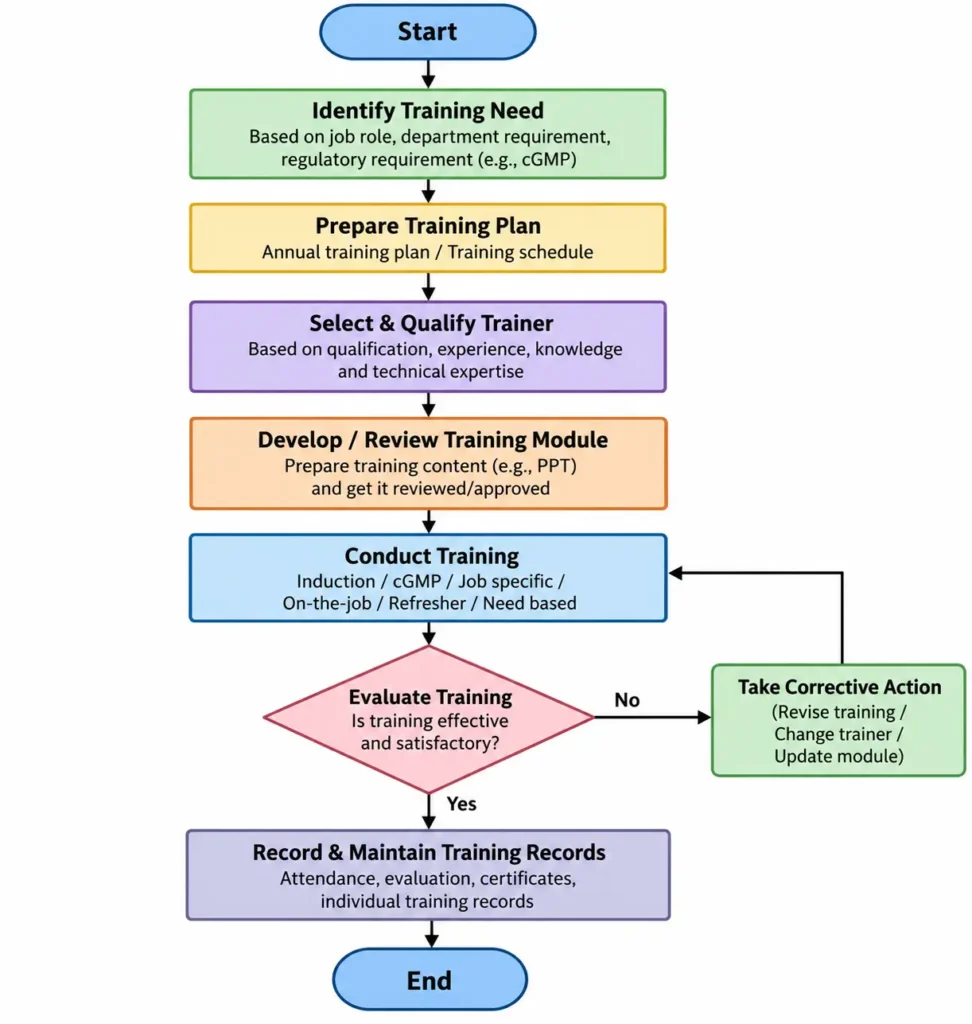
After training, the trainee’s understanding and effectiveness of training are evaluated. Personnel scoring below the required acceptance criterion are retrained and re-evaluated. Successful training is documented through attendance records, evaluation sheets, certificates, and individual training records, ensuring traceability, competency, and continued GMP compliance.
3. Benefits of Following SOP – Training of Personnel:
Following the Training of Personnel SOP ensures that employees receive structured, job-relevant training before performing assigned activities. The SOP supports induction, job-specific, cGMP/technical, on-the-job, refresher, and need-based training, helping personnel develop the knowledge and skills required for their responsibilities.
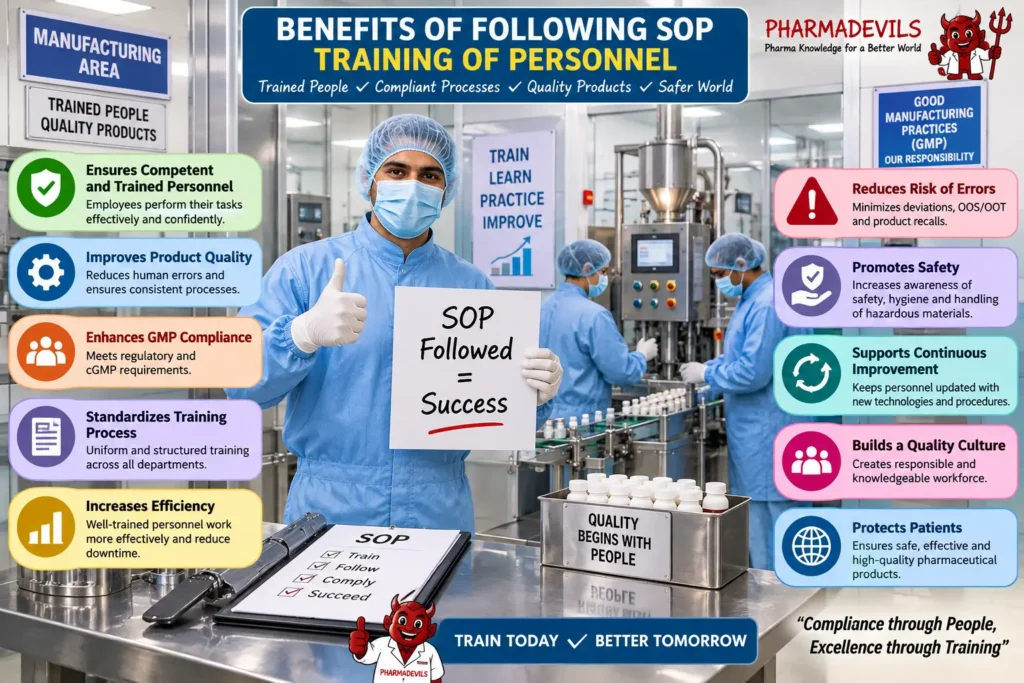
Effective implementation promotes GMP compliance, consistent work practices, improved employee competency, better product quality, and reduced risk of human error. Training effectiveness is evaluated to confirm employee understanding, and personnel who do not achieve the required acceptance criteria are retrained and re-evaluated. Proper training also improves safety awareness, strengthens documentation practices, encourages accountability, and helps create a strong quality culture. Maintaining attendance, evaluation, certification, and individual training records provides documented evidence that personnel are appropriately trained and competent to perform their assigned pharmaceutical operations.
4. Brainstorming for SOP Failure – Training of Personnel:
The brainstorming diagram identifies possible factors that may contribute to SOP failure in the pharmaceutical manufacturing area. The major potential causes include inadequate training, poor understanding of the SOP, insufficient supervision, weak documentation practices, unreported deviations, human error, poor housekeeping, improper gowning, absence of checklist usage, weak monitoring, lack of accountability, communication gaps, equipment-related issues, manpower shortages, improper line clearance, and failure to communicate revised procedures.
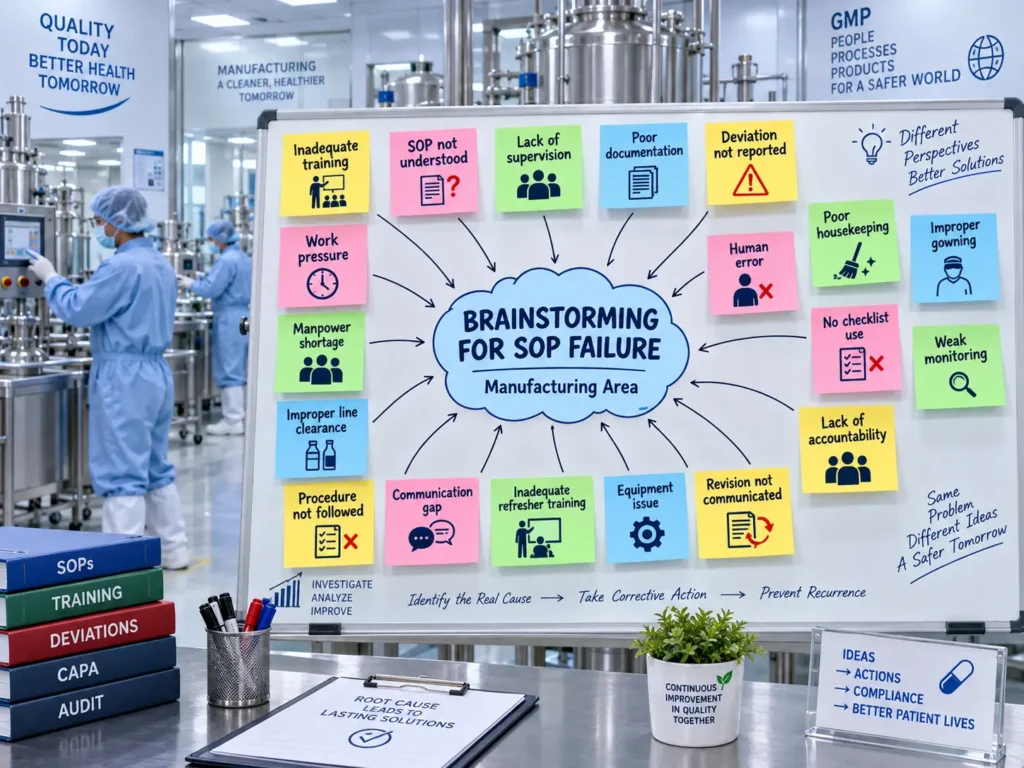
The purpose of this brainstorming exercise is to collect different viewpoints from Production, QA, Engineering, and other concerned functions so that all probable causes of SOP failure can be considered before detailed root-cause analysis. Particular attention should be given to training because the SOP requires personnel to be trained according to their job responsibilities and relevant GMP requirements before performing assigned work. The identified causes can subsequently be evaluated through 5-Why, Fishbone, or other investigation tools to establish the actual root cause and implement appropriate corrective and preventive actions.
5. 5-Why Analysis for SOP Failure – Training of Personnel:
The 5-Why analysis evaluates the underlying reasons for failure to follow an SOP in the pharmaceutical manufacturing area. The analysis begins with the observed problem that personnel are not following the approved SOP. The first contributing factor identified is inadequate understanding or awareness of the procedure. This is linked to insufficient SOP training, which may result from ineffective identification of training needs or failure to implement the planned training program.
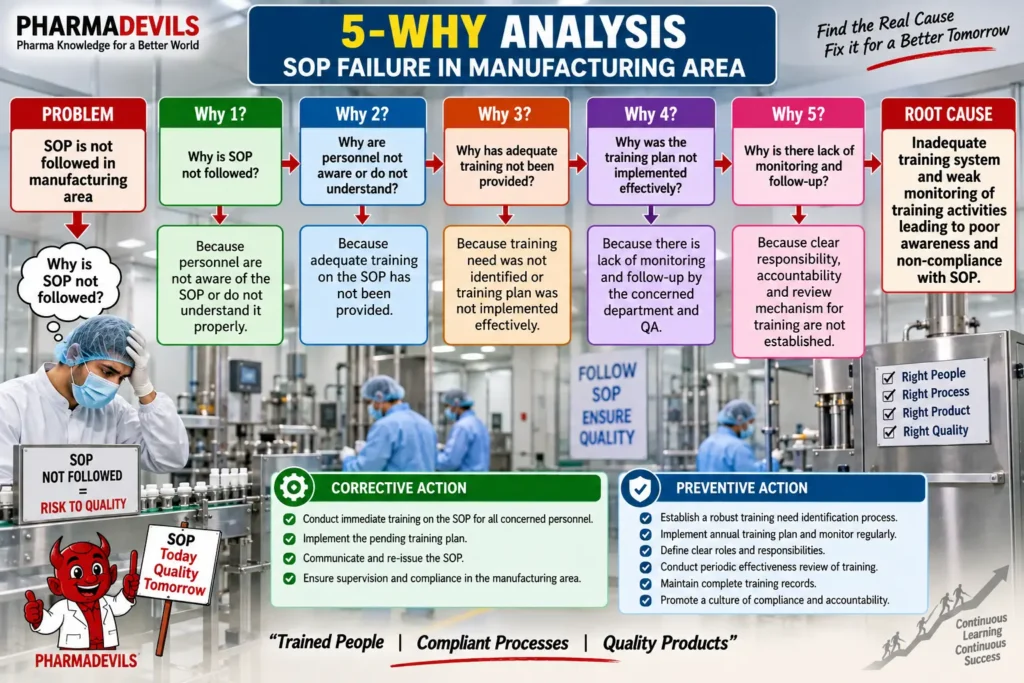
The analysis further indicates that weak monitoring and follow-up by the concerned department and Quality Assurance can allow training deficiencies to continue. Lack of clearly defined responsibility, accountability, and periodic review can further weaken the training system. The resulting root cause is therefore associated with an inadequate training and monitoring system, leading to poor SOP awareness and non-compliance. This is consistent with the SOP requirement that personnel be trained according to their job responsibilities and that training effectiveness be evaluated, with retraining required when performance is unsatisfactory.
6. Fishbone Analysis for SOP Failure – Training of Personnel:
The Fishbone Analysis identifies the major potential causes that may lead to failure in following the Training of Personnel SOP within the pharmaceutical manufacturing area. The causes can be grouped under Manpower, Method, Machine/Equipment, Material, Measurement, Environment, and Management. Manpower-related causes may include inadequate training, lack of awareness, inexperienced personnel, excessive workload, and weak supervision. Method-related causes may involve unclear procedures, failure to communicate revised SOPs, inadequate training plans, or poor control of training activities. Measurement-related causes can include ineffective monitoring, incomplete training records, and failure to evaluate training effectiveness. Management-related factors may include unclear responsibilities, insufficient follow-up, poor communication, and inadequate accountability.
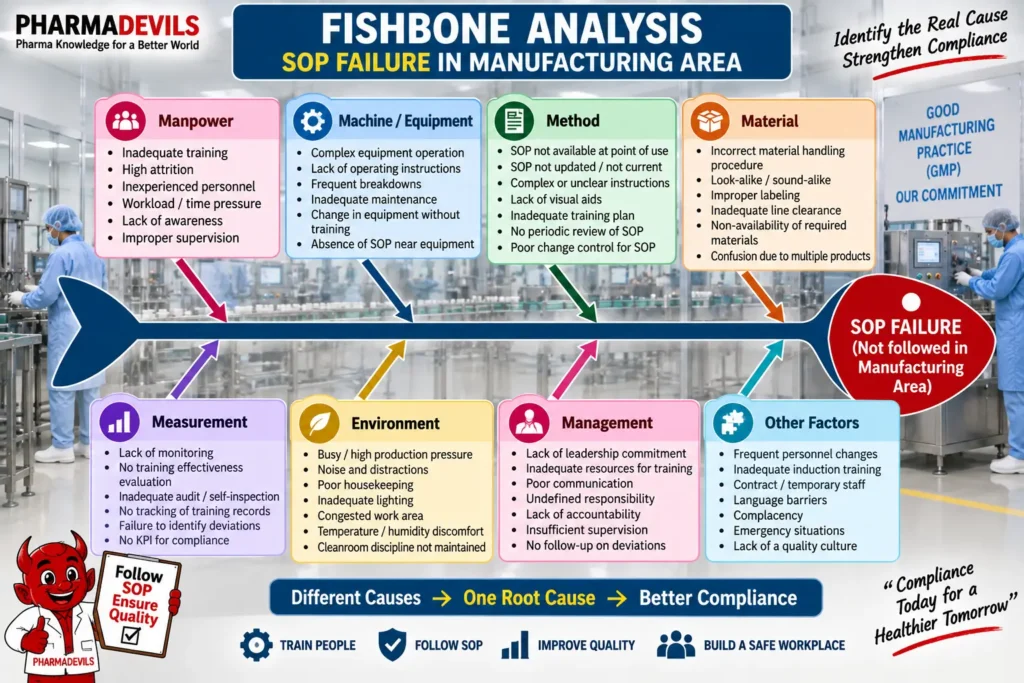
The SOP requires employees to be trained according to their area of operation and job responsibilities, with cGMP training mandatory for personnel. It also requires training effectiveness to be evaluated, with retraining when performance is below the specified acceptance level. Identifying these contributing factors helps determine the actual root cause and supports appropriate CAPA to prevent recurrence.
7. Fault Tree Analysis for SOP Failure – Training of Personnel:
The Fault Tree Analysis evaluates the possible causes that can lead to failure in following the Training of Personnel SOP within the pharmaceutical manufacturing area. The top event is SOP non-compliance, which may arise from several independent or combined causes related to people, process or method, equipment or material, and management systems. People-related causes may include inadequate training, lack of awareness, poor supervision, workload pressure, or failure to orient new and temporary personnel. Process-related causes may include unavailable or outdated SOPs, unclear instructions, document-control weaknesses, and lack of periodic review. Equipment and material factors can include equipment malfunction, inadequate maintenance, or use of incorrect materials. Management-related causes may involve poor monitoring, insufficient follow-up, weak accountability, ineffective audits, and inadequate communication.
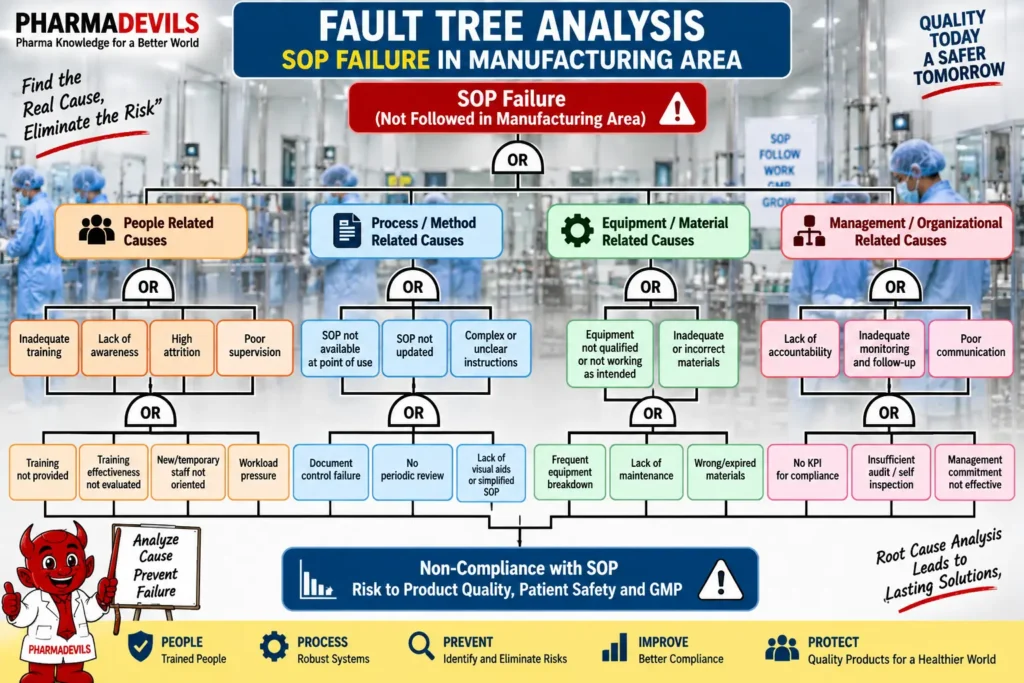
The SOP requires personnel to be trained according to their assigned responsibilities and cGMP requirements before performing work. It also requires evaluation of training effectiveness and retraining when the acceptance criteria are not achieved. Fault Tree Analysis therefore helps trace SOP failure back to underlying systemic causes so that suitable corrective and preventive actions can be established.
8. Impact Assessment – SOP Failure in Training of Personnel:
The Impact Assessment illustrates the potential consequences of failure to follow the Training of Personnel SOP in the pharmaceutical manufacturing area. Inadequate or ineffective training can lead to incorrect manufacturing practices, process deviations, documentation errors, OOS/OOT events, rework, batch rejection, and possible product quality defects. Such failures may also affect patient safety through the risk of ineffective, unsafe, or non-compliant products reaching the market. From a regulatory perspective, insufficient training and poor SOP compliance may result in audit observations, warning actions, increased regulatory scrutiny, and delays in product approvals.
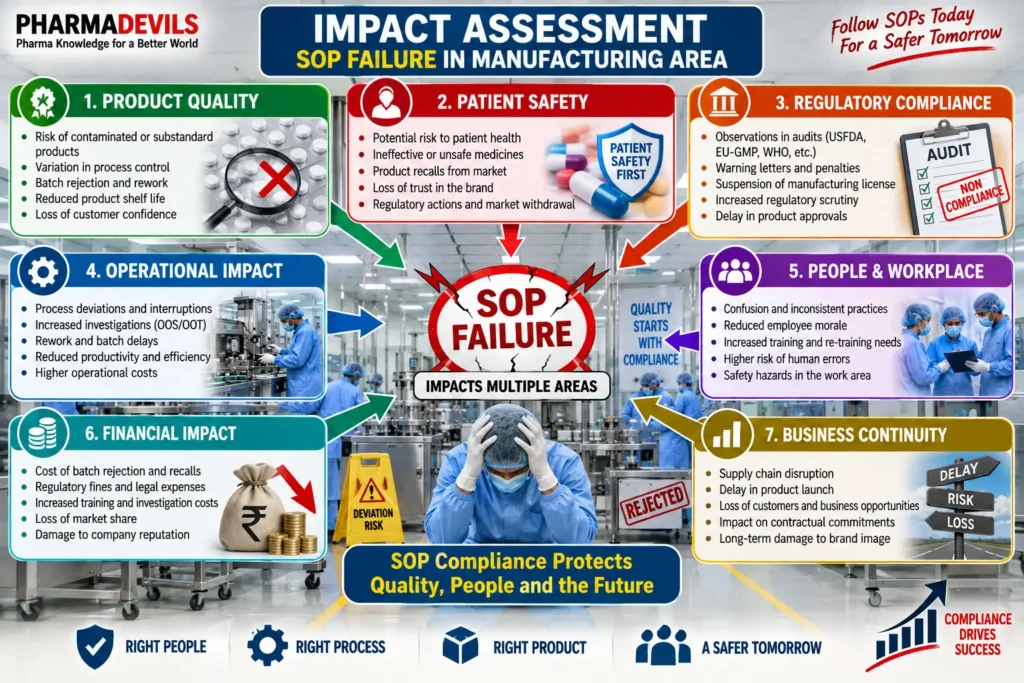
Operational impacts include production interruptions, reduced productivity, repeated investigations, increased retraining requirements, and higher operating costs. Employees may experience confusion, inconsistent practices, and increased risk of human error or workplace safety incidents. Financial and business impacts may include batch losses, recall costs, regulatory expenses, supply disruption, reputational damage, and loss of customer confidence. Effective SOP implementation therefore protects product quality, personnel competency, patient safety, regulatory compliance, and business continuity.
Questions & Answers – Training of Personnel SOP:
- Q: What is the objective of the Training of Personnel SOP?
A: The objective is to lay down a defined procedure for training personnel within the organization. - Q: To whom is this SOP applicable?
A: It applies to personnel engaged in manufacturing, testing, packing, holding, distribution, cGMP training, and other activities identified for effective and controlled operations. - Q: Who coordinates cGMP training?
A: The QA Training Coordinator or designee coordinates cGMP training and works with cross-functional departments to complete training as per identified needs. - Q: Who is responsible for job-specific training?
A: The departmental training coordinator is responsible for job-specific training and maintenance of individual training records. - Q: When should an employee be trained?
A: Every employee should be trained in their area of operation before starting assigned work, according to the nature of the job and responsibilities. - Q: Is cGMP training mandatory?
A: Yes. cGMP training is mandatory for employees and must be completed before a new joinee is placed into the operational area. - Q: How are internal trainers selected?
A: Internal trainers are identified based on qualification, skills, experience, knowledge, communication ability, and expertise in relevant operations. - Q: What are the major types of internal training?
A: They include induction training, cGMP/technical training, job-specific training, on-the-job training, refresher training, and re-training or need-based training. - Q: What is induction training?
A: Induction training provides an overview of the organization, parent department, and cross-functional departments to new employees. - Q: What is job-specific training?
A: It is training provided to a new entrant based on assigned job responsibilities, work requirements, competency, and identified training needs before execution of work. - Q: What is refresher training?
A: Refresher training is conducted for employees on procedures related to their functions and applicable cross-functional processes. It is carried out at least once a year and whenever procedures are revised. - Q: When is re-training required?
A: Re-training may be required for technical or cGMP topics when identified by the concerned head, and personnel scoring below 80% in training evaluation must be retrained. - Q: When can need-based training be initiated?
A: It may be initiated following incidents, deviations, OOS, market complaints, OOT, self-audits, external audits, performance reviews, or behavioral issues. - Q: What happens when a new or revised SOP is issued?
A: Concerned personnel must be trained after approval and before implementation of the new or revised SOP. - Q: How is training effectiveness evaluated?
A: Training effectiveness is evaluated using a questionnaire or oral feedback, depending on the need and type of training. - Q: What is the minimum qualifying score for training evaluation?
A: The minimum qualifying score is 80%. Employees scoring below 80% must be retrained and re-evaluated. - Q: What records are maintained for training?
A: Records include training attendance, training log cards, evaluation questionnaires, competency matrices, annual training planners, certificates, and individual training files. - Q: Who verifies training status and records?
A: Quality Assurance is responsible for verification of training status and training records. - Q: What happens if scheduled training is not conducted on time?
A: The concerned department must inform QA and arrange the training within one working week. - Q: Why is the Training of Personnel SOP important?
A: It helps ensure that personnel are appropriately trained, competent for assigned activities, aware of cGMP requirements, and capable of performing work consistently in accordance with approved procedures.
Reference Guidelines – Training of Personnel:
- US FDA – 21 CFR Part 211.25, Personnel Qualifications: requires personnel engaged in manufacturing, processing, packing, or holding drug products to have appropriate education, training, and experience, with continuing cGMP training conducted by qualified individuals. (eCFR)
- EU GMP – EudraLex Volume 4, Part I, Chapter 2: Personnel: provides GMP requirements for personnel, including responsibilities, qualification, training, hygiene, and continuing training. (Public Health)
- WHO GMP – TRS 986, Annex 2: Good Manufacturing Practices for Pharmaceutical Products – Main Principles: includes requirements for personnel to receive initial and continuing GMP training relevant to their duties. (World Health Organization)
- WHO Quality Assurance of Pharmaceuticals, Volume 2, 10th Edition, 2024: provides updated GMP guidance covering personnel, training, hygiene, quality systems, production, and inspection practices. (World Health Organization)
- Schedule M of the Drugs Rules, 1945 – India: includes GMP expectations for pharmaceutical personnel and arrangements for basic and in-service training with maintenance of training records. (CDSCO)
- PIC/S Guide to GMP for Medicinal Products, PE 009 – Part I, Chapter 2: Personnel: may also be referenced for personnel qualification, induction, continuing training, GMP awareness, hygiene, and training effectiveness.