







Brief Description
This SOP describes the standardized procedure for allocation of A.R. (Analytical Report) Numbers for miscellaneous activities handled by concerned departments. Its objective is to ensure that each applicable sample, validation, calibration, or cleaning-related activity receives a unique and traceable A.R. number. The concerned person is responsible for execution of the procedure, while the Department Head is responsible for its effective implementation. The SOP defines specific A.R. numbering formats for volumetric solutions, instrument calibration, rinse/swab analysis, gowning validation, cleaning validation, FBD bag cleaning, bottle washing machine cleaning, and stability samples, using designated prefixes together with year, month, and serial numbers. Separate annexure registers are provided to document and control each category, supporting proper identification, traceability, sampling, analysis, release, and record maintenance.
Skip to PDF content1. Flow Diagram:
The flow diagram illustrates the systematic process for allocating Analytical Report (A.R.) Numbers for miscellaneous activities. The process begins by identifying the activity requiring an A.R. number and then selecting the applicable category, such as volumetric solution, instrument calibration, swab/rinse analysis, gowning validation, cleaning validation, FBD bag cleaning, bottle washing machine cleaning, or stability sample.
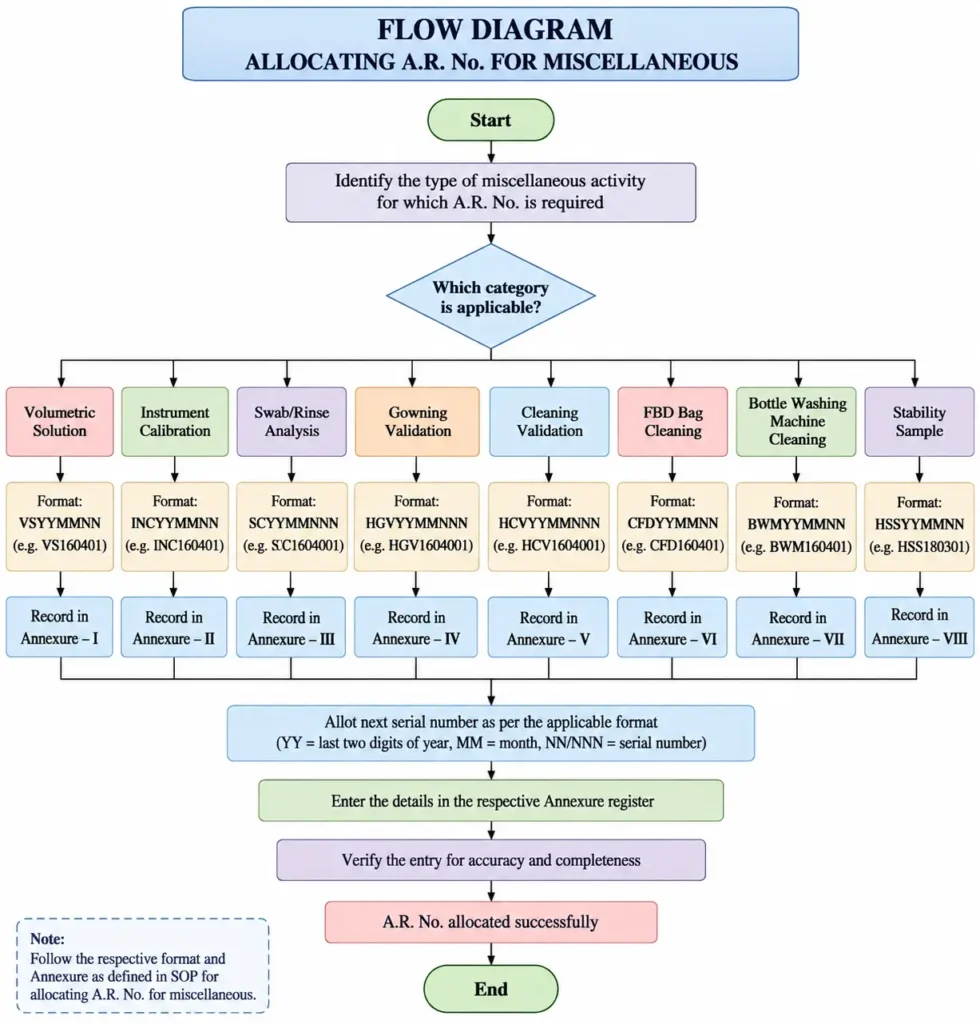
For each category, the relevant identification prefix, year, month, and sequential serial number are used according to the SOP-defined format. The assigned A.R. number is then recorded in the corresponding Annexure I to Annexure VIII register, depending on the activity type. After allocation, all required details are entered in the applicable register and verified for accuracy, completeness, and traceability. The process concludes once the A.R. number has been successfully allotted and documented, ensuring controlled identification and reliable record management.
2. Brainstorming Diagram for SOP Failure:
The brainstorming diagram highlights the potential causes of SOP failure in a pharmaceutical manufacturing area using a structured cause-identification approach. The central issue, “SOP Failure in Manufacturing Area,” is surrounded by major contributing categories such as Man, Machine, Method, Material, Manpower & Behavior, Documentation, Measurement, Environment, Management, and Other Factors.
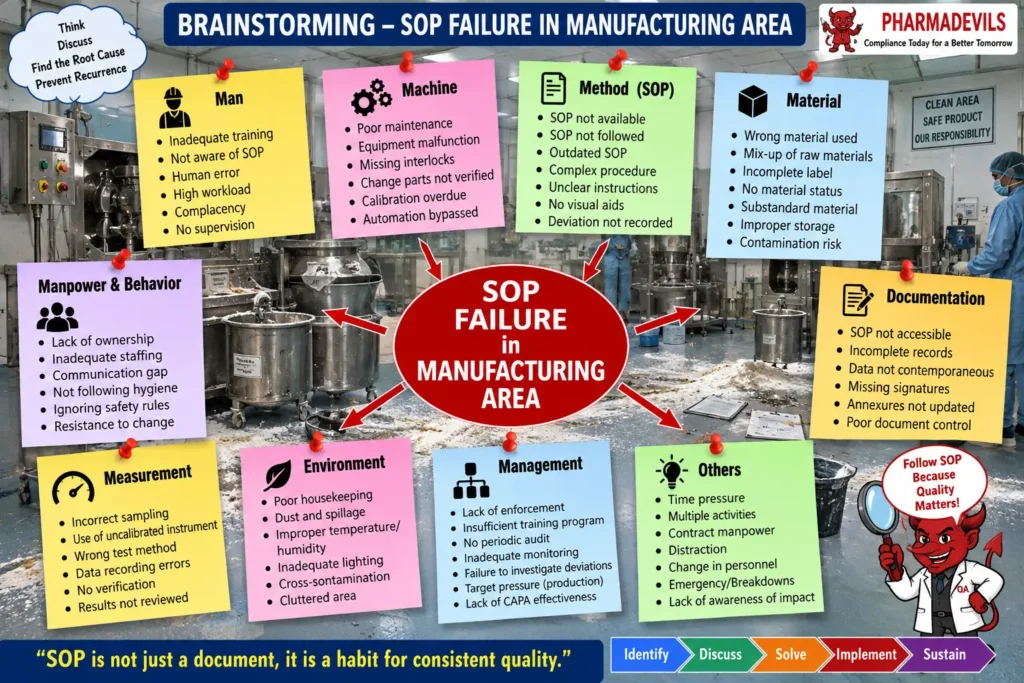
Possible causes include inadequate training, lack of SOP awareness, human error, equipment malfunction, overdue calibration, outdated or unclear SOPs, use of incorrect materials, poor documentation, incomplete records, improper sampling, weak supervision, poor housekeeping, cross-contamination risks, inadequate monitoring, production pressure, staffing shortages, communication gaps, and insufficient CAPA effectiveness. The diagram encourages cross-functional teams from Production, QA, QC, Engineering, and other departments to identify, discuss, evaluate, and prioritize potential causes. This brainstorming exercise supports effective root-cause investigation, appropriate CAPA development, improved SOP compliance, and prevention of recurrence, thereby strengthening GMP compliance and maintaining consistent product quality.
3. 5-Why Analysis for SOP Failure:
The 5-Why Analysis diagram systematically investigates the root cause of SOP failure in the pharmaceutical manufacturing area. The identified problem is that the approved SOP was not followed during manufacturing activities. The first “Why” indicates that operators were not fully aware of the SOP requirements. Further investigation identifies inadequate training and communication, followed by the absence of a structured training, refresher, and competency-assessment program.
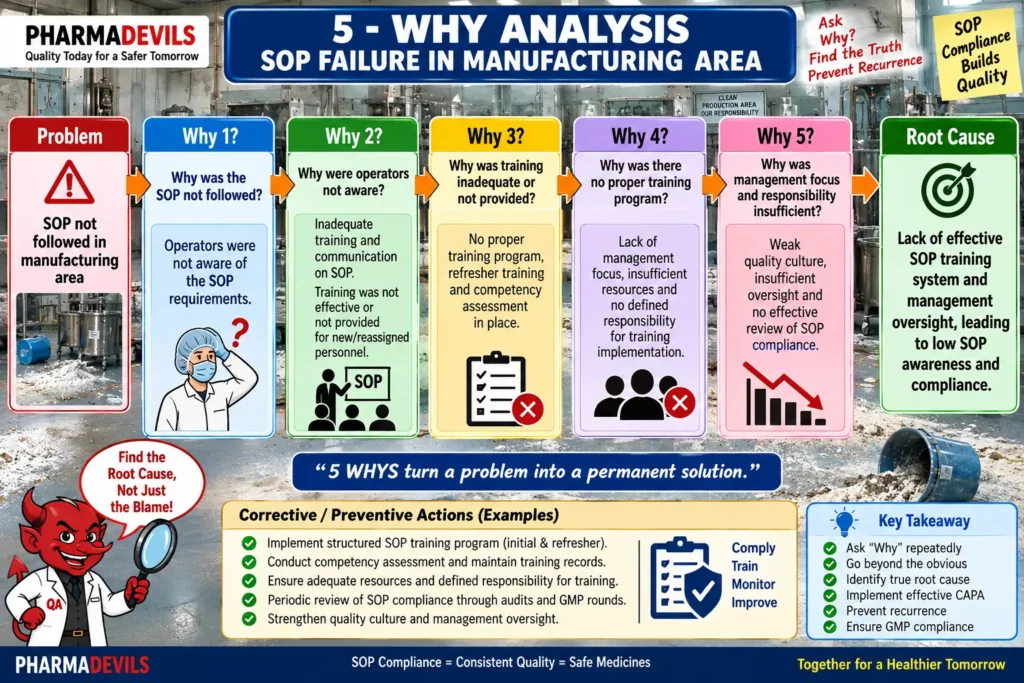
The analysis then highlights insufficient management focus, inadequate resources, and unclear responsibility for effective training implementation. The fifth “Why” identifies weaknesses in quality culture, management oversight, and periodic review of SOP compliance. The resulting root cause is an ineffective SOP training and monitoring system leading to poor awareness and inconsistent compliance. Appropriate CAPA should include structured initial and refresher training, competency assessment, periodic GMP audits, defined responsibilities, monitoring of SOP adherence, and strengthened management oversight to prevent recurrence.
4. Fishbone Analysis for SOP Failure:
The Fishbone Analysis diagram systematically identifies the potential causes of SOP failure in a pharmaceutical manufacturing area. The main problem is evaluated through major cause categories including Man/Personnel, Machine/Equipment, Method/SOP, Material, Measurement, Environment, Documentation, and Management.
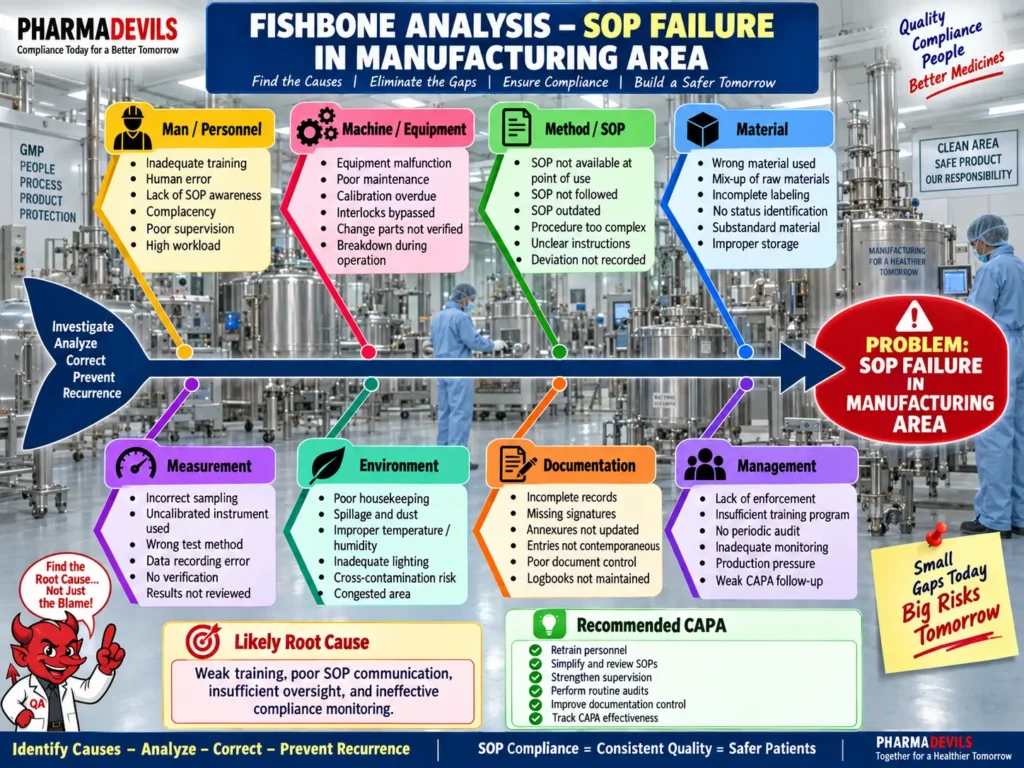
Personnel-related causes include inadequate training, human error, lack of SOP awareness, excessive workload, and poor supervision. Equipment factors include malfunction, inadequate maintenance, overdue calibration, bypassed interlocks, and unverified change parts. Method-related causes involve unavailable, outdated, unclear, or overly complex SOPs. Other contributors include material mix-ups, improper labeling or storage, incorrect sampling, poor housekeeping, cross-contamination risks, incomplete documentation, production pressure, inadequate audits, and weak CAPA follow-up.The analysis indicates that weak training, poor SOP communication, insufficient supervision, and ineffective compliance monitoring are likely major contributors. Recommended CAPA includes retraining personnel, SOP review, stronger supervision, routine audits, improved documentation control, and periodic CAPA effectiveness verification.
5. Fault Tree Analysis for SOP Failure:
The Fault Tree Analysis diagram evaluates the possible causes leading to the top event: SOP Failure in the Manufacturing Area. The analysis shows that SOP failure may occur due to one or more contributing factors related to personnel, SOP availability and adequacy, implementation effectiveness, equipment, materials, environment, documentation, and management control.
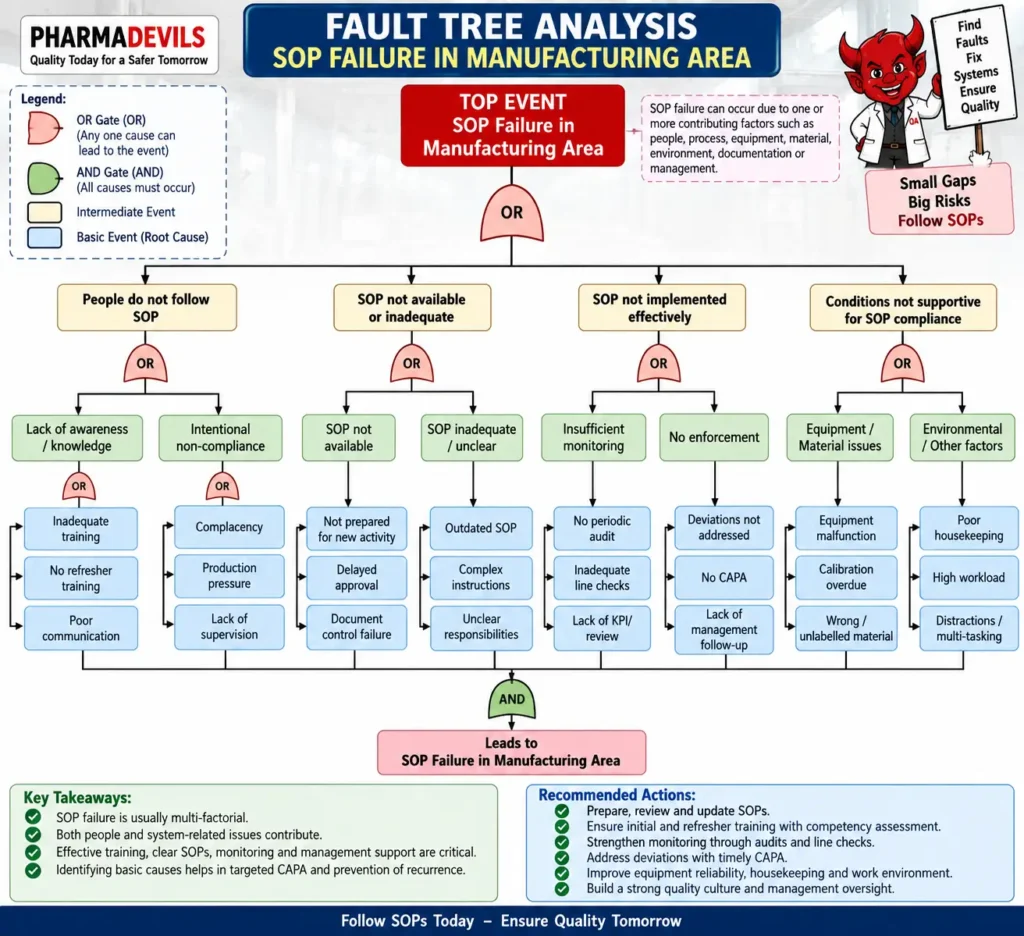
Major contributing events include employees not following the SOP, inadequate training or refresher training, poor communication, intentional non-compliance, outdated or unclear SOPs, insufficient monitoring, lack of enforcement, deviations not being addressed, ineffective CAPA, equipment malfunction, overdue calibration, incorrect material identification, poor housekeeping, excessive workload, and distractions. The fault tree helps break the main failure into intermediate and basic causes using logical relationships. This structured approach supports identification of root causes and development of targeted CAPA such as SOP review, competency-based training, periodic audits, stronger supervision, timely deviation handling, equipment control, and improved management oversight to prevent recurrence.
Questions & Answers – SOP for Allocating A.R. No. for Miscellaneous
Q1. What is the objective of this SOP?
Answer: The objective is to establish a defined procedure for allocating A.R. Numbers for miscellaneous activities.
Q2. What is the scope of this SOP?
Answer: The SOP is applicable to all concerned departments involved in allocating A.R. Numbers for miscellaneous activities.
Q3. Who is responsible for execution of this SOP?
Answer: The concerned person is responsible for execution of the SOP.
Q4. Who is responsible for effective implementation of the SOP?
Answer: The Department Head is responsible for effective implementation.
Q5. What does A.R. No. mean?
Answer: A.R. No. means Analytical Report Number.
Q6. How is the A.R. No. allotted for a volumetric solution?
Answer: The SOP gives the example VS160401, where VS represents volumetric solution, 16 represents the year, 04 represents April, and 01 is the serial number.
Q7. What prefix is used for instrument calibration?
Answer: The SOP uses INC for instrument calibration, for example INC160401.
Q8. What prefix is used for swab/rinse analysis?
Answer: The SOP uses SC for swab cleaning/rinse analysis, with an example format SC1604001.
Q9. Which Annexure is used for cleaning validation A.R. Numbers?
Answer: Cleaning validation A.R. Numbers are recorded in Annexure-V.
Q10. Which Annexure is used for FBD bag cleaning?
Answer: Annexure-VI is used for recording A.R. Numbers related to FBD bag cleaning.
Q11. Which Annexure is used for bottle washing machine cleaning?
Answer: A.R. Numbers for bottle washing machine cleaning are recorded in Annexure-VII.
Q12. Which Annexure is used for stability samples?
Answer: Stability sample A.R. Numbers are recorded in Annexure-VIII.
Q13. What are the eight A.R. No. registers included in the SOP?
Answer: The SOP includes registers for volumetric solutions, instrument calibration, swab/rinse analysis, gowning validation, cleaning validation, FBD bag cleaning, bottle washing machine cleaning, and stability samples.
Q14. Who provides training on this SOP?
Answer: The SOP specifies the Assistant Manager – QA as trainer, with concerned personnel as trainees.
Q15. What is the reference mentioned in the SOP?
Answer: The reference is stated as “In House.”
Reference Guidelines:
- WHO Good Manufacturing Practices for Pharmaceutical Products – Main Principles: supports controlled documentation, defined responsibilities, quality control activities, and maintenance of reliable GMP records. (World Health Organization)
- WHO Quality Assurance of Pharmaceuticals, Volume 2 – Good Manufacturing Practices and Inspection, 10th Edition (2024): provides comprehensive GMP expectations for manufacturing, quality control, documentation, validation, and record management. (World Health Organization)
- ICH Q10 – Pharmaceutical Quality System: supports an effective pharmaceutical quality system, documented processes, management responsibility, monitoring, continual improvement, and lifecycle control. (ICH Database)
- EU GMP, EudraLex Volume 4 – Chapter 4: Documentation: may be used as a reference for controlled records, traceability, contemporaneous entries, document approval, and retention requirements.
- 21 CFR Part 211 – Subpart I, Laboratory Controls and Records, particularly 21 CFR 211.160 and 211.194, may be considered for laboratory control systems and complete laboratory records.