







Brief Description
This Design Qualification Protocol cum Report is prepared for the Rapid Mixer Granulator (RMG). Its purpose is to confirm that the equipment design meets the User Requirement Specification, purchase order, cGMP, process, and safety requirements before use. The RMG is used for dry mixing and wet granulation in the same bowl under dust-free conditions. It consists of a main impeller, chopper, pneumatic lid, discharge system, PLC-based controls, and safety interlocks. Product-contact parts are mainly made of stainless steel 316/316L to support easy cleaning and prevent contamination. The protocol checks equipment capacity, dimensions, motor details, electrical supply, compressed air, materials of construction, drawings, and vendor suitability. Safety features ensure that the machine does not operate during unsafe conditions such as low air pressure, an open lid, open discharge port, motor trip, or emergency stop. Overall, the protocol confirms that the RMG design is suitable for its intended pharmaceutical manufacturing use.
Skip to PDF content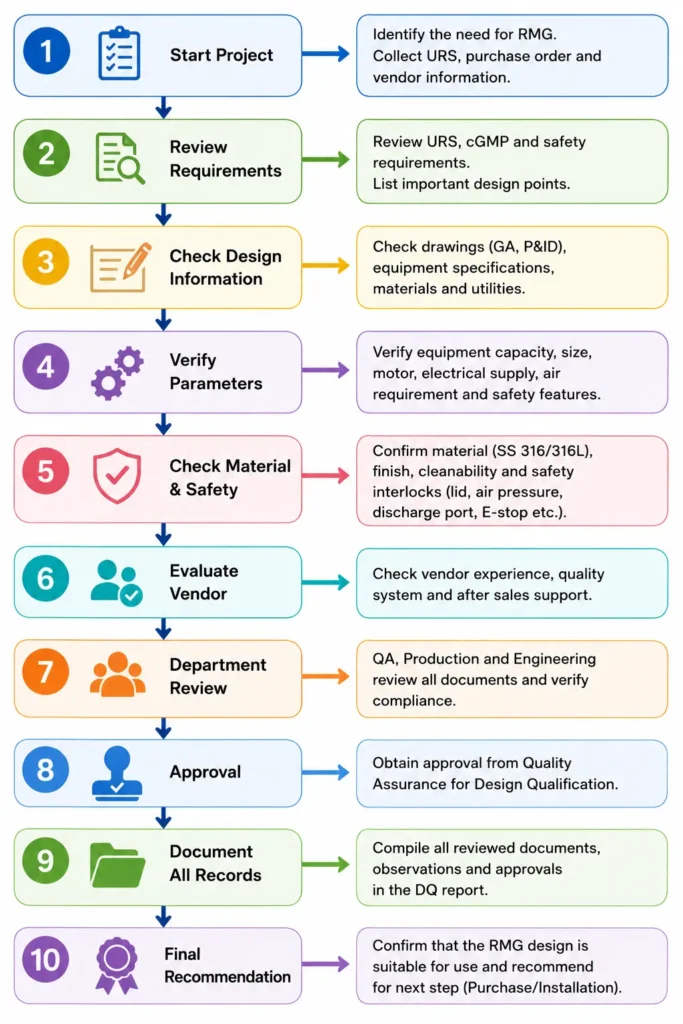
1. Brainstorming Analysis:
Design Qualification (DQ) for the Rapid Mixer Granulator (RMG) is intended to verify and document that the proposed equipment design meets the User Requirement Specification (URS), purchase order, supplier information, process/product requirements, cGMP expectations, and safety requirements before progressing with qualification activities.
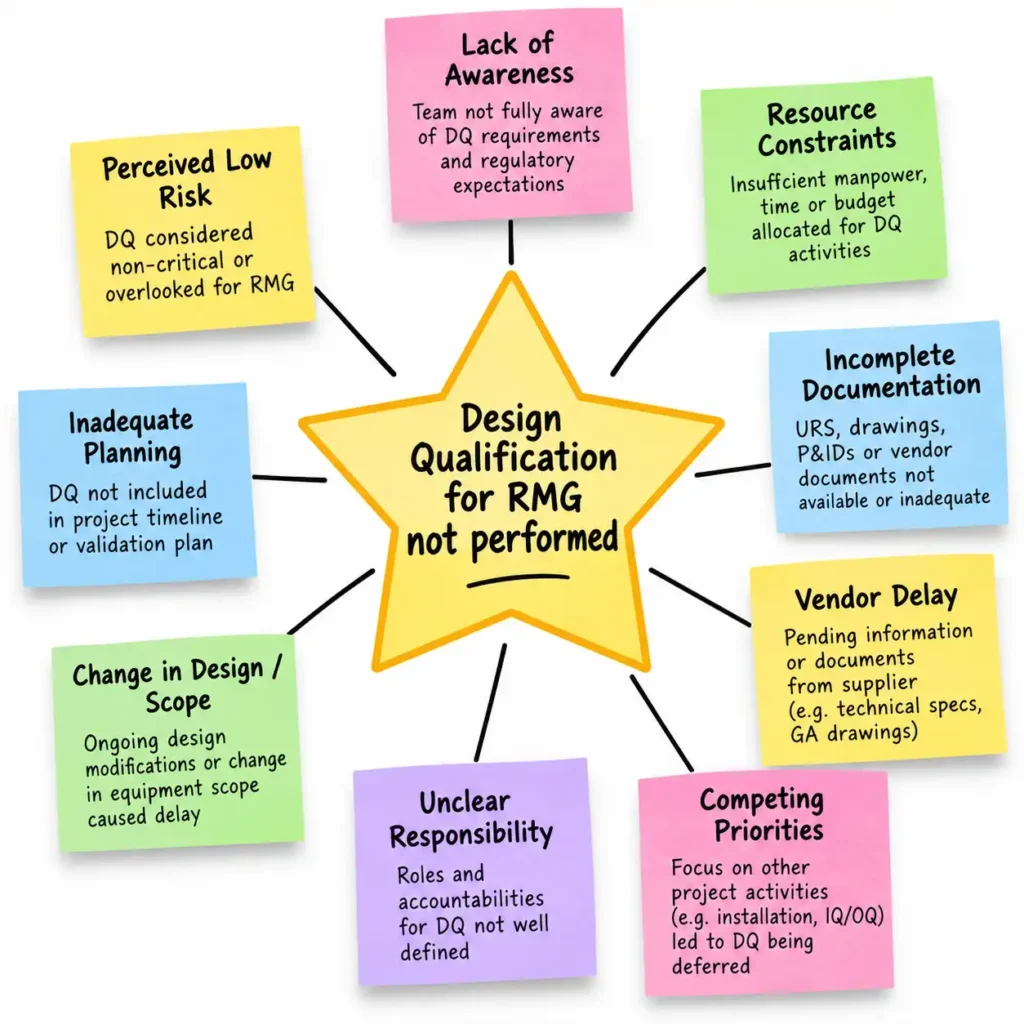
When DQ is not performed, there is no documented assurance that the RMG design is suitable for its intended dry mixing and wet-granulation application. Important design elements such as equipment specifications, utilities, GA drawings/P&IDs, technical features, material of construction, safety interlocks, and vendor requirements may remain unverified. This creates a GMP and project risk because design deficiencies may only be detected during IQ, OQ, commissioning, or routine operation, potentially leading to modifications, qualification delays, deviations, and additional change controls. The DQ should therefore be completed retrospectively with documented gap assessment, risk evaluation, corrective actions, and QA approval before further qualification is finalized.
2. 5 Why Analysis:
The 5 Why Analysis was performed to identify the underlying cause for Design Qualification (DQ) of the Rapid Mixer Granulator (RMG) not being performed. The analysis indicates that the DQ activity was not initiated before procurement or installation because project attention was shifted toward installation and execution activities. Responsibilities among Quality Assurance, Engineering, and Production were not clearly assigned, and the validation plan/project timeline did not establish DQ as a mandatory milestone.
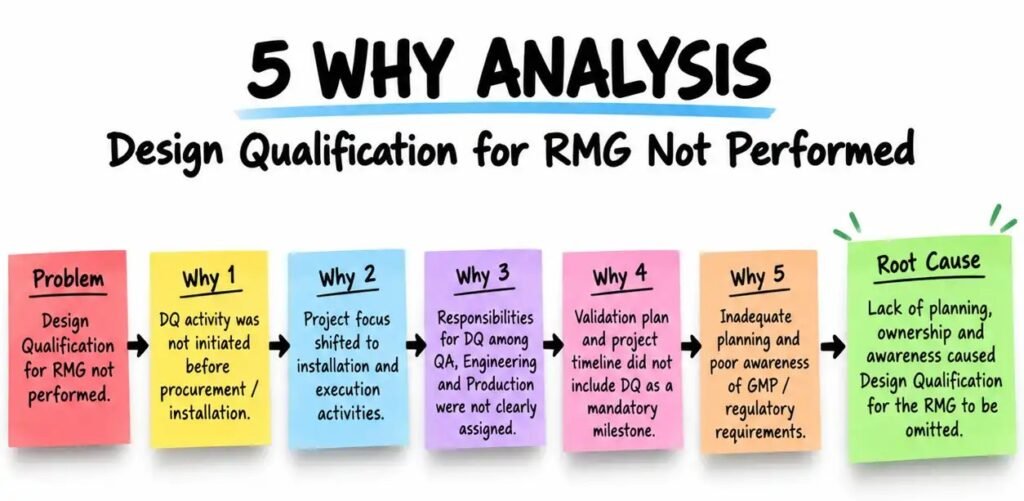
The investigation further identified inadequate planning and insufficient awareness of GMP and qualification requirements as contributing factors. The likely root cause is therefore lack of systematic planning, clear ownership, and awareness of DQ requirements, resulting in omission of the RMG Design Qualification activity. This is significant because DQ is intended to ensure that critical process/product, cGMP, safety, specification, drawing, and design requirements are properly considered and documented before qualification progresses.
Impact Assessment
Implementation of this Design Qualification will have a positive impact on the Rapid Mixer Granulator and its future use in production. It ensures that the equipment design meets the URS, cGMP, process, utility, and safety requirements before installation and operation. The review of capacity, dimensions, motors, electrical supply, compressed air, drawings, and equipment parameters helps confirm that the RMG is suitable for its intended purpose. Safety checks such as low air pressure, open lid, open discharge port, motor trip, and emergency stop reduce the risk of unsafe operation. Verification of stainless-steel product-contact parts supports cleaning and helps prevent contamination. Vendor evaluation and review by Quality Assurance, Production, and Engineering improve confidence in the equipment design. Proper documentation of drawings, specifications, observations, approvals, and any design changes improves traceability. Overall, Design Qualification helps prevent design-related problems, supports safe operation, and provides a strong base for the next qualification stages during manufacturing.
Critical Process Parameters & Critical Quality Attributes
Critical Process Parameters (CPP)
| CPP | Why it is Important |
|---|---|
| Main Impeller Speed | Controls proper mixing and movement of material inside the RMG bowl. |
| Chopper Speed | Helps break lumps and controls granule formation. |
| Dry Mixing Time | Ensures proper mixing of powders before binder addition. |
| Binder Addition | Helps convert the powder blend into a wet mass. |
| Wet Granulation Time | Controls the formation and consistency of granules. |
| Mixing/Granulation End Point | Monitored through process time and motor ampere reading. |
| Compressed Air Pressure | Required for proper pneumatic operation of lid and discharge system. |
| Impeller & Chopper Operation | Slow/fast operation is selected according to process requirements. |
The protocol specifically describes slow/fast operation of the main impeller and chopper, timer-controlled processing, binder addition during wet granulation, and monitoring through ampere readings.
Critical Quality Attributes (CQA)
The uploaded DQ protocol does not specifically define product CQAs. However, based on the RMG mixing and granulation process, the following quality attributes are normally affected by the above parameters:
| CQA | Expected Requirement |
| Blend Uniformity | Powder should be uniformly mixed. |
| Granule Size | Granules should have suitable and consistent size. |
| Granule Uniformity | Granules should be evenly formed. |
| Moisture Distribution | Binder/moisture should be uniformly distributed. |
| Granule Flow | Granules should have suitable flow for further processing. |
| Granule Density | Granules should have consistent bulk properties. |
| Absence of Large Lumps | Excessive lumps should not be present. |
These CQAs are process-based inferences and are not directly listed as acceptance criteria in the DQ document.
FMEA – Design Qualification of Rapid Mixer Granulator
Rating Scale: Severity (S), Occurrence (O) and Detection (D) = 1 to 5
RPN = S × O × D
The S/O/D values below are suggested risk ratings for assessment; the uploaded DQ protocol does not provide FMEA scores.
| S.No. | Failure Mode | Possible Effect | Possible Cause | Existing Control / Requirement | S | O | D | RPN | Risk |
|---|---|---|---|---|---|---|---|---|---|
| 1 | Incorrect RMG capacity/design | Equipment may not meet production requirement | Wrong design selection | Capacity and dimensions are verified against design requirements. | 4 | 2 | 2 | 16 | Medium |
| 2 | Incorrect impeller/chopper operation | Poor mixing or granulation | Motor or control problem | Main impeller and chopper specifications are verified. | 4 | 2 | 2 | 16 | Medium |
| 3 | Improper impeller clearance | Poor mixing, equipment damage or product retention | Incorrect assembly/design | Main impeller clearances are specified as 1–2 mm from bottom and 5–7 mm from side. | 4 | 2 | 2 | 16 | Medium |
| 4 | Wrong product-contact material | Contamination or difficulty in cleaning | Incorrect material selection | Bowl, lid, chopper and discharge parts are specified in SS/AISI 316. | 5 | 2 | 2 | 20 | Medium |
| 5 | Low compressed air pressure | Pneumatic functions may not work properly | Utility failure | Required air pressure and quality are defined; machine should not start at low air pressure. | 4 | 2 | 1 | 8 | Low |
| 6 | Machine starts with top lid open | Operator injury or product exposure | Safety interlock failure | Machine should not start when the top lid is open. | 5 | 1 | 1 | 5 | Low |
| 7 | Machine starts with discharge port open | Product loss or unsafe operation | Interlock failure | Machine should not start when discharge port is open. | 4 | 1 | 1 | 4 | Low |
| 8 | Main or chopper motor trips | Mixing/granulation stops and batch may be affected | Electrical or mechanical failure | Machine is designed not to run when main or chopper motor trips. | 4 | 2 | 1 | 8 | Low |
| 9 | Emergency stop does not function | Serious operator safety risk | Electrical/interlock failure | Emergency push button is required to stop machine operation. | 5 | 1 | 2 | 10 | Medium |
| 10 | Incorrect electrical supply | Equipment malfunction or motor damage | Wrong voltage/frequency | Electrical requirement is defined as 3-phase, 415 V and 50 Hz ±5%. | 4 | 2 | 2 | 16 | Medium |
| 11 | Unapproved design modification | Equipment may not meet URS/cGMP requirements | Change made without control | Any design change is required to follow documented change control. | 5 | 2 | 2 | 20 | Medium |
| 12 | Unsuitable vendor selected | Poor equipment quality or inadequate support | Incomplete vendor evaluation | Vendor review includes technical capability, quality standards, site inspection and customer feedback. | 4 | 2 | 2 | 16 | Medium |
Recommended Risk Control
Verify all equipment specifications against the approved URS and drawings before acceptance. Confirm material of construction, utilities, motor details, impeller clearances and safety interlocks during qualification. Test emergency stop, lid interlock, discharge interlock and low-air-pressure protection before operation. Any design change should be handled through approved change control. Vendor documents, drawings, manuals and specifications should be reviewed and approved by QA, Production and Engineering before final recommendation.
Questions & Answers
Q1. What is the purpose of Design Qualification for the Rapid Mixer Granulator?
Answer: The purpose is to confirm that the RMG design meets the URS, purchase order, cGMP, process, and safety requirements before use.
Q2. What is the main use of the Rapid Mixer Granulator?
Answer: The RMG is used for dry mixing of powders and wet granulation in the same bowl.
Q3. What is the gross capacity of the RMG?
Answer: The gross capacity of the RMG is 600 litres and its working capacity is 480 litres.
Q4. What is the working batch capacity of the RMG?
Answer: The working capacity mentioned in the protocol is 240 kg including binder and total wet mass.
Q5. What electrical supply is required for the RMG?
Answer: The machine requires a 3-phase, 415 V electrical supply with 50 Hz ±5% frequency.
Q6. What compressed air requirement is specified?
Answer: Compressed air should be oil-free, water-free, dust-free, with a flow pressure of 6 kg/cm².
Q7. Which materials are used for product-contact parts?
Answer: The bowl, top lid, chopper housing, chopper blade, filter, and discharge piston are mainly made of AISI/SS 316.
Q8. What happens if the top lid is open?
Answer: The machine should not start when the top lid is open. This is an important safety interlock.
Q9. What happens when the emergency push button is pressed?
Answer: The machine should stop and should not run when the emergency push button is pressed.
Q10. Who is responsible for Design Qualification activities?
Answer: Quality Assurance, Production, and Engineering are responsible for reviewing, verifying, supporting, and approving the Design Qualification activities.
Q11. How is wet granulation performed in the RMG?
Answer: Binder is added to the material while the main impeller and chopper operate at slow or fast speed. The process is controlled by time and monitored through ampere readings.
Q12. What should be done if any design change is required?
Answer: Any change from the agreed design should be handled through the approved change control procedure and properly documented.
Q13. Why is vendor evaluation required?
Answer: Vendor evaluation helps confirm the supplier’s technical capability, quality standards, experience, site condition, cost, and customer feedback before equipment acceptance.
Q14. Which documents should be attached with the DQ report?
Answer: Equipment technical details, engineering drawings, approved design specifications, and other relevant documents should be attached.
Q15. What is the final outcome of Design Qualification?
Answer: The final outcome is to confirm that the RMG design is suitable and meets the agreed requirements before moving to the next qualification stage.