







Brief Description
This Operational Qualification (OQ) Protocol cum Report is prepared for the Rapid Mixer Granulator (RMG), manufactured by Elicon Pharma with a capacity of 600 liters. The purpose of this document is to confirm that the machine works correctly, safely, and consistently as per design, user requirements, manufacturer specifications, and cGMP requirements. The protocol checks important documents, calibration status of instruments, machine functions, PLC operation, manual and automatic modes, impeller and chopper operation, discharge system, vibration, noise, and safety interlocks. It also verifies conditions such as low air pressure, open top lid, open discharge port, motor trips, emergency stop, and FBD trolley absence. Power failure and restart behavior are also checked. Quality Assurance, Production, and Engineering departments are responsible for reviewing and executing the qualification. Successful completion of all tests confirms that the RMG meets acceptance criteria and is ready for Performance Qualification before it is used for routine production activities.
Skip to PDF content1. Brainstorming Analysis:
The brainstorming analysis identifies possible reasons why the Operational Qualification (OQ) of the Rapid Mixer Granulator was not performed. Key causes include the absence of an approved OQ protocol, incomplete DQ/IQ documentation, unavailable trained personnel or vendor support, uncalibrated instruments, poor coordination between QA, Production and Engineering, inadequate change-control assessment, and unclear management responsibility.
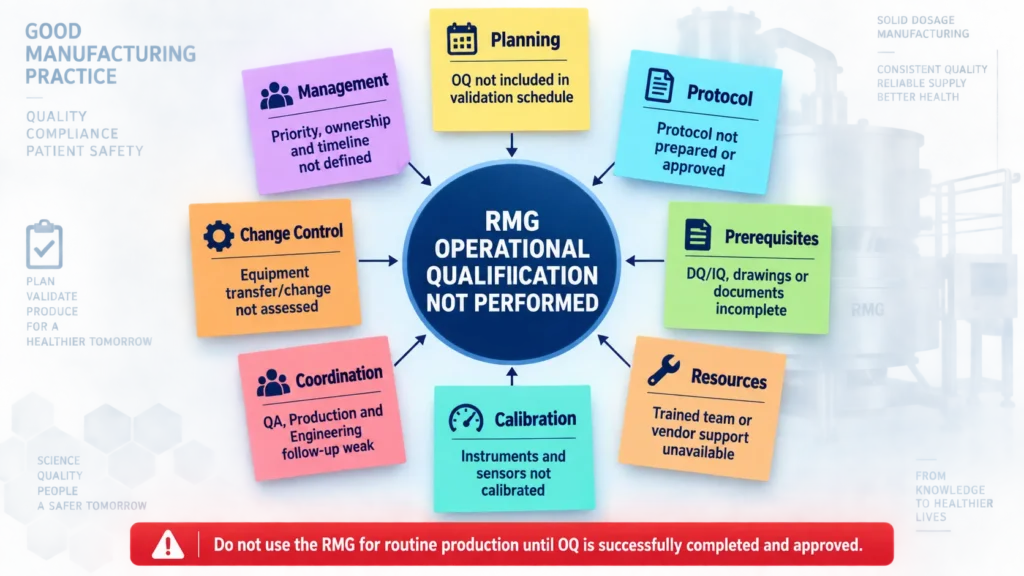
The analysis helps the validation team systematically evaluate these potential causes, determine the actual root cause, and establish appropriate CAPA. The RMG should not be released for routine production until its OQ is successfully executed, deviations are resolved, results meet predefined acceptance criteria, and the final report is approved by Quality Assurance.
2. 5 Why Analysis:
The Operational Qualification (OQ) of the Rapid Mixer Granulator (RMG) was not performed before its intended use. Consequently, critical functions such as impeller and chopper speeds, timers, control-panel operation, alarms, interlocks, emergency stop, lid locking, discharge mechanism and safety systems were not verified against approved acceptance criteria.
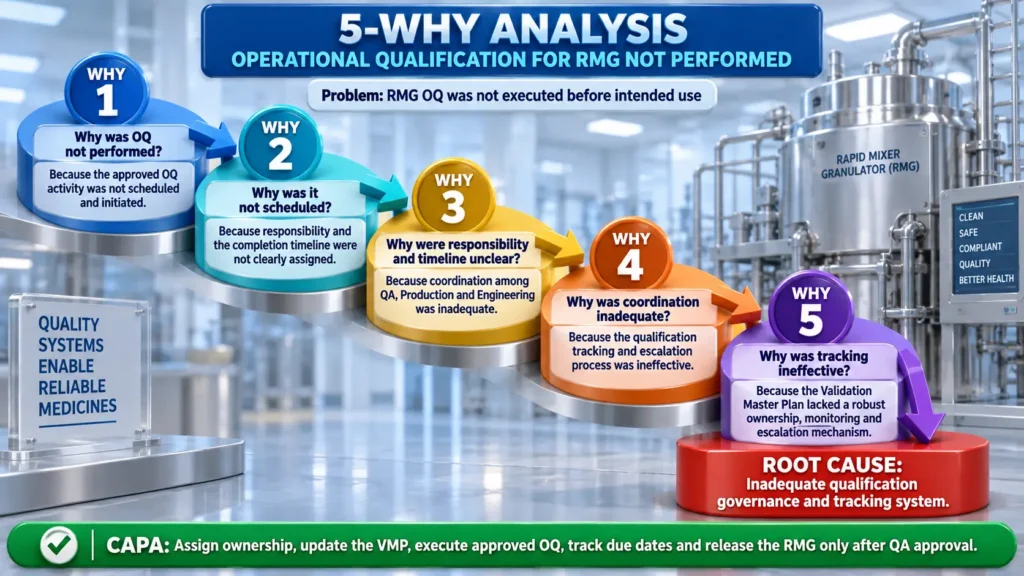
The investigation identified inadequate qualification planning, unclear responsibility, poor coordination among QA, Production and Engineering, and ineffective monitoring of the Validation Master Plan as potential causes. Until OQ is successfully completed, the consistent and safe operation of the RMG cannot be assured. The equipment should therefore remain under hold and must not be used for routine production. An approved OQ protocol should be executed, deviations resolved, results reviewed, and the final report approved by Quality Assurance before release for Performance Qualification or manufacturing use.
3. Heat Map Analysis:
The heat map evaluates risks arising from failure to perform Operational Qualification of the Rapid Mixer Granulator. Risks are ranked according to their severity and likelihood. Unverified safety interlocks, emergency-stop functions, impeller and chopper speeds, timers, alarms, sensors, control-panel operation and mixing performance fall within the high-to-critical risk zones.
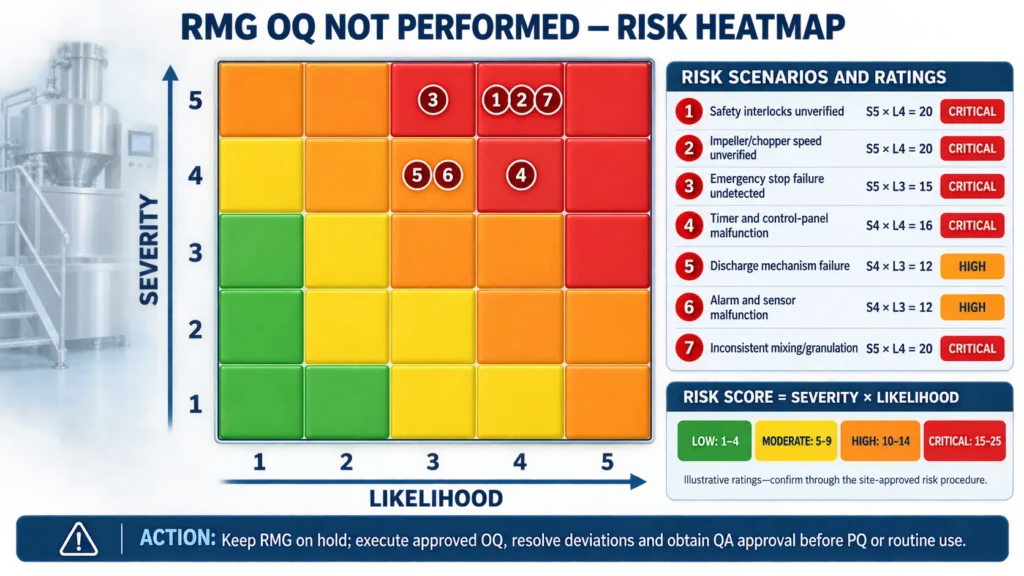
Without documented OQ, the safe, consistent and reproducible operation of the RMG cannot be assured, potentially affecting granule quality, operator safety and regulatory compliance. The RMG should remain on hold until the approved OQ protocol is executed, deviations are resolved and the final report is approved by Quality Assurance. Risk ratings should be confirmed using the site-approved risk-management procedure.
4. Impact Assessment:
This Operational Qualification of the Rapid Mixer Granulator will have a positive impact on product quality, equipment safety, and routine production. It confirms that the machine works correctly as per design, user requirements, and cGMP expectations. Important functions such as PLC operation, impeller and chopper movement, discharge system, alarms, safety interlocks, emergency stop, and power failure response are checked during qualification. Calibration status of critical instruments is also verified before testing. These checks help to reduce the risk of equipment failure, unsafe operation, process interruption, and poor granulation. Proper functioning of the machine supports uniform mixing and wet granulation and helps maintain consistent product quality. The qualification also improves coordination between Quality Assurance, Production, and Engineering departments. Any deviation found during testing can be recorded and corrected before routine use. Overall, successful OQ provides documented evidence that the RMG is safe, reliable, and ready for Performance Qualification and routine use.
Critical Process Parameters (CPP) & Critical Quality Attributes (CQA)
Based on the Rapid Mixer Granulator OQ protocol, the following parameters are important during granulation. The protocol directly describes impeller/chopper operation, timer-controlled mixing, binder addition, ampere monitoring, discharge, and safety functions.
| Critical Process Parameters (CPP) | Purpose / Impact |
|---|---|
| Main impeller speed | Controls mixing and distribution of material |
| Chopper speed | Helps break lumps and form uniform granules |
| Dry mixing time | Ensures uniform mixing before binder addition |
| Binder addition quantity/rate | Controls wetting and granule formation |
| Wet mixing/granulation time | Affects granule size and consistency |
| Motor ampere/load | Helps identify granulation end point |
| Discharge operation | Ensures complete and safe material transfer |
| Air pressure | Required for proper pneumatic operation |
| Mixing sequence | Maintains consistent granulation process |
The OQ specifies main impeller speed of 115 RPM and chopper speed of 2880 RPM for the described manual-mode check.
Critical Quality Attributes (CQA)
The uploaded OQ protocol does not define product-specific CQAs or their acceptance limits. For an RMG granulation process, the following are commonly monitored as CQAs and should be finalized from the product development/PV documents:
| Critical Quality Attributes (CQA) | Importance |
|---|---|
| Granule size distribution | Ensures uniform granules |
| Moisture content / LOD | Prevents over-wet or under-dry granules |
| Granule flow | Supports smooth compression or filling |
| Bulk density | Affects material handling and compression |
| Blend/granule uniformity | Supports uniform drug content |
| Appearance of granules | Detects lumps or abnormal granulation |
| Assay / content uniformity | Ensures correct drug strength |
| Final product dissolution | Confirms proper drug release |
The protocol mainly verifies that the RMG operates correctly and consistently before Performance Qualification.
FMEA – Rapid Mixer Granulator (RMG)
The OQ protocol checks calibration, PLC operation, vibration/noise, safety interlocks, emergency stop, motor trips, discharge operation, and power-failure behavior.
Suggested scoring: Severity (S), Occurrence (O), Detection (D) = 1 to 5.
RPN = S × O × D. These scores are suggested for risk assessment; the uploaded protocol does not provide its own FMEA scoring system.
| S.No. | Failure Mode | Possible Effect | Possible Cause | Existing Control | S | O | D | RPN | Recommended Action |
|---|---|---|---|---|---|---|---|---|---|
| 1 | Main air pressure low | Machine may not operate correctly | Low compressed-air supply | Air-pressure safety interlock | 4 | 2 | 2 | 16 | Check air pressure before operation |
| 2 | Top lid open during operation | Operator injury / material exposure | Lid not properly closed | Lid-open interlock | 5 | 2 | 1 | 10 | Verify interlock during OQ |
| 3 | Discharge port open during mixing | Material loss or unsafe operation | Valve/interlock failure | Discharge-port interlock | 4 | 2 | 2 | 16 | Check valve and interlock before batch |
| 4 | Impeller/chopper not running correctly | Poor mixing or granulation | Motor or PLC problem | Operational function checks | 4 | 2 | 2 | 16 | Check speed, motor and PLC operation |
| 5 | Excessive vibration or noise | Equipment damage and process disturbance | Loose parts or mechanical problem | Vibration/noise check | 3 | 2 | 2 | 12 | Inspect and maintain equipment |
| 6 | Main/chopper motor trips | Process stops during granulation | Overload or electrical fault | Motor-trip interlock | 4 | 2 | 2 | 16 | Check motor load and electrical system |
| 7 | FBD trolley not in position | Material may spill during discharge | Incorrect trolley placement | FBD trolley presence interlock | 4 | 2 | 2 | 16 | Verify trolley position before discharge |
| 8 | Emergency stop fails | Serious operator/equipment safety risk | Faulty emergency switch | Emergency-stop testing | 5 | 1 | 2 | 10 | Test emergency stop before qualification approval |
| 9 | Machine automatically restarts after power failure | Unexpected movement and safety risk | PLC restart logic failure | Power-failure verification | 5 | 1 | 2 | 10 | Ensure manual restart is required |
| 10 | Instrument calibration overdue | Incorrect readings and unreliable OQ results | Missed calibration | Calibration-status verification | 4 | 2 | 2 | 16 | Use only instruments within calibration validity |
| 11 | PLC/manual/auto mode malfunction | Incorrect machine operation | Software or electrical problem | Functional checks through PLC | 4 | 2 | 2 | 16 | Verify all modes and HMI functions |
| 12 | Emergency stop remains pressed but machine moves | Injury or equipment damage | Interlock/electrical failure | Movement check with E-stop pressed | 5 | 1 | 2 | 10 | Correct immediately before equipment release |
The protocol specifically requires the machine not to operate when the top lid is open, air pressure is low, discharge port is open, impeller is lifted, FBD trolley is absent, motors trip, or emergency stop is pressed.
It also requires the equipment to stop safely during power failure and not restart automatically after power is restored.
Questions & Answers – Operational Qualification of Rapid Mixer Granulator
Q1. What is the purpose of Operational Qualification of RMG?
Answer: The purpose is to verify that the Rapid Mixer Granulator operates correctly as per design, user requirements, acceptance criteria, manufacturer specifications, and cGMP requirements.
Q2. What is the capacity of the Rapid Mixer Granulator?
Answer: The RMG capacity mentioned in the protocol is 600 liters.
Q3. Who is responsible for RMG Operational Qualification?
Answer: Quality Assurance, Production, and Engineering departments are responsible for review, coordination, execution, monitoring, calibration, and approval of the OQ activity.
Q4. What documents are checked before starting OQ?
Answer: Approved DQ and IQ documents, P&ID, electrical drawings, equipment technical specifications, and calibration certificates are checked before OQ.
Q5. Why is calibration status checked during OQ?
Answer: Calibration is checked to ensure that all critical instruments used during testing are within their valid calibration period.
Q6. What is the main impeller speed mentioned in the protocol?
Answer: The main impeller speed is 115 RPM during the specified manual-mode operational check.
Q7. What is the chopper speed mentioned in the protocol?
Answer: The chopper impeller speed is 2880 RPM during the specified manual-mode check.
Q8. What safety interlocks are checked during OQ?
Answer: Interlocks for low air pressure, open top lid, open discharge port, lifted impeller, motor trips, emergency stop, and absence of FBD trolley are checked.
Q9. What should happen when the emergency stop button is pressed?
Answer: The equipment should stop, and no operating function should move while the emergency stop remains pressed.
Q10. What happens during a power failure test?
Answer: The equipment should stop in a safe condition. After power is restored, the machine should not restart automatically.
Q11. What is checked for vibration and noise?
Answer: The machine should operate without undue vibration or abnormal noise.
Q12. What is the final result of successful OQ?
Answer: Successful completion of OQ confirms that the RMG meets the defined acceptance criteria and is ready for Performance Qualification.
Reference Guidelines:
- Revised Schedule M, Drugs Rules, 1945 – India
Requires documented evidence that premises, utilities and equipment operate according to their design specifications through Operational Qualification. See section 5.3(c). - EU GMP Annex 15 – Qualification and Validation
Sections 3.9–3.12 cover OQ, including tests based on process knowledge, upper and lower operating limits and successful completion before moving to the next qualification stage. - WHO TRS No. 1019, Annex 3 – GMP: Guidelines on Validation
Provides lifecycle-based requirements for qualification of facilities, utilities and equipment, including documented IQ, OQ and PQ activities. - ICH Q9(R1) – Quality Risk Management
Supports science- and risk-based assessment using tools such as FMEA, risk ranking, risk matrices and heat maps. - PIC/S GMP Guide PE 009-17, Annex 15 – Qualification and Validation
Provides GMP expectations for qualification planning, protocols, acceptance criteria, deviations, documentation and formal equipment release. - US FDA – Process Validation: General Principles and Practices
Describes a lifecycle approach requiring qualified facilities and equipment before commercial manufacturing activities.