





1. Brief Description:
This Performance Qualification (PQ) Protocol is prepared to confirm that the Rapid Mixer Granulator (RMG) works properly, consistently, and gives repeatable results during routine operation. The RMG is used for dry mixing and wet granulation in the same bowl. Before starting PQ, Design Qualification, Installation Qualification, Operational Qualification, operation and cleaning SOP, and preventive maintenance SOP should be completed. During performance qualification, required documents are checked for availability and approval. The equipment is tested using both placebo formulation and actual drug product. Important checks include impeller and chopper load, dry mixing, wet mixing, granule formation, absence of dry powder lumps, uniform mixing, and proper product discharge. Samples are collected from different locations of the RMG and checked for uniformity. Drug product samples are also sent to Quality Control for blend uniformity analysis. Any deviation, non-compliance, or change observed during PQ must be documented and reviewed and approved before final conclusion.
Skip to PDF content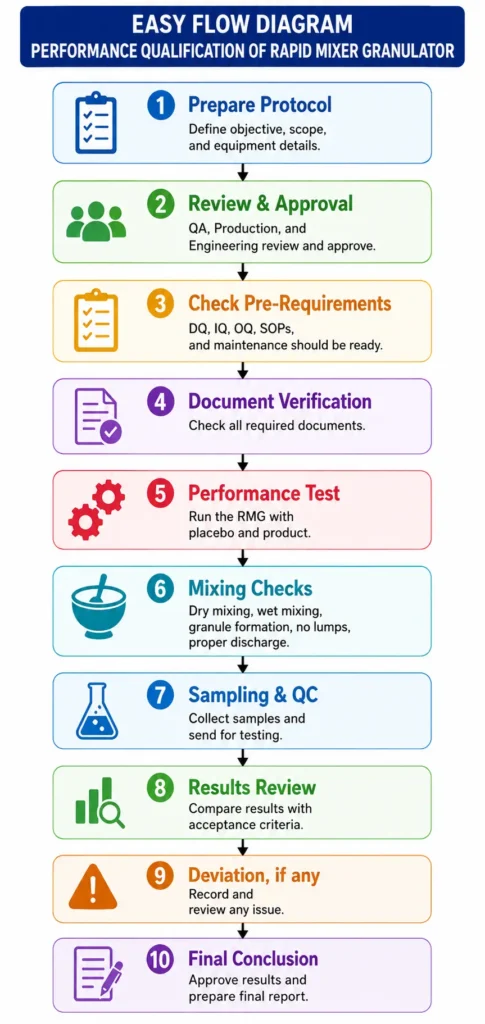
2. Brainstorming:
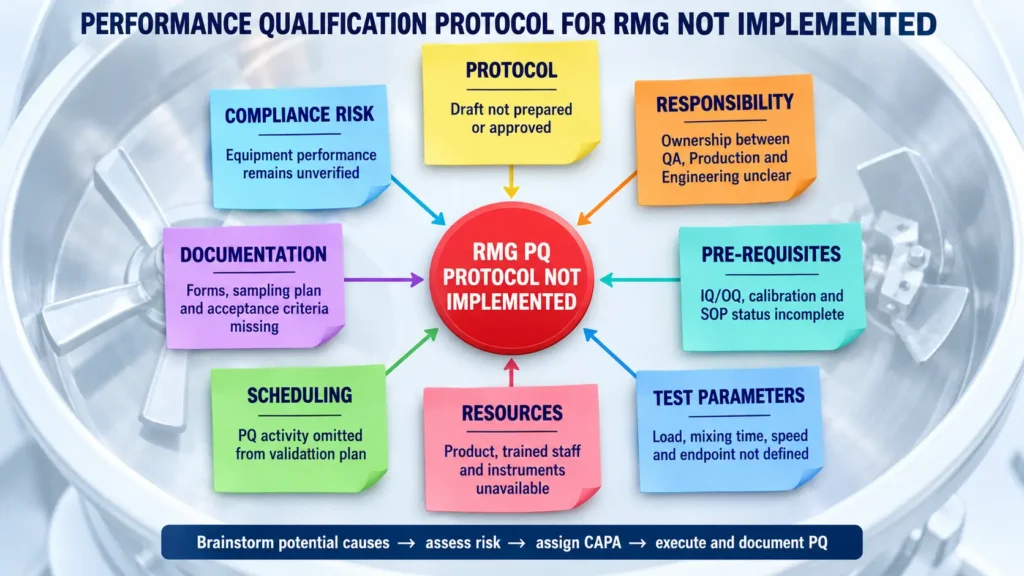
The brainstorming analysis identifies possible reasons why the Performance Qualification Protocol for the Rapid Mixer Granulator (RMG) was not implemented. Key causes include an unapproved protocol, unclear departmental responsibilities, incomplete IQ/OQ and calibration prerequisites, undefined test parameters and acceptance criteria, inadequate resources, poor scheduling, and missing documentation. This analysis supports risk evaluation, root-cause identification, CAPA assignment, and timely execution of the RMG Performance Qualification.
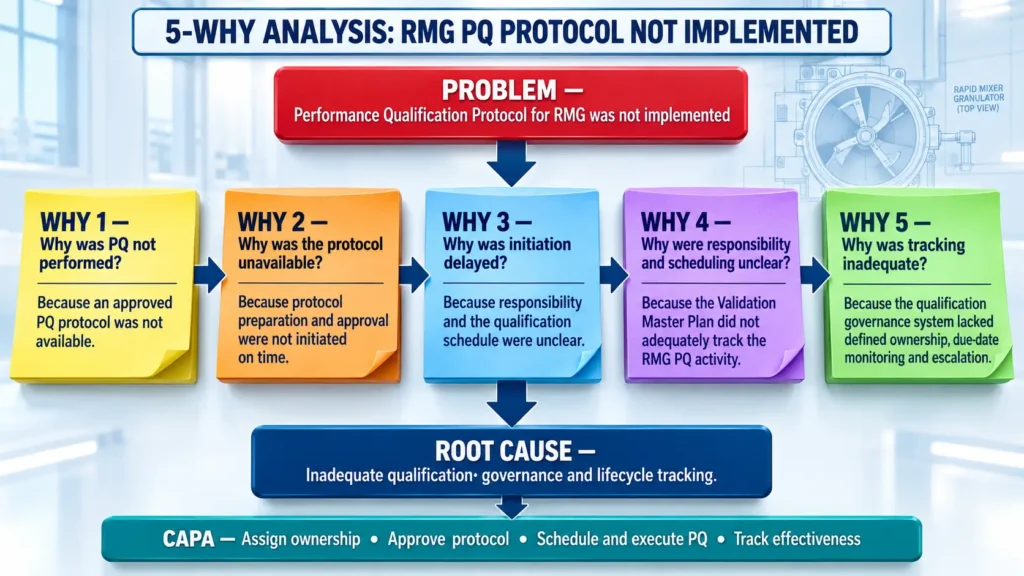
3. 5-Why Analysis:
The 5-Why analysis identifies the root cause for non-implementation of the RMG Performance Qualification Protocol. The immediate cause was the unavailability of an approved protocol due to delayed preparation and approval. Further analysis revealed unclear departmental responsibility, inadequate qualification scheduling, and ineffective tracking through the Validation Master Plan. The root cause was determined as inadequate qualification governance and lifecycle monitoring. CAPA should include assigning ownership, approving the protocol, scheduling and executing PQ, and monitoring effectiveness.
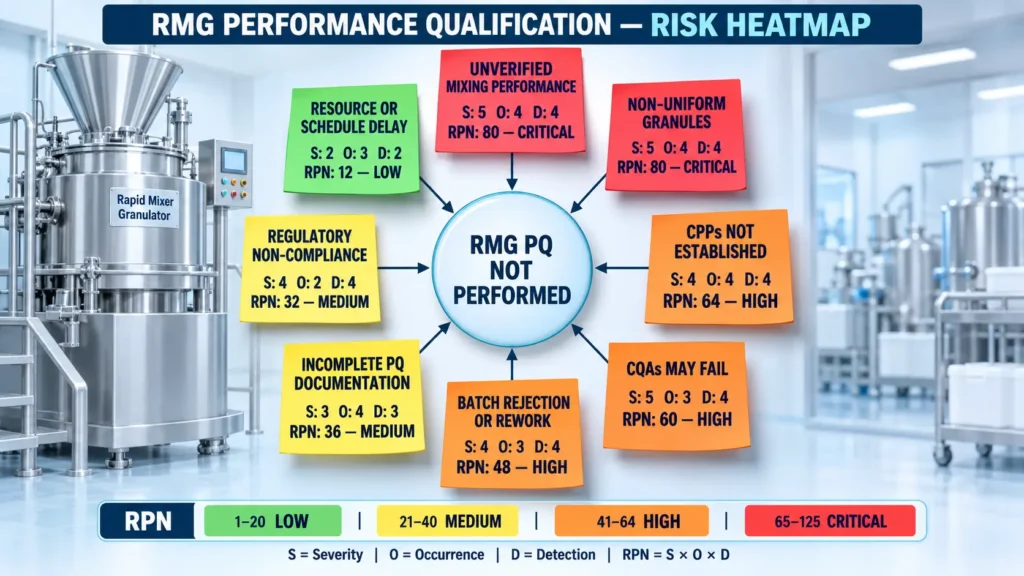
4. Heatmap Analysis:
The heatmap evaluates risks associated with non-performance of RMG Performance Qualification using Severity, Occurrence and Detection scores. Unverified mixing performance and non-uniform granules are classified as critical risks. Undefined CPPs, potential CQA failures, and batch rejection or rework are high risks. Incomplete PQ documentation and regulatory non-compliance are medium risks, while resource or scheduling delays are low risk. The assessment helps prioritize immediate CAPA and completion of RMG qualification activities.
5. Impact Assessment:
The Performance Qualification of the Rapid Mixer Granulator will have a positive impact on product quality, process consistency, and GMP compliance. This activity confirms that the RMG performs properly during dry mixing, wet mixing, granulation, and product discharge. It also checks that important parameters such as impeller load, chopper load, mixing uniformity, granule formation, and absence of dry powder lumps remain within acceptable limits. Samples are collected from different locations of the RMG to confirm uniform mixing, and drug product samples are tested for blend uniformity. Proper document verification before qualification helps ensure that DQ, IQ, OQ, SOPs, and maintenance requirements are complete and approved. Any deviation or non-compliance observed during the study is recorded and reviewed by Quality Assurance. Overall, this PQ helps reduce the risk of poor mixing, uneven product quality, process failure, and batch rejection, while supporting reliable and repeatable manufacturing performance during routine production every time.
Critical Process Parameters (CPPs)
| S.No. | Critical Process Parameter | Purpose |
|---|---|---|
| 1 | Dry Mixing Time | Ensures proper mixing of dry ingredients. |
| 2 | Wet Mixing Time | Ensures proper formation of wet mass. |
| 3 | Impeller Speed / Operation | Helps achieve uniform mixing of materials. |
| 4 | Chopper Speed / Operation | Helps break lumps and supports proper granulation. |
| 5 | Impeller Ampere Load | Indicates load on the impeller during processing. |
| 6 | Chopper Ampere Load | Indicates load on the chopper during granulation. |
| 7 | Binder Addition | Supports formation of a uniform cohesive wet mass. |
| 8 | Total Processing Time | Helps maintain consistent mixing and granulation. |
The protocol states that impeller and chopper operation, process time, binder addition, and equipment load are monitored during dry and wet mixing.
Critical Quality Attributes (CQAs)
| S.No. | Critical Quality Attribute | Expected Requirement |
|---|---|---|
| 1 | Dry Mix Uniformity | Uniform appearance at all sampling locations. |
| 2 | Wet Mass Uniformity | Uniform cohesive wet mass at all locations. |
| 3 | Granule Formation | Proper granules should be formed. |
| 4 | Absence of Dry Lumps | No dry powder lumps should be present. |
| 5 | Blend Uniformity | Samples from different locations should be uniform. |
| 6 | Assay | Results should meet the product specification. |
| 7 | RSD of Assay | Should be not more than 5.0%. |
| 8 | Product Discharge | Product should discharge properly from the RMG. |
These attributes are directly supported by the PQ checks and acceptance criteria in the protocol.
FMEA – Performance Qualification of Rapid Mixer Granulator (RMG)
The PQ protocol does not provide FMEA scores, so the S/O/D ratings below are a proposed risk assessment based on the tests, checks, and acceptance criteria defined in the protocol.
Rating Scale: Severity (S), Occurrence (O), Detection (D): 1 = Low, 5 = High
RPN = S × O × D
| S.No. | Failure Mode | Possible Effect | Possible Cause | S | O | D | RPN | Recommended Control |
|---|---|---|---|---|---|---|---|---|
| 1 | Required qualification documents not available | PQ may be performed without proper qualification status | DQ/IQ/OQ or SOP not completed | 4 | 2 | 2 | 16 | Verify all documents before PQ |
| 2 | Impeller/chopper load outside required range | Improper mixing or granulation | Excess load, equipment problem, incorrect batch load | 4 | 2 | 2 | 16 | Monitor ampere load during operation |
| 3 | Non-uniform dry mixing | Uneven distribution of ingredients | Improper mixing time or impeller operation | 5 | 3 | 3 | 45 | Check samples from different RMG locations |
| 4 | Non-uniform wet mass | Poor granulation and inconsistent product | Improper binder addition or mixing | 5 | 3 | 3 | 45 | Check wet mass uniformity at different locations |
| 5 | Dry powder lumps present | Poor granule quality and non-uniform product | Inadequate wet mixing/chopper operation | 4 | 3 | 2 | 24 | Visually inspect samples for lumps |
| 6 | Improper granule formation | Poor downstream processing | Incorrect wet mixing or granulation conditions | 4 | 3 | 3 | 36 | Verify granule formation during PQ |
| 7 | Blend uniformity/assay failure | Content may not be uniform | Inadequate mixing or poor material distribution | 5 | 2 | 3 | 30 | Perform blend uniformity testing; assay RSD should be NMT 5.0% |
| 8 | Product not discharged properly | Material loss or process interruption | Discharge valve/pneumatic system problem | 3 | 2 | 2 | 12 | Check complete product discharge |
| 9 | Samples not collected from correct locations | Mixing uniformity may not be properly evaluated | Incorrect sampling practice | 4 | 2 | 3 | 24 | Follow defined upper, middle and lower sampling locations |
| 10 | Deviation not recorded or investigated | Qualification conclusion may be unreliable | Documentation failure | 4 | 2 | 3 | 24 | Record deviation and obtain QA assessment |
The protocol specifically requires checks for dry mixing, wet mixing, granule formation, absence of dry powder lumps, product discharge, and blend uniformity. It also specifies that assay results must meet product limits and the RSD of assay values should not exceed 5.0%.
Highest proposed risks: Non-uniform dry mixing and non-uniform wet mixing (RPN 45). These should receive special attention during RMG Performance Qualification.
Questions & Answers – Performance Qualification of Rapid Mixer Granulator
1. What is the purpose of Performance Qualification of RMG?
The purpose is to confirm that the Rapid Mixer Granulator performs consistently and repeatedly within its established operating range and meets the predefined acceptance criteria.
2. What is the full form of RMG?
RMG stands for Rapid Mixer Granulator.
3. What activities should be completed before starting PQ?
DQ, IQ, OQ, SOP for operation and cleaning, and SOP for preventive maintenance should be completed before PQ.
4. Which departments are involved in RMG Performance Qualification?
Quality Assurance, Production, and Engineering are involved in review, coordination, monitoring, troubleshooting, and maintenance activities.
5. What type of formulations are used during PQ?
The protocol evaluates performance using both a placebo formulation and an actual drug product.
6. What checks are performed during dry mixing?
Appearance and uniformity of the dry mix are checked at different locations of the RMG.
7. What checks are performed during wet mixing?
Wet mass appearance, uniformity, granule formation, presence of dry powder lumps, and product discharge are checked.
8. Why are samples collected from different locations of the RMG?
Samples are collected from different locations to confirm that the mixing is uniform throughout the bowl.
9. What analysis is performed on drug product samples?
Collected samples are sent to Quality Control for blend uniformity analysis.
10. What is the acceptance criterion for assay RSD?
The RSD of individual assay values should be not more than 5.0%.
11. What should be the condition of the wet mixed mass?
The wet mixed mass should be uniform at all locations, and no dry powder lumps should be present.
12. What sampling layers are defined in the protocol?
Samples are taken from the upper, middle, and lower layers of the RMG.
13. How many samples are mentioned in the protocol?
The protocol mentions 3 samples from the upper layer, 4 from the middle layer, 3 from the lower layer, and 1 composite sample.
14. What should be done if a deviation occurs during PQ?
The deviation should be documented and informed to Head QA. Its impact on equipment operation and performance should be assessed before the final conclusion.
15. What is the frequency of RMG Performance Qualification?
The protocol states PQ should be performed once every two years, after a major breakdown or major modification, or after a change of location.
Reference Guidelines:
- EU Guidelines for GMP – Annex 15: Qualification and Validation
Requires equipment to undergo documented DQ, IQ, OQ and PQ before routine GMP use.
European Commission – EudraLex Volume 4, Annex 15 - US FDA – Process Validation: General Principles and Practices (2011)
Describes lifecycle process validation and qualification of facilities, utilities and manufacturing equipment.
FDA Process Validation Guidance - 21 CFR Part 211.63 – Equipment Design, Size and Location
Requires manufacturing equipment to be suitable for its intended operation.
21 CFR §211.63 - 21 CFR Part 211.68 – Automatic, Mechanical and Electronic Equipment
Requires appropriate controls, calibration, inspection and checks for manufacturing equipment.
21 CFR §211.68 - WHO Technical Report Series No. 1019, Annex 3 – Good Manufacturing Practices: Guidelines on Validation
Provides expectations for qualification protocols, predefined acceptance criteria, deviation handling, reports and approval.
WHO TRS 1019, Annex 3 - PIC/S PI 006 – Recommendations on Validation Master Plan, Installation and Operational Qualification, Non-Sterile Process Validation and Cleaning Validation
Provides guidance for planning, documenting and executing equipment qualification activities.
PIC/S Guidance Documents - ICH Q8(R2) – Pharmaceutical Development
Supports identification and control of Critical Material Attributes, Critical Process Parameters and Critical Quality Attributes.
ICH Q8(R2) - ICH Q9(R1) – Quality Risk Management
Supports risk identification, risk scoring, mitigation, review and prioritization of RMG PQ risks.
ICH Q9(R1) - ICH Q10 – Pharmaceutical Quality System
Establishes management responsibility, CAPA, change management and continual improvement requirements.
ICH Q10