







Brief Description
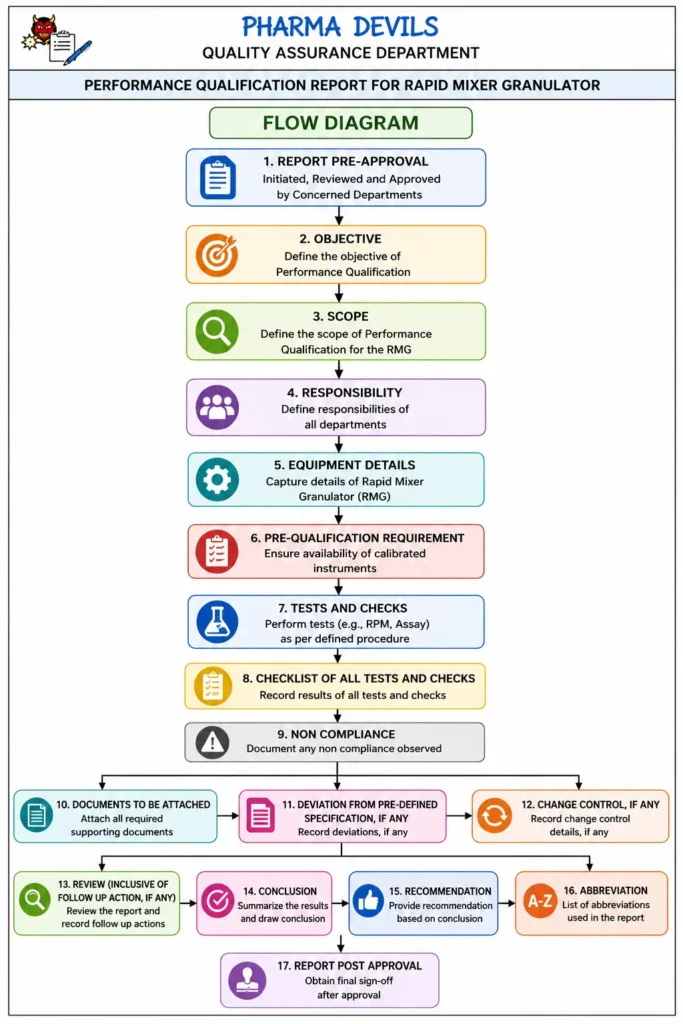
This Performance Qualification (PQ) Report is prepared for the Rapid Mixer Granulator (RMG) used in the granulation area. The purpose of this report is to confirm that the RMG performs consistently and gives reliable results during routine operation. It also checks that the related Standard Operating Procedures are suitable for normal use. The qualification is carried out for three batches. During testing, the impeller and chopper speeds are checked at slow and fast settings using a calibrated tachometer, and mixing time is verified with a calibrated stopwatch. Product samples are taken from upper, middle, and lower locations after mixing to check assay and blend uniformity. Ten sampling points are used, and the assay results are evaluated with an acceptance limit of RSD not more than 5%. Quality Assurance, Production, and Engineering are involved in review, execution, monitoring, and approval. Any deviation, non-compliance, change control, conclusion, and recommendation are properly documented.
Impact Assessment
This Performance Qualification Report helps confirm that the Rapid Mixer Granulator (RMG) works properly and gives consistent results during routine production. The report checks important operating conditions such as impeller and chopper speed and also verifies product mixing through assay testing. Testing is performed for three batches, and samples are taken from upper, middle, and lower locations inside the RMG to check whether the material is mixed evenly. Calibrated instruments, such as a stopwatch and tachometer, are used to support reliable measurements. This activity reduces the chance of poor mixing, uneven drug distribution, and inconsistent product quality. It also confirms that the operating procedure is suitable for normal use. Any deviation, non-compliance, or change is recorded and reviewed before final approval. Overall, successful qualification gives confidence that the RMG is fit for use, performs consistently, and can support the manufacture of uniform and acceptable quality products during regular manufacturing operations.
Critical Process Parameters & Critical Quality Attributes
Based on the Performance Qualification Report for the Rapid Mixer Granulator (RMG), the main parameters and quality attributes are:
Critical Process Parameters (CPP)
| CPP | Purpose / Importance |
|---|---|
| Impeller Slow Speed (RPM) | Controls movement and initial mixing of material. |
| Impeller Fast Speed (RPM) | Provides stronger mixing and helps achieve uniform distribution. |
| Chopper Slow Speed (RPM) | Helps break lumps and supports proper granulation. |
| Chopper Fast Speed (RPM) | Provides effective lump breaking and granule formation. |
| Mixing Time | Ensures sufficient time is provided to obtain uniform mixing. |
| Batch Load / Batch Size | The material should be loaded according to the capacity of the RMG. |
The report specifically requires RPM verification for the impeller and chopper at slow and fast speeds and uses calibrated instruments for RPM and mixing-time measurement.
Critical Quality Attributes (CQA)
| CQA | Acceptance / Evaluation |
|---|---|
| Assay | Samples are tested to confirm proper distribution of the API. |
| Mixing Uniformity | Samples are collected from upper, middle and lower areas of the RMG. |
| Assay RSD | NMT 5% as specified in the report. |
| Consistency Between Sampling Locations | Results from all sampling points should demonstrate uniform mixing. |
The report specifies 3 upper, 4 middle and 3 lower sampling points and evaluates assay results across these locations, with assay RSD specified as NMT 5%.
Simple relationship:
Impeller Speed + Chopper Speed + Mixing Time + Batch Load → Proper Mixing → Uniform Assay → RSD NMT 5%
FMEA – Performance Qualification of Rapid Mixer Granulator (RMG)
The uploaded PQ report does not contain a formal FMEA. The following FMEA is developed from the report’s stated controls: calibrated stopwatch/tachometer, verification of impeller and chopper RPM, three-batch testing, defined batch loading, upper/middle/lower sampling, assay testing, and assay RSD limit of NMT 5%.
Rating: Severity (S), Occurrence (O), Detection (D): 1 = Low, 5 = High.
RPN = S × O × D
| No. | Failure Mode | Possible Impact | Possible Cause | Existing / Proposed Control | S | O | D | RPN |
|---|---|---|---|---|---|---|---|---|
| 1 | Incorrect impeller RPM | Poor or non-uniform mixing | Wrong speed setting or machine problem | Verify slow and fast RPM using calibrated tachometer | 5 | 2 | 2 | 20 |
| 2 | Incorrect chopper RPM | Improper granulation / lump formation | Incorrect setting or equipment malfunction | Verify chopper slow and fast RPM | 4 | 2 | 2 | 16 |
| 3 | Incorrect mixing time | Material may not mix uniformly | Wrong timer setting or operator error | Use calibrated stopwatch and approved operating procedure | 5 | 2 | 2 | 20 |
| 4 | Incorrect batch load | Ineffective mixing performance | Batch quantity not suitable for RMG capacity | Load product according to equipment capacity | 5 | 2 | 3 | 30 |
| 5 | Inadequate sampling | Mixing problem may remain undetected | Samples not taken from defined locations | Take 3 upper, 4 middle and 3 lower samples | 5 | 2 | 3 | 30 |
| 6 | High variation in assay | Non-uniform API distribution | Inadequate mixing or unsuitable process settings | Test assay from different RMG locations; verify RSD | 5 | 3 | 2 | 30 |
| 7 | Assay RSD above limit | Batch may not demonstrate acceptable mixing uniformity | Poor mixing or process variation | Acceptance criterion: RSD NMT 5% | 5 | 2 | 2 | 20 |
| 8 | Uncalibrated measuring instrument | Incorrect RPM or time measurement | Calibration overdue or instrument malfunction | Confirm calibration of stopwatch and tachometer before PQ | 4 | 2 | 2 | 16 |
| 9 | PQ not performed for three batches | Consistent machine performance not demonstrated | Incomplete qualification execution | Perform testing for three batches as specified | 4 | 2 | 2 | 16 |
| 10 | SOP not followed during testing | Incorrect operation and unreliable PQ results | Operator error or inadequate training | Operate RMG according to approved SOP | 4 | 2 | 3 | 24 |
| 11 | Deviation / non-compliance not recorded | Qualification issues may not be properly investigated | Documentation failure | Record and review deviations and non-compliance | 4 | 2 | 3 | 24 |
| 12 | Incomplete qualification records | Poor traceability and difficulty during audit | Missing results, signatures or supporting documents | Review documents and obtain QA verification/approval | 3 | 2 | 2 | 12 |
The report specifically requires operation as per SOP, three-batch execution, verification of impeller/chopper RPM, appropriate batch loading, and sampling from different locations. The sampling plan covers upper, middle, and lower layers, while the assay tables specify an RSD of NMT 5%.
Highest suggested risks: Incorrect batch load, inadequate sampling, and high assay variation — RPN 30. These should receive particular attention during RMG Performance Qualification.
Questions & Answers – Performance Qualification Report for Rapid Mixer Granulator (RMG)
1. What is the purpose of Performance Qualification of the RMG?
To confirm that the Rapid Mixer Granulator operates consistently and repeatedly within its operating range.
2. What does RMG stand for?
RMG stands for Rapid Mixer Granulator.
3. Where is the RMG installed?
The equipment is installed in the Granulation Area.
4. Which departments are involved in the qualification activity?
Quality Assurance, Production, and Engineering are involved in the Performance Qualification activity.
5. What is the responsibility of Quality Assurance?
QA prepares, reviews, approves, compiles, coordinates, and monitors the Performance Qualification activity.
6. Which calibrated instruments are required before PQ?
A calibrated stopwatch for measuring mixing time and a calibrated tachometer for measuring impeller and chopper RPM are required.
7. What main tests are performed during RMG PQ?
The main tests mentioned in the report are RPM verification and assay testing.
8. How many batches are tested during Performance Qualification?
The test is carried out for three batches.
9. Which RPMs are checked during the qualification?
The RPM of the impeller and chopper at slow and fast speeds is checked.
10. Why is the machine first operated in empty condition?
It is operated empty to verify the impeller and chopper RPM before loading the product.
11. How should the product be loaded into the RMG?
The product batch should be loaded according to the capacity of the equipment.
12. From which locations are samples collected?
Samples are collected from the upper, middle, and lower portions of the RMG.
13. How many sampling points are used?
There are 10 sampling points: 3 upper, 4 middle, and 3 lower points.
14. Why are samples taken from different locations?
To check whether the product is mixed uniformly throughout the RMG.
15. What quality test is performed on the collected samples?
The collected samples are evaluated for percentage assay.
16. What is the acceptance limit for assay RSD mentioned in the report?
The assay RSD should be NMT 5%.
17. What does NMT mean?
NMT means Not More Than.
18. What should be done if a deviation occurs during qualification?
Any deviation from the predefined specification should be recorded and reviewed.
19. What is reviewed after completion of qualification activities?
Follow-up actions, conclusion, and recommendations are reviewed before final approval.
20. When can the RMG be considered successfully performance qualified?
The RMG can be considered successfully qualified when the required tests are completed satisfactorily, results meet the defined requirements, and the executed report is reviewed and approved.