






1. Brief Description:
This Performance Qualification (PQ) Protocol is prepared to confirm that the Rapid Mixer Granulator (RMG) works consistently and gives reliable performance during routine use. The RMG is used for dry powder mixing and wet granulation in the granulation area. Its product-contact parts are made of SS-316, and the machine uses an impeller and chopper for proper mixing. Before qualification, a calibrated stopwatch and tachometer are required. During PQ, the machine is checked for impeller and chopper RPM and product assay. The study is performed on three batches. RPM is verified at slow and fast speed under empty condition, then the product is loaded as per machine capacity and operated at set parameters. Samples are collected from upper, middle, and lower locations after mixing. Any deviation or non-compliance must be recorded, investigated, and evaluated by Quality Assurance before final conclusion and qualification approval. This helps confirm uniform mixing and equipment performance.
Skip to PDF content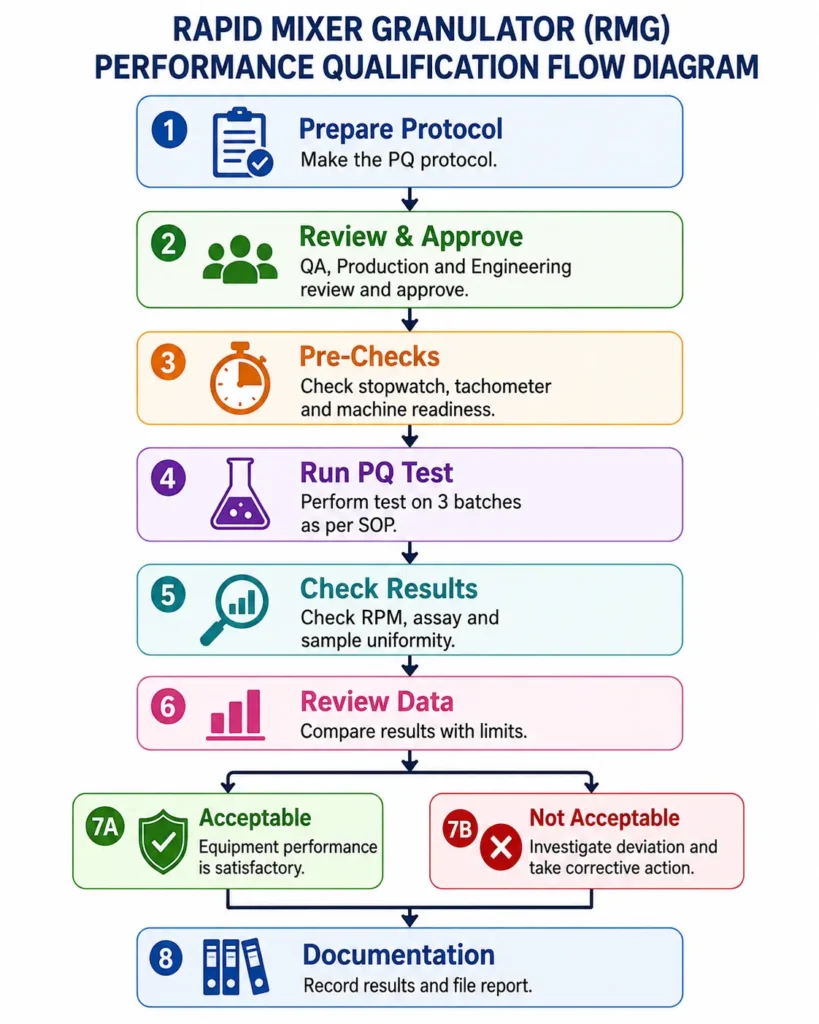
2. Flow Diagram:
This Performance Qualification (PQ) Protocol is prepared to confirm that the Rapid Mixer Granulator (RMG) works consistently and gives reliable performance during routine use. The RMG is used for dry powder mixing and wet granulation in the granulation area. Its product-contact parts are made of SS-316, and the machine uses an impeller and chopper for proper mixing. Before qualification, a calibrated stopwatch and tachometer are required. During PQ, the machine is checked for impeller and chopper RPM and product assay. The study is performed on three batches. RPM is verified at slow and fast speed under empty condition, then the product is loaded as per machine capacity and operated at set parameters. Samples are collected from upper, middle, and lower locations after mixing. Any deviation or non-compliance must be recorded, investigated, and evaluated by Quality Assurance before final conclusion and qualification approval. This helps confirm uniform mixing and equipment performance.
3. Brainstorming:
The brainstorming diagram identifies the probable reasons and associated risks when the Performance Qualification (PQ) of a Rapid Mixer Granulator (RMG) has not been performed. Key contributing factors may include an unapproved PQ protocol, missed qualification schedule, manpower shortage, production priority, delayed engineering support, uncalibrated instruments, absence of planned test batches, incomplete documentation, inadequate training, and poor coordination between QA, Production, QC, and Engineering. The approved protocol requires the RMG to be demonstrated as operating reproducibly and consistently within its defined operating range and also requires verification of the suitability of routine operating procedures. It further specifies PQ testing such as impeller and chopper RPM verification, product loading, sampling from upper, middle and lower locations, and execution over three batches.
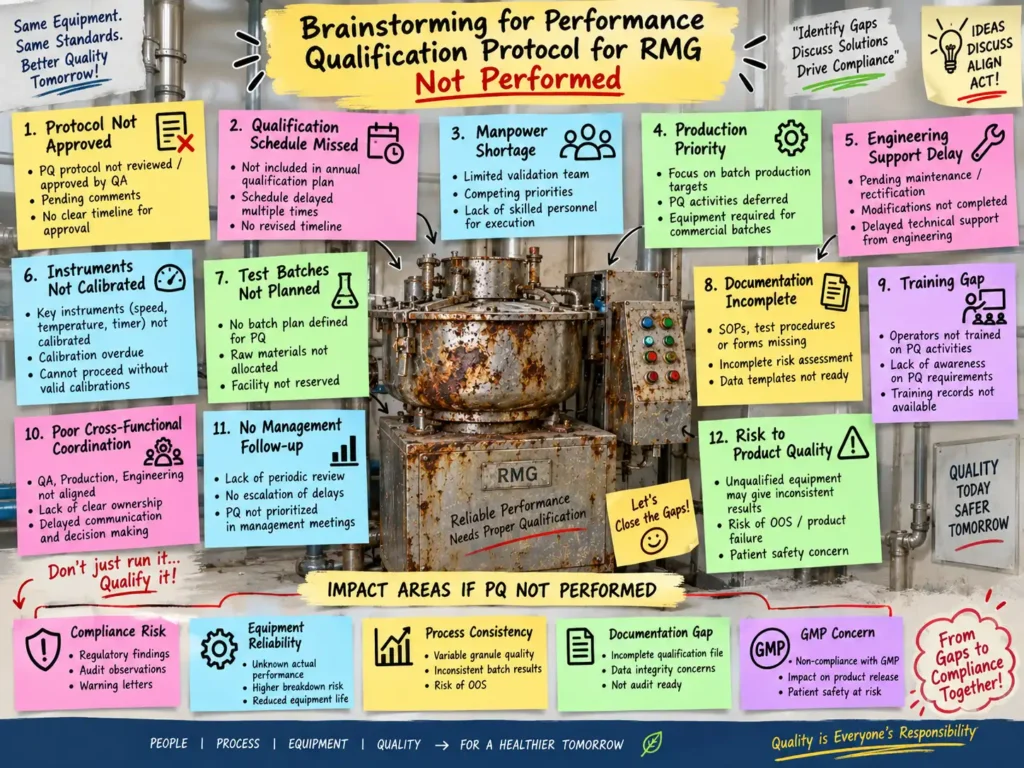
Failure to perform PQ can therefore create uncertainty regarding equipment performance, process consistency, blend quality, GMP compliance, documentation completeness, and continued suitability of the RMG for routine manufacturing. The brainstorming exercise helps identify these gaps systematically so that appropriate investigation, CAPA, scheduling, training, calibration, and qualification activities can be initiated.
4. 5 Why Analysis:
The 5 Why Analysis systematically investigates why the Performance Qualification (PQ) of the Rapid Mixer Granulator (RMG) was not performed. The analysis begins with the immediate problem—PQ activity was not initiated as per the planned qualification schedule—and progressively examines deeper contributing factors such as delayed protocol review and approval, inadequate execution planning, weak coordination between QA, Production, Engineering and QC, unclear responsibility and resource allocation, and insufficient management follow-up.
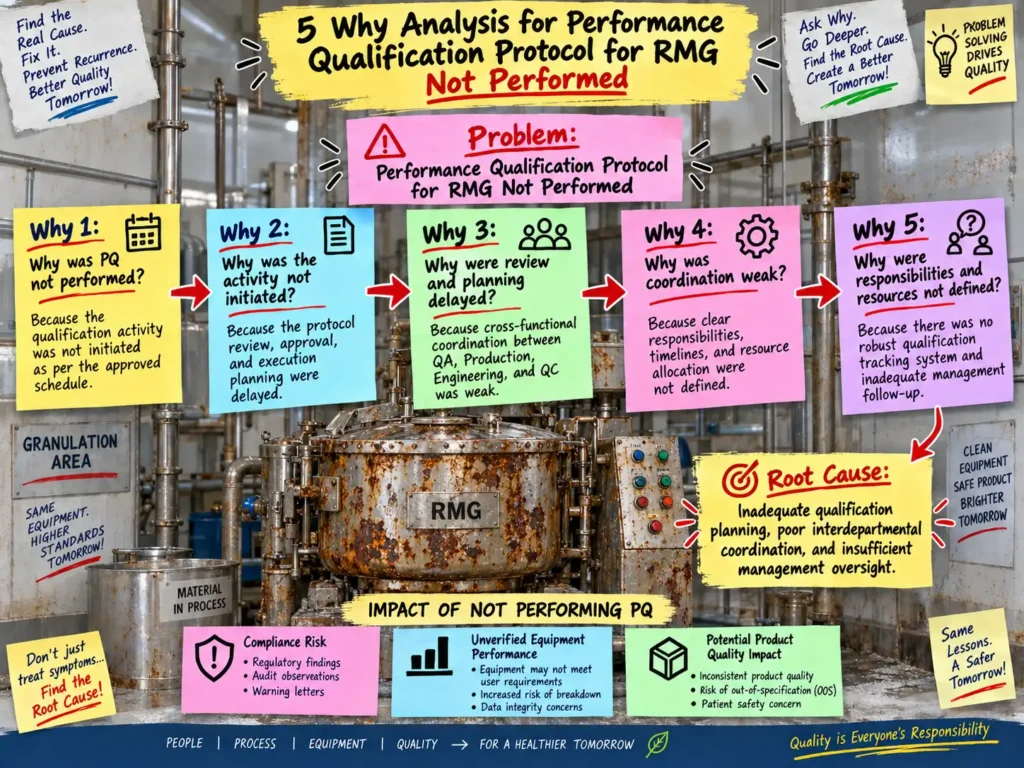
The protocol itself requires scheduled requalification and specifies pre-qualification requirements such as a calibrated stopwatch and tachometer. It also requires verification of impeller and chopper RPM, product loading and sampling during PQ, with testing performed over three batches. The 5 Why exercise therefore identifies the likely systemic root cause as inadequate qualification planning, cross-functional coordination, responsibility tracking and management oversight, helping define focused CAPA to prevent recurrence.
5. Heat Map Analysis:
The Heat Map Root Tree Analysis provides a risk-based visual assessment of the possible causes and consequences when the Performance Qualification (PQ) Protocol for a Rapid Mixer Granulator (RMG) is not performed. The analysis groups potential causes into key areas such as protocol/documentation gaps, planning and scheduling failure, manpower and training deficiencies, engineering or calibration delays, production priorities, weak cross-functional coordination, and inadequate management oversight.
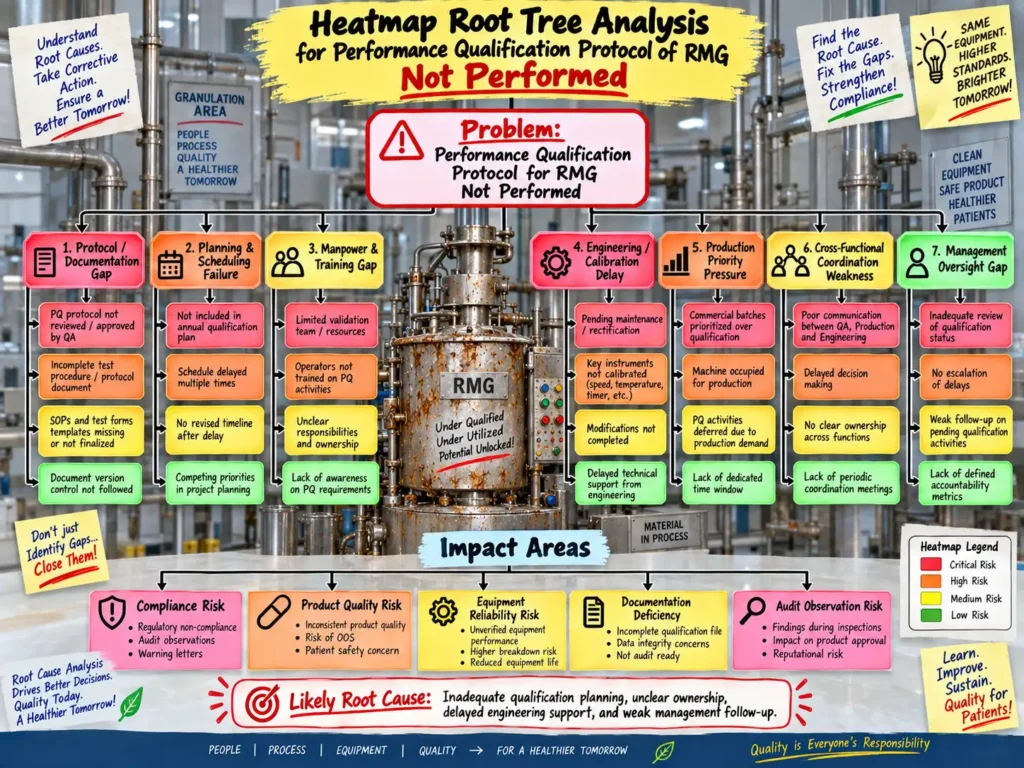
Risk levels are represented from critical/high risk to medium and lower risk, helping prioritize investigation and corrective actions. The protocol requires the RMG to demonstrate reproducible and consistent operation and specifies responsibilities for QA, Production and QC during PQ activities. Failure to complete PQ may result in unverified equipment performance, inconsistent processing, incomplete qualification documentation, GMP compliance concerns and potential product-quality impact. The heat map therefore helps identify the most significant root causes and supports prioritization of CAPA, qualification scheduling, calibration, training and management follow-up.
Critical Control Parameters (CCPs) & Critical Quality Attributes (CQAs)
Based on the RMG Performance Qualification Protocol, the following parameters are important during qualification. The protocol specifically requires RPM verification, controlled mixing time, operation at set product parameters, and testing of samples collected from different locations.
| Critical Control Parameter | What to Control / Check | Purpose |
|---|---|---|
| Impeller RPM | Slow and fast speed | Ensures proper mixing |
| Chopper RPM | Slow and fast speed | Supports proper wet granulation |
| Mixing Time | As per approved product parameter | Prevents under- or over-mixing |
| Batch Load | As per machine capacity | Ensures consistent RMG performance |
| Operating Parameters | Set as per product requirement | Maintains repeatable processing |
| Sampling Locations | Upper 3, Middle 4, Lower 3 points | Confirms performance throughout the batch |
Critical Quality Attributes
| Critical Quality Attribute | Requirement / Check | Importance |
|---|---|---|
| Assay | Test samples after mixing | Confirms required drug content |
| Mixing Uniformity | Compare assay results from different sampling locations | Helps confirm uniform distribution throughout the batch |
Note: The protocol explicitly lists RPM and Assay as PQ tests. Mixing uniformity is a reasonable interpretation of the multi-location sampling procedure, but it is not separately named as a CQA in the uploaded protocol.
FMEA – Performance Qualification of Rapid Mixer Granulator (RMG)
The protocol requires checking RPM, assay, three-batch performance, product loading, sampling from upper/middle/lower locations, and use of calibrated stopwatch and tachometer.
The failure modes and risk scores below are a risk-assessment interpretation based on these protocol activities.
Scoring: Severity (S), Occurrence (O), Detection (D): 1 = Low, 5 = High. RPN = S × O × D
| S.No. | Process / Parameter | Possible Failure Mode | Possible Effect | Possible Cause | S | O | D | RPN | Recommended Control / Action |
|---|---|---|---|---|---|---|---|---|---|
| 1 | Impeller RPM | RPM too low/high | Poor or excessive mixing | Incorrect speed setting or equipment issue | 4 | 2 | 2 | 16 | Verify RPM using calibrated tachometer |
| 2 | Chopper RPM | Chopper speed incorrect | Improper wet granulation | Wrong setting or mechanical problem | 4 | 2 | 2 | 16 | Check slow and fast RPM before operation |
| 3 | Mixing Time | Mixing time incorrect | Non-uniform blend | Incorrect timer setting/operator error | 4 | 2 | 2 | 16 | Use calibrated stopwatch and follow SOP |
| 4 | Batch Load | Too much or too little material loaded | Poor mixing performance | Incorrect batch quantity | 4 | 2 | 3 | 24 | Load material according to machine capacity |
| 5 | Mixing Uniformity | Material not uniformly mixed | Variation in assay | Improper RPM, time or loading | 5 | 2 | 3 | 30 | Collect samples from upper, middle and lower locations |
| 6 | Assay | Assay result outside limit | Product quality may be affected | Poor mixing or sampling variation | 5 | 2 | 2 | 20 | Test samples and investigate any failure |
| 7 | Sampling | Samples not taken from defined locations | Incorrect assessment of mixing | Sampling procedure not followed | 4 | 2 | 3 | 24 | Follow specified 3 upper, 4 middle and 3 lower sampling points |
| 8 | Calibration | Stopwatch/tachometer not calibrated | Incorrect qualification results | Calibration expired | 4 | 2 | 2 | 16 | Verify calibration status before PQ |
| 9 | Three-Batch PQ | Less than three batches tested | Reproducibility not demonstrated | Incomplete qualification execution | 4 | 2 | 2 | 16 | Perform PQ on three batches as required |
| 10 | Deviation Handling | Deviation not investigated | Equipment may be wrongly qualified | Poor documentation or review | 5 | 2 | 3 | 30 | Record deviation, investigate and obtain QA evaluation |
Highest-Risk Areas
The comparatively higher risks are mixing uniformity and deviation handling, with an illustrative RPN of 30 each. Proper multi-location sampling, assay testing, calibrated instruments, QA review, and investigation of deviations are therefore important before accepting the RMG for routine use. The protocol requires deviations and non-conformances to be investigated and documented in the qualification report.
Questions & Answers
1. What is the purpose of this PQ Protocol?
The purpose is to confirm that the Rapid Mixer Granulator (RMG) works consistently and reliably within its operating range.
2. What equipment is covered in this protocol?
This protocol covers the Performance Qualification of the Rapid Mixer Granulator (RMG).
3. Where is the RMG installed?
The RMG is installed in the Granulation Area.
4. What is the main use of the RMG?
The RMG is used for dry powder mixing and wet mass granulation.
5. What is the material of the product-contact parts?
The product-contact parts are made of SS-316.
6. Which departments are involved in PQ activities?
Quality Assurance, Production, Quality Control, and Engineering are involved in the qualification activity.
7. What is the role of Quality Assurance?
QA prepares, reviews, approves, compiles, coordinates, and monitors the Performance Qualification activity.
8. When is requalification required?
Requalification is required once every two years, after a major breakdown or modification, and after a change in equipment location.
9. Which calibrated instruments are required before PQ?
A calibrated stopwatch and calibrated tachometer are required.
10. What tests are performed during PQ?
The protocol specifies RPM and assay tests.
11. How many batches are tested during PQ?
The PQ test is carried out on three batches.
12. Which RPMs are checked?
The RPM of the impeller and chopper is checked at slow and fast speed under empty condition.
13. How is the product loaded during the test?
The product is loaded according to the batch size and machine capacity.
14. From where are samples collected?
Samples are collected from the upper, middle, and lower locations after mixing. The protocol specifies 3 upper, 4 middle, and 3 lower sampling points.
15. What happens if a deviation is observed?
The deviation is reported to the Head QA, documented, investigated, and its impact is evaluated before the final conclusion.
16. Which documents should be attached with the PQ?
Calibration certificates and QC raw data should be attached.
17. What is the final purpose of RMG Performance Qualification?
The final purpose is to provide documented evidence that the RMG performs consistently and is suitable for routine operation.
Reference Guidelines:
- Validation Master Plan (VMP) – provides the site-level framework, responsibilities, qualification strategy, acceptance criteria and documentation requirements for equipment qualification.
- Schedule M – Good Manufacturing Practices and Requirements of Premises, Plant and Equipment for Pharmaceutical Products – applicable to GMP expectations for pharmaceutical facilities, equipment and qualification activities in India.
- WHO – Quality Assurance of Pharmaceuticals, Volume 2: Good Manufacturing Practices and Inspection – referenced for GMP and qualification principles.
- FDA/ISPE Baseline Pharmaceutical Engineering Guide, Volume 5 – Commissioning and Qualification Guide, First Edition, March 2001 – listed as additional guidance for commissioning and qualification.
- EU Guide to Good Manufacturing Practice, Part 4, 1997 – listed in the protocol as supplementary qualification guidance.
- European Commission Working Party on Control of Medicines and Inspections – Validation Master Plan, Design Qualification, Installation & Operational Qualification, Non-Sterile Process Validation and Cleaning Validation, October 1999.
For an RMG PQ not performed investigation, these references should be considered together with the site’s approved qualification SOP, qualification schedule, deviation/CAPA procedure, calibration program and change-control system. The protocol itself requires deviations and non-conformances identified during qualification to be investigated and documented in the qualification report.