






1. Brief Description:
This Installation Qualification (IQ) Protocol cum Report is prepared for the Rapid Mixer Granulator (RMG) used for dry mixing and wet granulation of pharmaceutical materials. The main purpose of this document is to confirm that the equipment is installed correctly, matches the approved design and specifications, and follows cGMP requirements. The RMG has a gross capacity of 600 liters and is supplied by Elicon Pharma. The qualification includes checking required documents, equipment location, mounting, leveling, electrical supply, compressed air, material of construction, drawings, technical specifications, and installation connections. It also verifies important parts such as the mixing bowl, main impeller, chopper, motors, PLC, discharge system, control panel, staircase, and safety features. Safety checks ensure the machine does not run under unsafe conditions. Any deviation or change found during qualification must be recorded and reviewed. After successful completion, the equipment can be recommended for further qualification and routine use in production.
Skip to PDF content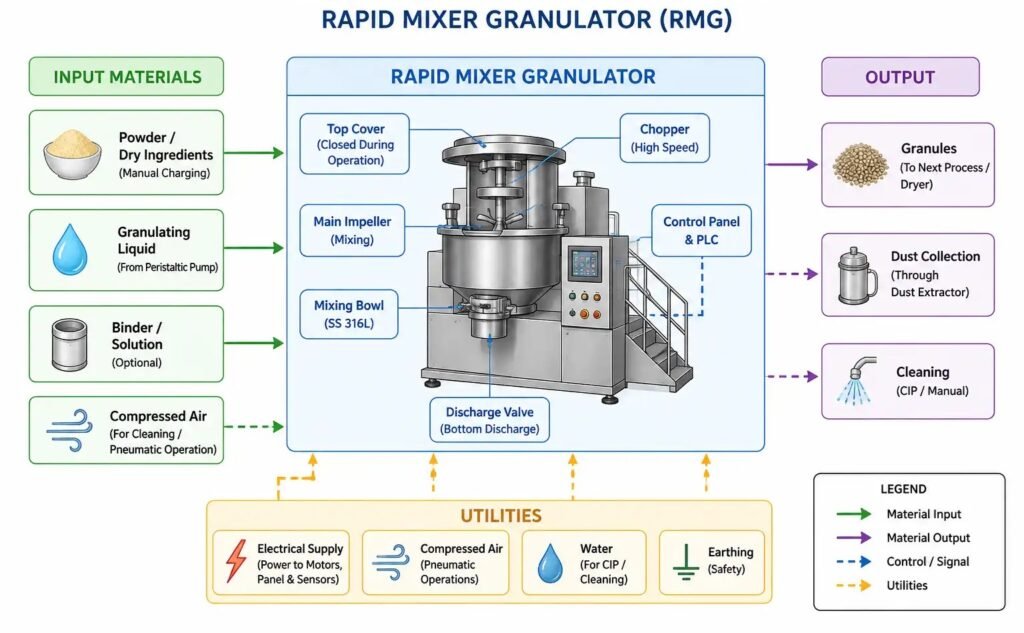
Impact Assessment
This Installation Qualification of the Rapid Mixer Granulator will have a positive impact on equipment reliability, product quality, and operator safety. It confirms that the RMG is installed correctly and matches the approved design, technical specifications, and cGMP requirements. Important checks include equipment location, mounting, leveling, electrical supply, compressed air, material of construction, drawings, major components, and installation connections. Safety features are also checked to ensure the machine does not operate when unsafe conditions are present, such as low air pressure, an open lid, open discharge port, motor trip, or emergency stop activation. Proper qualification reduces the risk of equipment failure, contamination, unsafe operation, and production problems. It also helps Production, Engineering, and Quality Assurance confirm that the machine is suitable for further qualification and routine use. Overall, the IQ provides documented evidence that the RMG installation is safe, controlled, and ready for reliable pharmaceutical manufacturing operations in the facility.
Critical Process Parameters (CPPs) – Rapid Mixer Granulator
Based on the attached RMG IQ document, the following operating parameters are relevant to the mixing and granulation process:
| Critical Process Parameter | Importance |
|---|---|
| Main impeller speed | Controls mixing and distribution of material |
| Chopper speed | Helps break lumps and control granule formation |
| Mixing time | Ensures proper and uniform mixing |
| Wet granulation time | Controls formation of the required granules |
| Binder addition | Influences granule formation and consistency |
| Granulation end point / motor ampere | Helps identify completion of wet granulation |
| Working capacity | RMG working capacity is specified as 480 L |
| Chopper RPM | Specified as 1430/2900 RPM |
| Compressed air pressure | Required pressure is 6 bar |
| Electrical supply | 415 V ±10%, 50 Hz ±5% |
| Impeller clearance | Bottom: 1–2 mm; Side: 5–7 mm |
The protocol states that the main impeller and chopper operate at slow/fast speeds according to process requirements, with process duration controlled by a timer. Wet granulation is monitored through the motor ampere reading. Technical specifications and impeller clearances are also defined in the IQ.
Critical Quality Attributes (CQAs)
For an RMG wet-granulation process, typical CQAs from general pharmaceutical practice may include:
- Blend uniformity
- Granule size distribution
- Moisture content / Loss on Drying
- Granule bulk density
- Tapped density
- Flow properties
- Granule appearance
- Assay / drug-content uniformity
- Compressibility of granules
- Absence of excessive lumps or fines
These CQAs should be finalized from the product-specific Process Validation Protocol, MFR/BMR, development report, and finished-product requirements, rather than from the Installation Qualification document alone.
FMEA Risk Assessment – Rapid Mixer Granulator Installation Qualification
The FMEA below is based on the installation checks, utilities, MOC verification, technical specifications, and safety requirements given in the attached RMG IQ protocol.
Scoring: Severity (S), Occurrence (O), Detection (D) = 1–5; RPN = S × O × D.
The numerical scores below are suggested risk ratings; the IQ document itself does not provide FMEA scores.
| S.No. | Failure Mode / Risk | Possible Effect | Possible Cause | Existing Control / Check | S | O | D | RPN | Recommended Action |
|---|---|---|---|---|---|---|---|---|---|
| 1 | Improper grouting or mounting | Vibration, unstable operation, equipment damage | Incorrect installation | Grouting and mounting verification | 4 | 2 | 2 | 16 | Correct mounting before operation |
| 2 | Equipment not properly leveled | Poor mixing, vibration, mechanical stress | Improper leveling | Leveling check during IQ | 4 | 2 | 2 | 16 | Re-level and verify |
| 3 | Incorrect electrical supply | Equipment failure or unsafe operation | Wrong voltage/frequency | 3-phase, 415 V ±10%, 50 Hz ±5% verification | 5 | 2 | 2 | 20 | Verify electrical supply before start |
| 4 | Loose or unsafe electrical wiring | Electric shock, trip, machine breakdown | Poor electrical connection | Wiring and electrical connection checks | 5 | 2 | 2 | 20 | Tighten, insulate and protect connections |
| 5 | Low or incorrect compressed air pressure | Pneumatic system may not work correctly | Low pressure, leakage | Compressed air pressure specified at 6 bar | 4 | 3 | 2 | 24 | Check pressure and leakage |
| 6 | Contaminated compressed air | Possible contamination or pneumatic malfunction | Oil, water or dust in air | Air required to be oil, water and dust free | 4 | 2 | 3 | 24 | Verify compressed-air quality |
| 7 | Wrong material of construction | Product contamination or corrosion risk | Incorrect component material | MOC verification for bowl, chopper, lid, discharge parts, etc. | 5 | 2 | 2 | 20 | Verify MOC certificates before approval |
| 8 | Loose bolts / incorrect mechanical adjustment | Vibration, breakdown or unsafe operation | Poor assembly | Bolt tightening and mechanical adjustment checks | 4 | 2 | 2 | 16 | Tighten and recheck all assemblies |
| 9 | Pneumatic connections improperly fitted | Failure of lid/discharge movement | Leakage or incorrect fitting | Pneumatic connection verification | 4 | 2 | 2 | 16 | Correct fittings and perform leakage check |
| 10 | Safety interlock failure | Machine may operate under unsafe condition | Interlock or control-system failure | Lid, discharge, low-air, motor-trip and emergency-stop checks | 5 | 2 | 2 | 20 | Verify all interlocks before qualification approval |
| 11 | Incorrect impeller clearance | Mechanical contact, poor mixing or equipment damage | Improper installation/alignment | Bottom clearance 1–2 mm; side clearance 5–7 mm | 5 | 2 | 2 | 20 | Measure and adjust clearance |
| 12 | Required drawings/documents unavailable | Incorrect installation may remain undetected | Incomplete documentation | DQ, P&ID, electrical drawings, technical specifications and MOC certificates verified | 3 | 2 | 2 | 12 | Complete and approve documents before IQ closure |
The protocol specifically requires verification of electrical supply and compressed air conditions. It also specifies MOC checks for major components and product-contact parts. The main impeller clearance is specified as 1–2 mm from the bowl bottom and 5–7 mm from the side. Safety checks require the RMG not to start or run during conditions such as low air pressure, open lid, open discharge, motor trip, or emergency-stop activation.
Overall Risk Conclusion: The identified installation risks are generally controllable through IQ verification. All higher-risk items, especially electrical supply, compressed air, MOC, impeller clearance, and safety interlocks, should be satisfactorily verified before the RMG is released for further qualification.
Questions & Answers
1. What is the purpose of this Installation Qualification (IQ)?
The purpose is to confirm that the Rapid Mixer Granulator is installed correctly, matches the approved design and specifications, follows cGMP requirements, and can be operated safely and effectively.
2. What is a Rapid Mixer Granulator used for?
It is used for mixing powders or blends and for wet granulation of pharmaceutical materials.
3. What is the capacity of the RMG?
The gross capacity is 600 liters and the working capacity is 480 liters.
4. Who is the manufacturer of the RMG?
The manufacturer and supplier mentioned in the protocol is Elicon Pharma.
5. Which departments are involved in Installation Qualification?
Quality Assurance, Production, and Engineering departments are involved in review, execution, monitoring, and approval of the qualification activity.
6. What documents should be checked before qualification?
Design Qualification, P&ID, electrical circuit diagram, equipment technical specification, and material-of-construction certificates should be available and approved.
7. What electrical supply is required for the RMG?
The required electrical supply is 3 phase, 415 V ±10%, and 50 Hz ±5%.
8. What compressed air pressure is required?
The required compressed air pressure is 6 bar, and the air should be free from oil, water, and dust.
9. What is the material of construction of the mixing bowl?
The mixing bowl is made of AISI 316 stainless steel.
10. What are the main parts of the RMG?
Important parts include the mixing bowl, main impeller, chopper, top lid, discharge system, motors, PLC, control panel, platform, and staircase.
11. How does the RMG perform mixing and granulation?
The main impeller and chopper operate at slow or fast speed as required. During wet granulation, binder is added and the process is monitored using the motor ampere reading.
12. What is the clearance of the main impeller from the bottom of the bowl?
The clearance should be 1 to 2 mm.
13. What is the clearance of the main impeller from the side of the bowl?
The clearance should be 5 to 7 mm.
14. What installation checks are performed?
Major components, utilities, bolts, electrical connections, mechanical adjustments, and pneumatic connections are checked during installation qualification.
15. What happens if the top lid or discharge port is open?
The machine should not start when the top lid or discharge port is open.
16. What happens when the emergency push button is pressed?
The machine should stop and should not run.
17. What should be done if any deviation is found during IQ?
The deviation should be recorded with its reason and approved by an authorized person.
18. What documents should be attached to the IQ report?
The Material of Construction certificate and the Operation & Maintenance Manual should be attached.
19. Why are safety interlocks checked during IQ?
They are checked to ensure that the machine cannot operate under unsafe conditions and to protect the operator and equipment.
20. When can the RMG proceed for further qualification?
After all installation checks are completed satisfactorily, deviations are addressed, and the IQ protocol cum report is reviewed and approved, the equipment can proceed for further qualification.