







Facility Qualification – Installation Qualification (IQ) is a documented process used to confirm that a pharmaceutical facility, utility, room, or supporting system has been installed correctly according to approved design specifications, drawings, manufacturer recommendations, and GMP requirements. IQ verifies important installation details such as equipment location, construction materials, dimensions, piping, electrical connections, HVAC systems, utilities, instruments, safety features, identification labels, and calibration status. It also checks whether required documents, including manuals, certificates, drawings, material certificates, and calibration records, are available and approved. Any difference between the approved design and actual installation is recorded, investigated, and corrected before further qualification. Successful completion of IQ provides documented evidence that the facility and its associated systems are properly installed, safe, suitable for operation, and ready for Operational Qualification (OQ). This step helps prevent installation errors, supports regulatory compliance, improves reliability, and ensures that subsequent qualification activities are performed on a correctly installed facility.
Skip to PDF content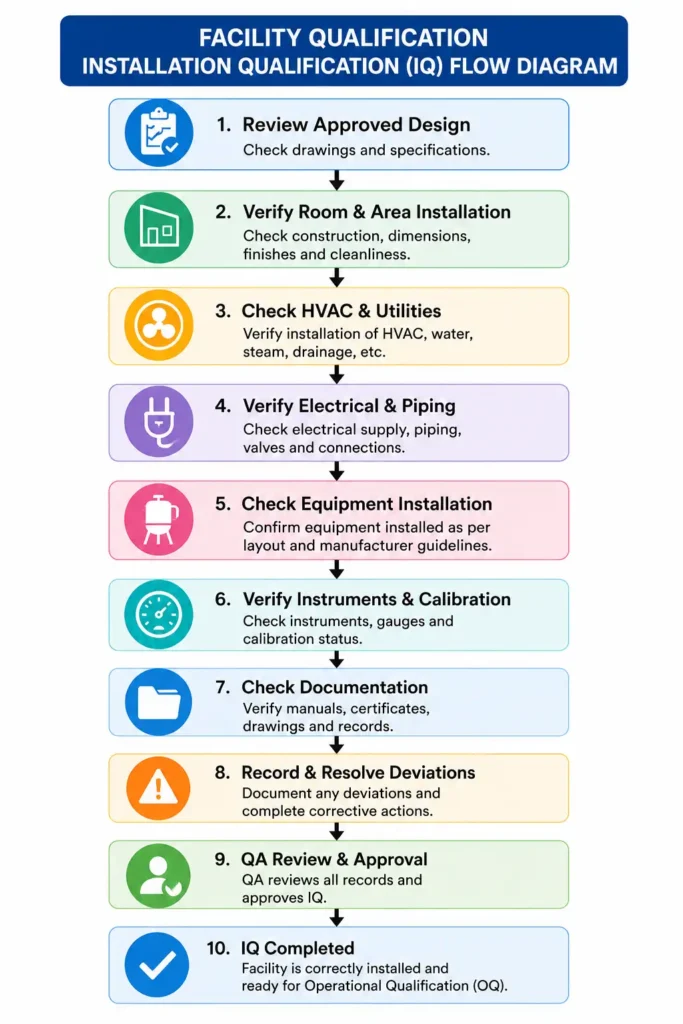
IMPACT ASSESSMENT
Facility Qualification – Installation Qualification (IQ) has an important impact on product quality, patient safety, and GMP compliance. It confirms that rooms, utilities, equipment, piping, electrical systems, HVAC, instruments, and other facility components are installed correctly as per approved design and requirements. If IQ is not performed properly, hidden installation errors may cause equipment failure, contamination, incorrect environmental conditions, utility problems, or unsafe operations. These issues can later affect manufacturing, testing, and product quality. Proper IQ also ensures that drawings, manuals, certificates, and calibration records are available and correct. Any mismatch or deviation found during verification is documented and corrected before the facility is used. This reduces the risk of breakdowns, rework, regulatory observations, and costly delays. Therefore, successful IQ provides confidence that the facility is safe, reliable, compliant, and ready for Operational Qualification and further routine pharmaceutical operations without unexpected installation-related problems during production or quality control activities later.
1. Brainstorming for Installation Qualification of Facility Not Performed
The brainstorming analysis identifies possible reasons why the Installation Qualification (IQ) of a pharmaceutical facility was not performed or completed as required. Facility IQ is intended to verify documented installation parameters such as room dimensions, finishes and material of construction, doors, drainage, electrical provisions, lighting and communication systems. Potential causes highlighted during brainstorming include lack of trained personnel, unclear responsibilities, missing or incomplete IQ protocols, inadequate project planning, delayed approvals, incomplete facility installation, pending utilities, vendor delays, insufficient management resources, and poor understanding of qualification requirements. Particular attention should be given to utilities, environmental conditions, HVAC/air supply, pressure gradients, filtration systems, personnel/material access and installed equipment, all of which form part of the facility IQ verification.
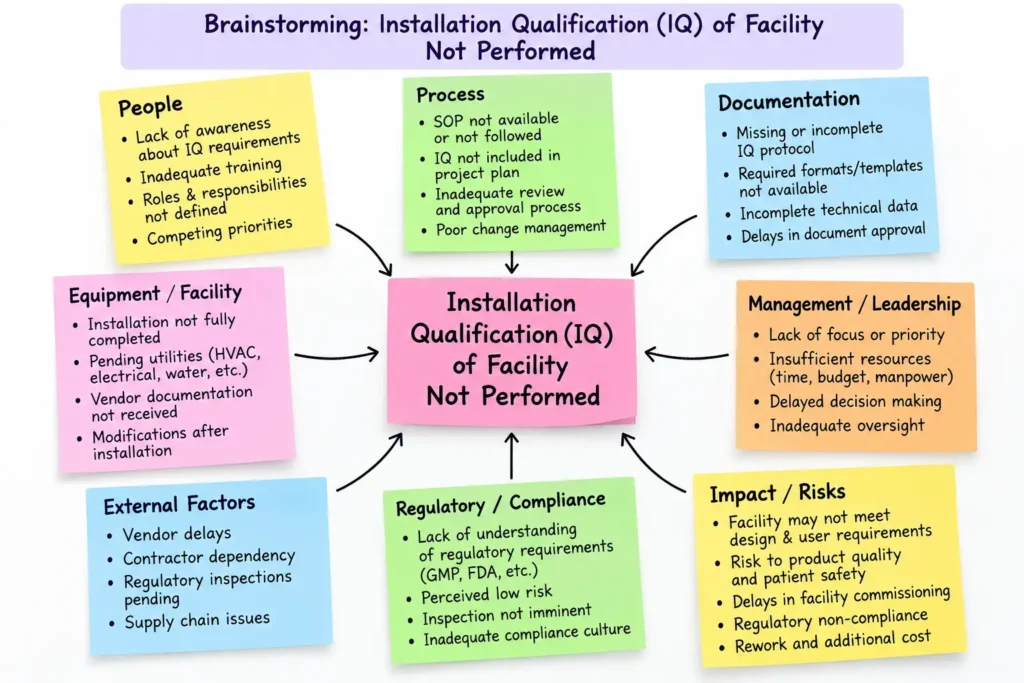
Failure to perform IQ may result in unverified facility conditions, commissioning delays, compliance concerns, rework and potential quality risks. Any identified deviations should therefore be documented, evaluated and followed by appropriate recommendations and approval.
2. 5 Why Analysis for Installation Qualification of Facility Not Performed
The 5 Why analysis is used to systematically identify the underlying reason why the Installation Qualification (IQ) of the facility was not performed. The investigation begins with the immediate issue—IQ activities were not executed—and progressively examines deeper causes such as delay in preparation or approval of the IQ protocol/checklist, unclear responsibilities between User Department, Engineering, EHS and QA, inadequate project coordination, weak document control, insufficient resources and inadequate management oversight. The facility IQ format itself requires defined preparation, review and approval responsibilities before execution.
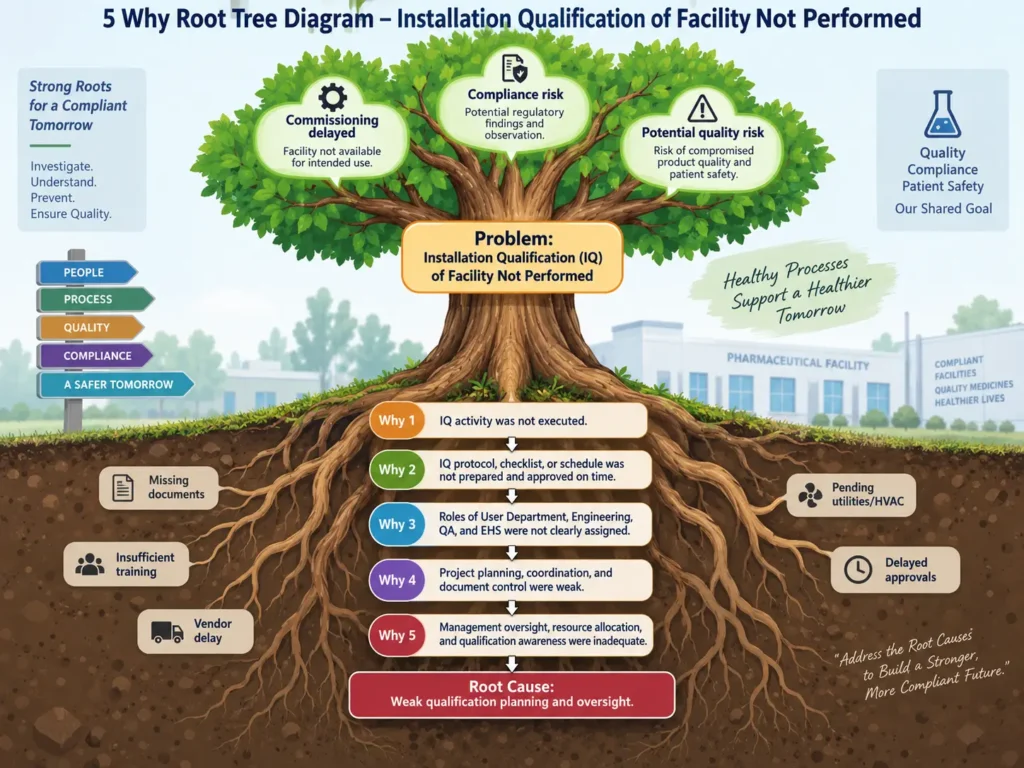
The analysis ultimately indicates weak qualification planning and oversight as the probable root cause. Failure to perform IQ may leave critical installation parameters—such as room finishes, utilities, HVAC, pressure differentials, filtration, access and equipment installation—without documented verification. The identified root cause should be addressed through timely protocol preparation, clear responsibility assignment, qualification scheduling, adequate resources, training and QA/Engineering monitoring.
Critical Process Parameters & Critical Quality Attributes – Facility Installation Qualification
For a Facility Installation Qualification (IQ), the terms CPP and CQA are not used in the same way as for a manufacturing process. Based on the provided IQ checklist, the more appropriate interpretation is critical installation/facility parameters and the quality/compliance attributes they are intended to assure.
| Critical Parameter / Facility Parameter | Critical Quality / Compliance Attribute |
|---|---|
| Room dimensions, area and volume | Facility matches approved design and intended use |
| Wall, floor and ceiling MOC | Cleanable, durable and suitable construction |
| Epoxy coating and surface finish | Smooth, intact and contamination-resistant surfaces |
| Corners, joints, cracks and crevices | Prevention of dirt accumulation and microbial harbourage |
| Door construction and interlocking | Controlled access and maintenance of room segregation |
| View panels and wall flushness | Hygienic construction and ease of cleaning |
| Drain points and sinks | Proper drainage and contamination control |
| Electrical power, UPS and auto-trip | Reliable and safe operation of facility systems |
| Lighting level | Adequate visibility for operation, cleaning and inspection |
| Fire alarms, extinguishers and smoke detectors | Personnel and facility safety |
| Potable water, purified water and WFI supply | Availability of required utility quality |
| Chilled water, steam, compressed air, nitrogen and vacuum | Utility availability and correct installation |
| Room temperature | Suitable controlled environment |
| Relative humidity | Prevention of product/process impact due to excess or low humidity |
| Room classification | Required cleanroom/environmental grade |
| Air changes per hour | Adequate ventilation and contamination control |
| Pressure gradient | Prevention of undesired air movement and cross-contamination |
| Pressure difference with adjacent areas | Maintenance of area segregation |
| Pre-filters, fine filters and HEPA filters | Effective particulate control |
| HEPA filter size and installation | Required filtration capacity |
| Airflow pattern | Appropriate movement of clean air |
| Supply and return air cut-outs | Correct HVAC distribution |
| Personnel and material entry routes | Controlled movement and reduced mix-up/contamination risk |
| Emergency exit | Safety and regulatory compliance |
| Equipment installation | Equipment positioned as intended and supported by required utilities |
The IQ format specifically includes verification of room finishes, doors, drainage, electrical systems, utilities, environmental conditions, air changes, pressure gradients, filtration systems, air supply/return, personnel and material access, and installed equipment.
Key Critical Quality Attributes
The main quality/compliance attributes supported by these checks are:
- Facility design conformity
- Cleanability and hygienic construction
- Environmental control
- Air cleanliness and pressure segregation
- Utility availability
- Contamination and cross-contamination control
- Personnel and material flow control
- Safety compliance
- Operational readiness
- Documented installation compliance
Any deviation found during IQ should be recorded, assessed, and followed by recommendations/conclusion before final post-approval.
Questions & Answers – Installation Qualification of Facility
1. What is Facility Installation Qualification (IQ)?
Facility IQ is documented verification that the facility and its associated systems are installed according to defined requirements and approved specifications. The provided format evaluates room details, finishes, utilities, environmental conditions, air supply, access, equipment and other installation parameters.
2. Who is involved in the pre-approval of Facility IQ?
The format includes the User Department, User Department Head, EHS, Engineering Head, Quality Assurance and QA Head in preparation, checking, review and approval activities.
3. Which room parameters are checked during Facility IQ?
Room number, location, purpose, dimensions, area, volume and manpower occupancy are included in the installation parameters.
4. What facility finishes are verified during IQ?
The IQ format checks wall and flooring MOC, epoxy coating, corners and joints, wall treatment, ceiling construction, cracks and crevices, doors and view panels.
5. Are electrical and communication systems covered in Facility IQ?
Yes. The format includes power outlets, UPS/auto trip, lighting level, lamps, telephone, data link/cable and digital or analog clocks.
6. Which safety provisions are checked?
Safety checks include alarms, fire extinguishers, noise and vibration, smoke detectors and manual call points.
7. Which utilities are verified during Facility IQ?
The checklist covers potable water, purified water, WFI, chilled water, boiler steam, pure steam, compressed air, nitrogen, vacuum, exhaust/dust extraction and steam condensate/trap.
8. What environmental parameters are included?
The facility IQ includes the applicable standard, room classification, temperature and relative humidity.
9. What HVAC or air-supply parameters are checked?
The checklist includes ACPH, forced/natural air supply, pressure gradient, pressure difference with adjacent areas, filtration system, HEPA filters, recirculation, airflow pattern and supply/return air cutouts.
10. What happens if Facility IQ is not performed?
Critical installation parameters remain without documented verification. From a qualification perspective, this can create uncertainty about whether the facility installation meets the intended requirements and should be investigated before routine use.
11. How should deviations identified during Facility IQ be handled?
The format provides a dedicated section for Deviations/Incident/Changes/OOS, followed by recommendations and conclusion.
12. Who performs post-approval after completion of Facility IQ?
Post-approval includes checks by the User Department, Engineering, Health, Safety and Environment, review by Quality Assurance, and approval by the QA Head.
Reference Guidelines – Installation Qualification of Facility
- WHO TRS 1019, Annex 3 – Good Manufacturing Practices: Guidelines on Validation, Appendix 6: Guidelines on Qualification
This is one of the most directly applicable references. WHO states that premises, systems, utilities and equipment should be appropriately designed, installed, qualified, operated and maintained. It also requires qualification to be performed according to approved protocols with predefined acceptance criteria.
WHO TRS 1019 Annex 3 – Guidelines on Validation - EU GMP – EudraLex Volume 4, Annex 15: Qualification and Validation
Annex 15 provides the qualification lifecycle for facilities, utilities, systems and equipment, including URS, DQ, IQ, OQ and PQ.
European Commission EudraLex Volume 4 - EU GMP – Chapter 3: Premises and Equipment
Relevant for facility layout, construction, maintenance, lighting, temperature, humidity, ventilation and prevention of contamination or cross-contamination.
EU GMP Chapter 3 – Premises and Equipment - PIC/S PI 006 – Recommendations on Qualification and Validation
PIC/S specifically describes IQ as documented evidence that premises, supporting utilities and equipment have been built and installed in accordance with their design specifications. As of 9 September 2026, PI 006-3 remains the applicable version; the revised PI 006-4 has been published and is scheduled to enter into force on 1 October 2026.
PIC/S Publications - India – Revised Schedule M, Drugs Rules, 1945, G.S.R. 922(E), 28 December 2023
For Indian pharmaceutical facilities, Revised Schedule M is a key regulatory reference covering GMP and requirements for premises, plant, equipment, pharmaceutical quality systems and qualification/validation.
CDSCO Revised Schedule M – G.S.R. 922(E)