





1. Introduction to Paracetamol, Phenylephrine Hydrochloride & Cetirizine Dihydrochloride Tablets (BMR):
The Batch Manufacturing Record (BMR) for Paracetamol, Phenylephrine Hydrochloride & Cetirizine Dihydrochloride Tablets is a comprehensive pharmaceutical document designed to ensure controlled manufacturing, consistent product quality, traceability, and compliance with Good Manufacturing Practices (GMP). Each uncoated tablet contains Paracetamol IP 325 mg, Phenylephrine Hydrochloride IP 10 mg, and Cetirizine Dihydrochloride IP 5 mg. Paracetamol provides analgesic and antipyretic effects, phenylephrine acts as a nasal decongestant, and cetirizine is an antihistamine used to relieve allergic symptoms. The manufacturing process involves raw material dispensing, sifting, binder preparation, wet granulation, drying, milling, blending, lubrication, tablet compression, and packing. Each manufacturing stage requires documented process controls, equipment verification, and quality checks to maintain product consistency. The BMR includes material specifications, dispensing calculations, equipment details, manufacturing instructions, in-process quality checks, batch yield reconciliation, and Quality Assurance verification. Critical quality parameters include tablet weight variation, hardness, thickness, friability, disintegration, and finished product testing according to approved specifications. Proper documentation ensures complete batch traceability, accountability, deviation management, and regulatory compliance. The BMR serves as an essential reference for production personnel, Quality Assurance teams, quality investigations, internal audits, and regulatory inspections, supporting reliable pharmaceutical manufacturing and consistent finished product quality.
Skip to PDF content2. Manufacturing Process Flow Diagram for Paracetamol, Phenylephrine HCl & Cetirizine Dihydrochloride Tablets:
The manufacturing flow diagram illustrates the systematic production of Paracetamol, Phenylephrine Hydrochloride & Cetirizine Dihydrochloride Tablets in accordance with Good Manufacturing Practices (GMP). The process begins with raw material dispensing and sifting through specified mesh sizes to ensure uniform particle distribution. Binder preparation is followed by wet granulation using a Rapid Mixer Granulator (RMG). The wet granules undergo milling, drying in a Fluid Bed Dryer (FBD), and final sizing to achieve the required granule characteristics. The dried granules are blended with prescribed excipients, followed by lubrication to improve flow and compression properties. Tablet compression is performed using suitable punches and dies under controlled operating conditions.
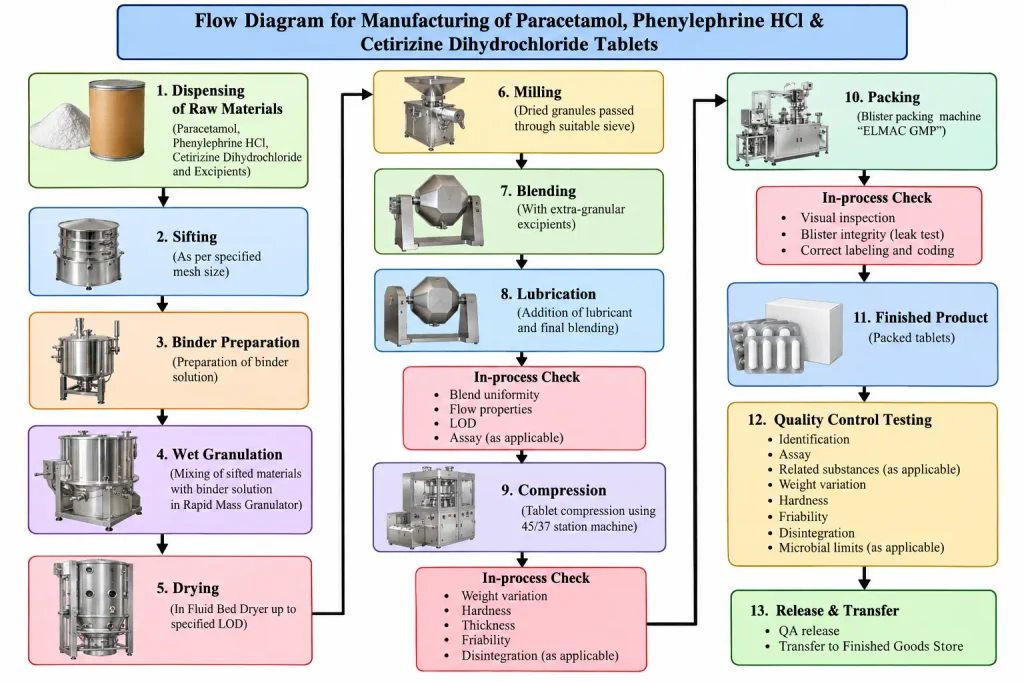
In-process quality checks include moisture content, tablet weight variation, hardness, thickness, friability, and disintegration. Compressed tablets undergo blister packing, packaging integrity verification, and finished product testing. Finally, Quality Assurance reviews manufacturing documentation, verifies compliance, and authorizes batch release and transfer to the finished goods store.
3. Critical Process Parameters (CPP) and Critical Quality Attributes (CQA) of Paracetamol, Phenylephrine HCl & Cetirizine Dihydrochloride Tablets:
Critical Process Parameters (CPP) and Critical Quality Attributes (CQA) are essential elements in manufacturing Paracetamol, Phenylephrine Hydrochloride & Cetirizine Dihydrochloride Tablets, ensuring consistent product quality, safety, and compliance with Good Manufacturing Practices (GMP). CPPs include raw material dispensing accuracy, sieve mesh size, binder preparation, granulation time, impeller speed, drying temperature, moisture content, blending time, lubrication duration, compression force, and blister sealing parameters. These parameters require monitoring and control according to approved manufacturing instructions.
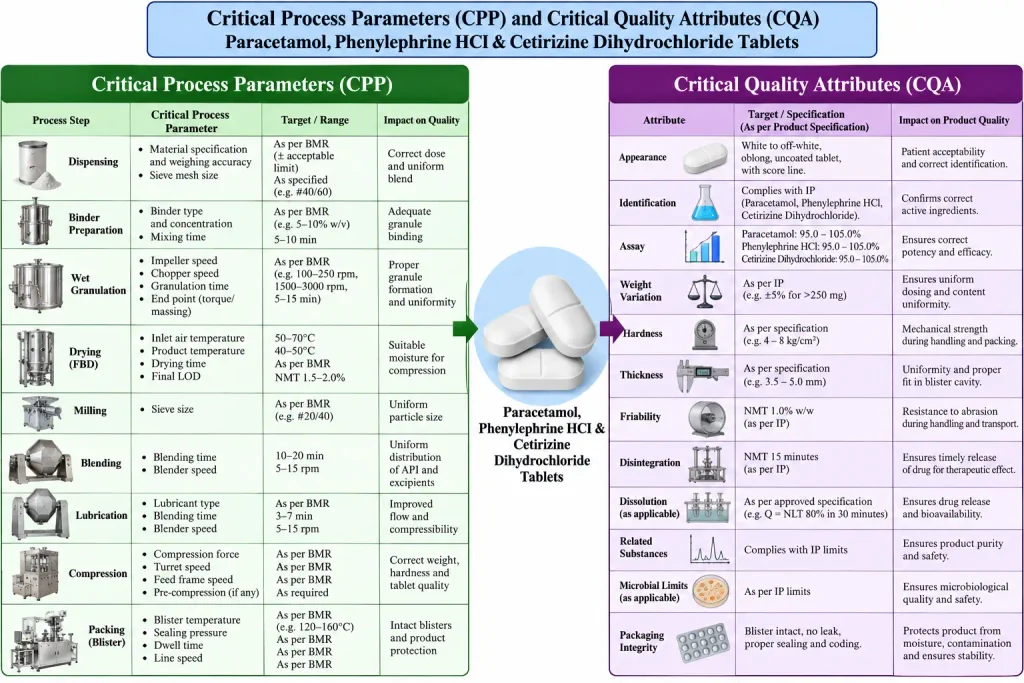
CQAs include tablet appearance, identification, assay, weight variation, hardness, thickness, friability, disintegration, dissolution, related substances, and packaging integrity, as applicable to approved product specifications. Effective CPP monitoring helps minimize manufacturing variability, prevent processing deviations, and maintain consistent tablet characteristics. CQA evaluation confirms that finished tablets meet established quality requirements. Together, CPPs and CQAs support process validation, quality risk management, batch-to-batch consistency, regulatory compliance, and reliable pharmaceutical manufacturing throughout the product lifecycle.