







1. Introduction – Standard Operating Procedure for Reference Sample:
The Standard Operating Procedure for Reference Sample describes the systematic method for preparation, identification, handling, storage, use, monitoring, and disposal of reference samples used for comparison with routine production samples. The procedure is intended mainly for comparison of color, clarity, and fill volume of manufactured liquid products.Reference samples provide an approved visual and physical benchmark during manufacturing, filling, and inspection activities. For manufacturing comparison, samples are collected from an acceptable batch, stored in a suitable transparent container, properly labelled, and maintained as reference samples. The SOP specifies preparation of two manufacturing reference samples—one for Production and one for QC—with a validity period of three months. For filling operations, minimum and maximum volume reference samples are prepared using verified fill volumes and calibrated equipment so that visual inspectors can consistently assess filled containers against an established standard.Proper implementation of this SOP supports consistency in product appearance and fill-volume evaluation, improves inspection reliability, and ensures traceable control of reference samples throughout their defined period of use.
Skip to PDF content2. Flow Diagram – Standard Operating Procedure for Reference Sample:
The Standard Operating Procedure for Reference Sample establishes a controlled system for preparing and using reference samples during pharmaceutical manufacturing and filling operations. The SOP covers reference samples used for color, clarity, and volume comparison of routine batches. For manufacturing, a sample is collected from an approved batch that has passed the color comparison test and is stored in a transparent round or flint bottle with complete identification details. Two reference samples are prepared—one for Production and one for QC—and the manufacturing reference sample remains valid for three months.
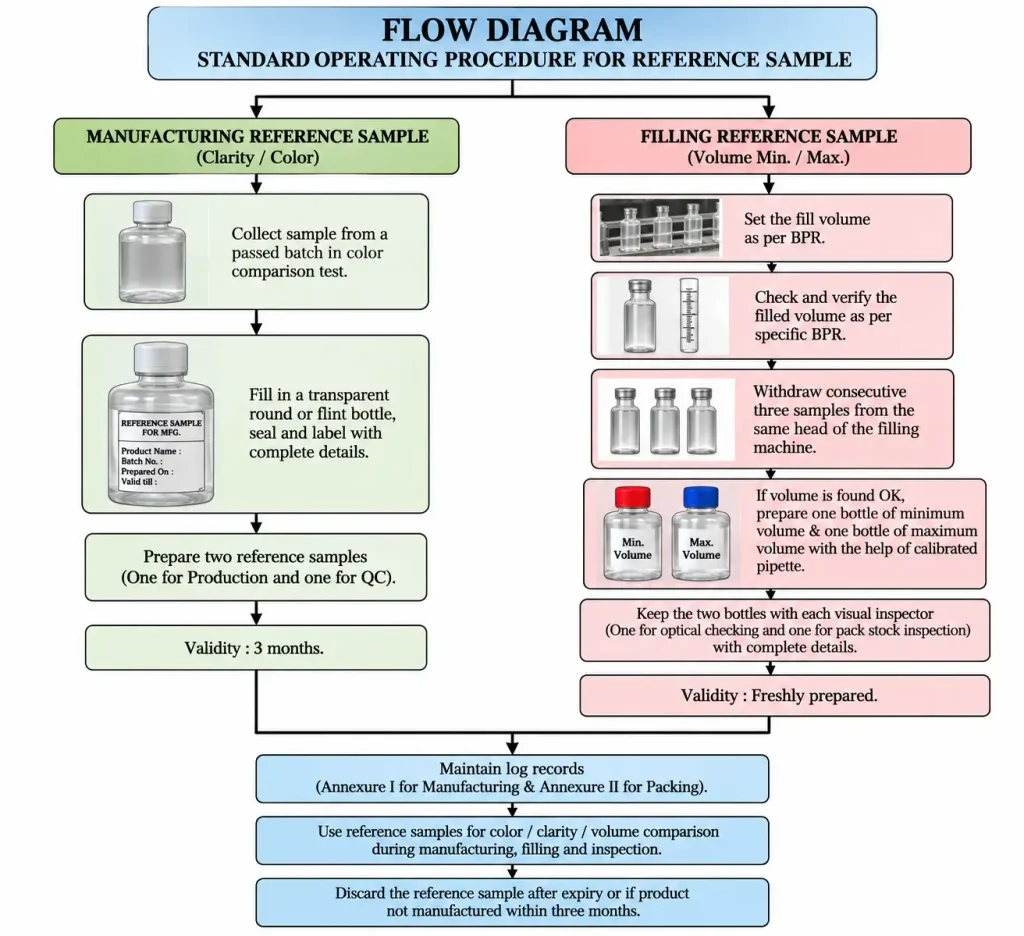
For filling operations, the fill volume is set and verified as per the BPR. Consecutive samples are withdrawn from the same filling head, and minimum and maximum volume reference bottles are prepared using a calibrated pipette. These samples are freshly prepared and used by visual inspectors for comparison during filling and inspection activities. The SOP also requires appropriate recording of reference sample details in the defined annexures, supporting traceability, consistency, and controlled use of reference standards.
3. Benefits of Following the Standard Operating Procedure for Reference Sample:
Following the Standard Operating Procedure for Reference Sample helps ensure that reference samples are prepared, identified, stored, used, and replaced in a consistent and controlled manner. The SOP provides an established reference for comparison of color, clarity, and fill volume during manufacturing and filling operations.
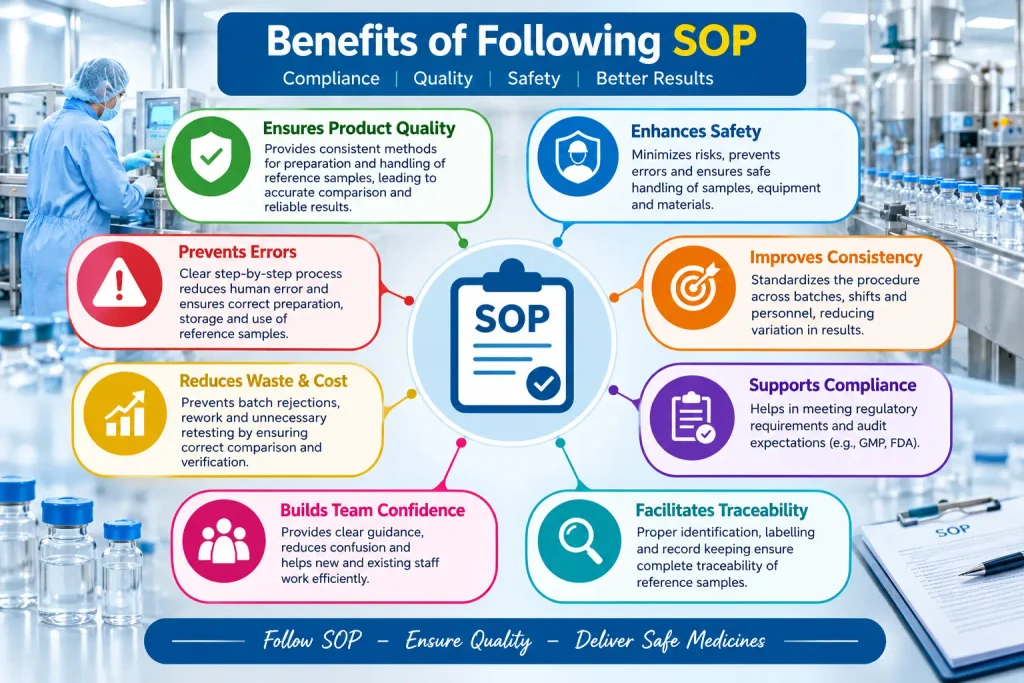
Proper implementation of this SOP improves the reliability of visual inspection by providing approved comparison samples for Production and QC. The use of correctly labelled reference bottles reduces the possibility of sample mix-up, incorrect identification, and inconsistent assessment. Manufacturing reference samples are maintained for a defined validity period of three months, while filling reference samples are freshly prepared for use. The procedure also supports accurate fill-volume verification through preparation of minimum and maximum volume samples using a calibrated pipette. Maintaining the prescribed reference sample logs further strengthens traceability, accountability, and documentation control.
4. Brainstorming for SOP Failure – Standard Operating Procedure for Reference Sample:
The brainstorming analysis for failure of the Standard Operating Procedure for Reference Sample is used to identify possible causes that may affect the correct preparation, handling, identification, storage, use, and documentation of reference samples. The SOP requires manufacturing reference samples to be collected from an acceptable batch, stored in a transparent container, properly labelled, and prepared in two sets for Production and QC.
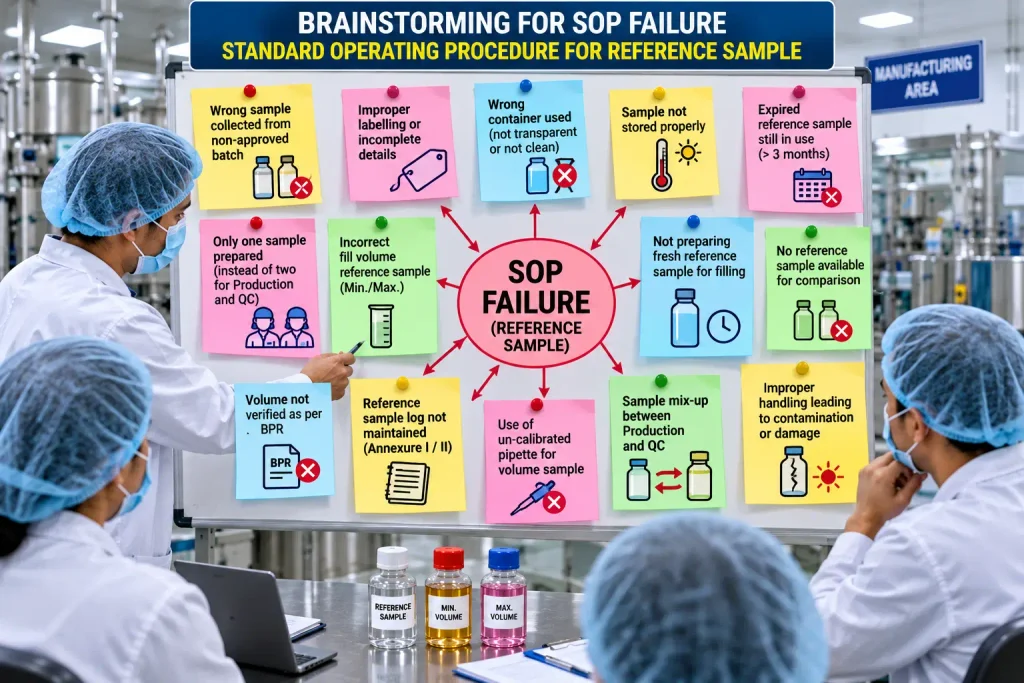
Potential failure points include wrong sample selection, incomplete labelling, use of an unsuitable container, preparation of only one reference sample, use of an expired manufacturing reference sample, and absence of a suitable comparison sample. For filling reference samples, failures may include incorrect fill-volume verification, improper preparation of minimum and maximum volume samples, or use of an uncalibrated pipette. Another important brainstorming area is documentation and traceability. Missing or incomplete entries in the reference sample consumption log or reference standard logbook can make it difficult to establish sample history, validity, use, and disposal status. This brainstorming exercise helps the team recognize weak points in the process so that appropriate controls, training, verification, and corrective actions can be implemented to prevent SOP failure and maintain consistent reference-sample management.
5. 5-Why Analysis for SOP Failure – Standard Operating Procedure for Reference Sample:
The 5-Why Analysis for failure of the Standard Operating Procedure for Reference Sample is used to identify the underlying reasons for deviations in preparation, verification, handling, validity control, and documentation of reference samples. The SOP requires manufacturing reference samples to be collected from an approved batch, properly labelled, prepared in two sets for Production and QC, and maintained for a defined validity period.
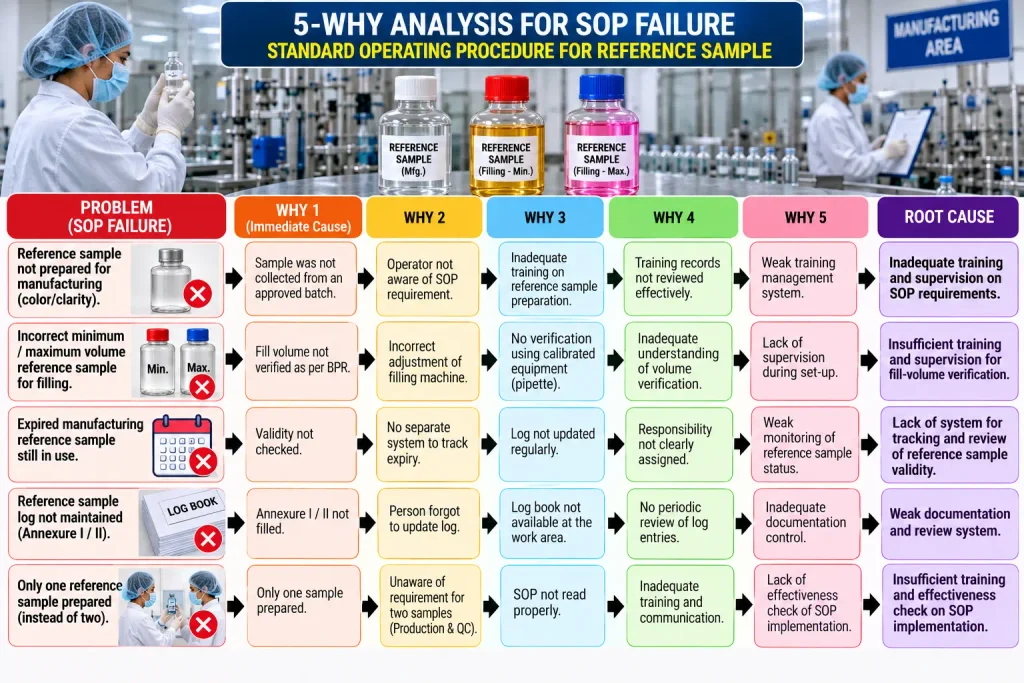
For filling operations, the SOP requires fill volume to be set and verified as per the BPR, followed by preparation of minimum and maximum volume reference samples using a calibrated pipette. Failures such as incorrect sample preparation, use of expired samples, inadequate volume verification, preparation of only one sample, or missing log entries can therefore be traced through successive “Why” questions.The 5-Why approach helps move beyond the immediate error to identify deeper causes such as insufficient training, weak supervision, lack of validity tracking, inadequate documentation review, or ineffective SOP implementation checks. Maintaining Annexure I and Annexure II records is also important for traceability and control of reference samples.
6. Fishbone Analysis for SOP Failure – Standard Operating Procedure for Reference Sample:
The Fishbone Analysis for failure of the Standard Operating Procedure for Reference Sample is used to systematically identify possible causes that may lead to incorrect preparation, handling, verification, use, or documentation of reference samples. The SOP requires manufacturing reference samples to be collected from a passed batch, stored in a transparent round or flint bottle, properly labelled, and prepared in two sets—one for Production and one.
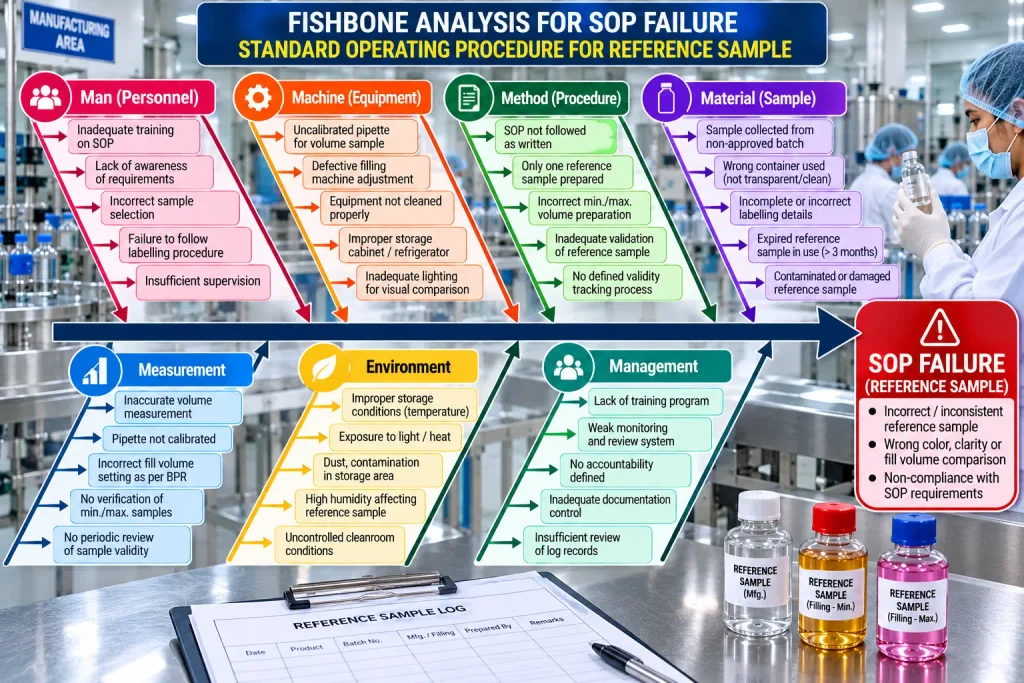
Potential causes of SOP failure can be grouped under major categories such as Man, Machine, Method, Material, Measurement, Environment, and Management. Personnel-related causes may include inadequate training, lack of awareness, or insufficient supervision. Equipment-related causes may include use of an uncalibrated pipette or improper filling-machine adjustment. Method-related failures can include not following the approved procedure, preparing only one sample instead of two, or incorrect preparation of minimum and maximum volume samples. The SOP specifically requires fill-volume verification and preparation of reference samples using a calibrated pipette. Material and sample-related causes may include wrong sample selection, incorrect containers, incomplete labelling, expired reference samples, or sample contamination. Documentation and management failures may include incomplete Annexure I or Annexure II records, poor validity tracking, and inadequate review.
7. Fault Tree Analysis for SOP Failure – Standard Operating Procedure for Reference Sample:
The Fault Tree Analysis for failure of the Standard Operating Procedure for Reference Sample evaluates how different individual failures can combine to result in an overall reference-sample control failure. The top event may occur when the reference sample is not prepared, is incorrectly prepared, is improperly identified, or is used beyond its defined validity.The SOP requires manufacturing reference samples to be collected from a passed batch, stored in a transparent round or flint bottle, properly labelled, and prepared in two sets—one for Production and one for QC. Failures at this stage may arise from incorrect batch selection, preparation of only one sample, or incomplete identification details.
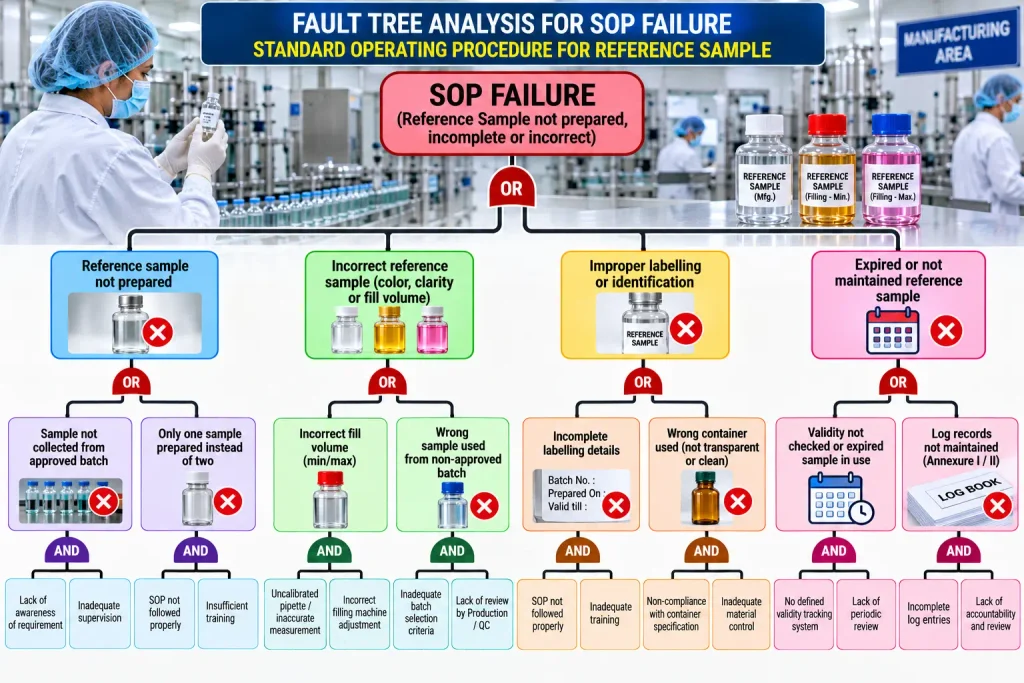
For filling reference samples, the SOP requires verification of fill volume as per the BPR and preparation of minimum and maximum volume samples using a calibrated pipette. Incorrect volume setting, improper measurement, or failure to prepare the required samples can therefore contribute directly to the top event.The fault tree also includes failures related to validity and documentation. Manufacturing reference samples are valid for three months, while filling reference samples are freshly prepared. Incomplete Annexure I or Annexure II records can further weaken traceability and control.
8. Impact Assessment for SOP Failure – Standard Operating Procedure for Reference Sample:
The Impact Assessment for failure of the Standard Operating Procedure for Reference Sample evaluates the possible consequences of improper preparation, verification, handling, use, validity control, or documentation of reference samples. The SOP is intended to support comparison of color, clarity, and fill volume for manufactured batches. Failure to follow the procedure may result in incorrect visual comparison, inaccurate fill-volume assessment, use of an unsuitable or expired reference sample, and inconsistent inspection decisions. For filling operations, the SOP requires verification of fill volume as per the BPR and preparation of minimum and maximum volume samples using a calibrated pipette.
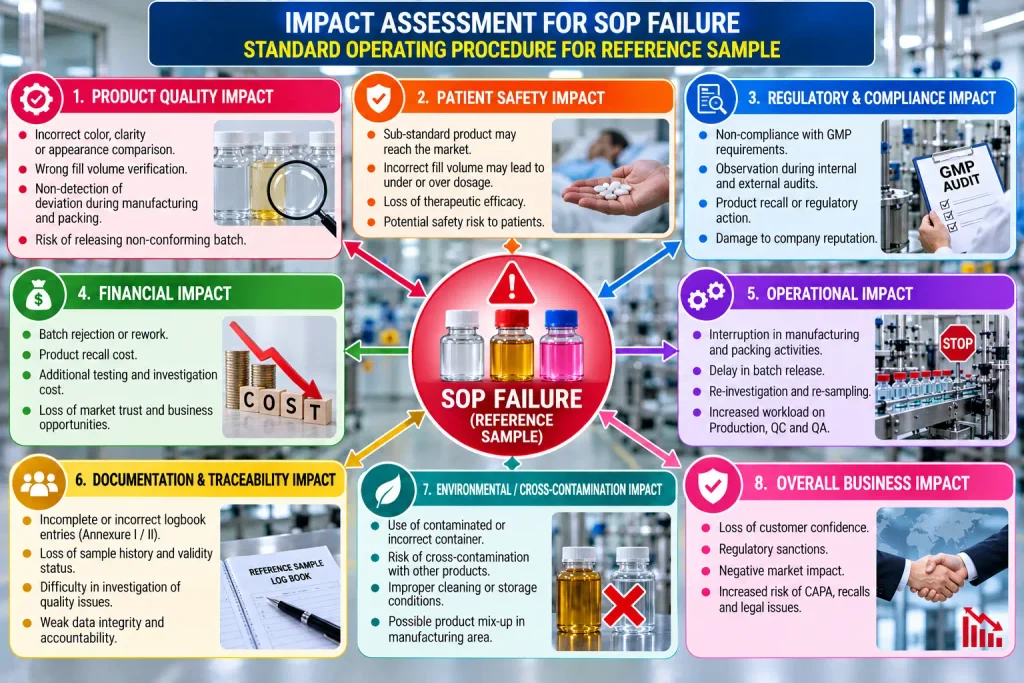
The impact may also extend to batch evaluation, documentation reliability, traceability, investigation effectiveness, and GMP compliance. Manufacturing reference samples have a Incomplete Annexure I or Annexure II records can further affect the ability to confirm sample history, use, validity, and disposal.
9. CAPA for SOP Failure – Standard Operating Procedure for Reference Sample:
The Corrective and Preventive Action (CAPA) for failure of the Standard Operating Procedure for Reference Sample is intended to eliminate identified deficiencies and prevent recurrence of errors related to preparation, verification, validity, handling, and documentation of reference samples.Corrective actions may include preparing the required reference samples correctly, re-verifying fill volume as per the BPR, replacing expired samples, correcting incomplete log entries, and providing immediate training to concerned personnel. The SOP requires two manufacturing reference samples, one for Production and one for QC, with a validity of three months.
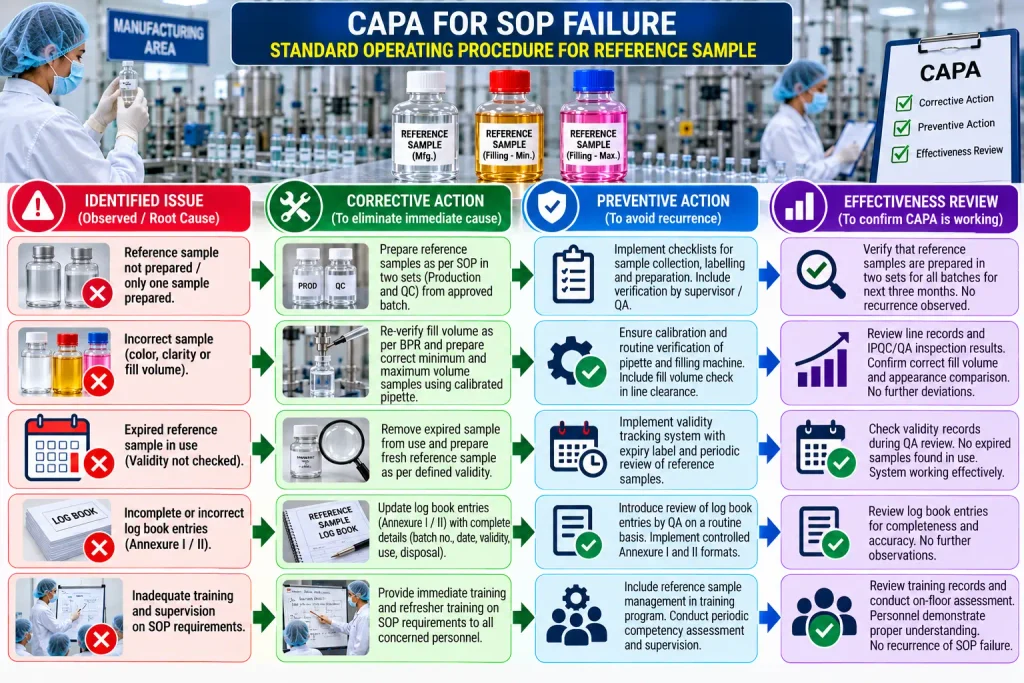
For filling operations, minimum and maximum volume referene samples should be prepared after verification of fill volume and using a calibrated pipette. Preventive actions should include routine checklist verification, calibration control, validity tracking, periodic review of reference-sample records, refresher training, and QA supervision. Effectiveness should be confirmed through periodic review of reference-sample preparation, validity status, logbook completeness, and compliance with Annexure I and Annexure II requirements.
Questions & Answers – Standard Operating Procedure for Reference Sample:
- What is the objective of this SOP?
The objective is to define the procedure for preparation and handling of reference samples used for comparison with regular samples. - What is the scope of the SOP?
It is applicable to the comparison of color, clarity, and volume of - Who is responsible for execution of the SOP?
IPQA Chemist/Officer is responsible for execution of the SOP. - Who is responsible for effective implementation of the SOP?
Deputy Manager–Production and Head–QA/QC are responsible for effective implementation. - From which batch should a manufacturing reference sample be collected?
It should be collected from a batch that has passed the color comparison test. - Which type of container should be used for the manufacturing reference sample?
A transparent round or flint bottle should be used and properly sealed. - What details should appear on the manufacturing reference sample label?
Product name, batch number, prepared-on date, and valid-till date should be mentioned. - How many manufacturing reference samples should be prepared?
Two samples should be prepared—one for Production and one for QC. - What is the validity of the manufacturing reference sample?
The validity is three months. - How should the filling reference sample process begin?
Fill volume should first be set as per the BPR and then verified against the specific BPR requirement.