







1. Introduction to Batch Packing Record (BPR) of Paracetamol, Phenylephrine Hydrochloride & Cetirizine Dihydrochloride Suspension
The Batch Packing Record (BPR) of Paracetamol, Phenylephrine Hydrochloride, and Cetirizine Dihydrochloride Suspension is an essential pharmaceutical document designed to ensure systematic, controlled, and traceable packaging operations in accordance with Good Manufacturing Practices (GMP). This combination formulation contains Paracetamol IP 250 mg, Phenylephrine Hydrochloride IP 5 mg, and Cetirizine Dihydrochloride IP 2 mg per 5 mL, providing antipyretic, analgesic, nasal decongestant, and antihistaminic activities. The BPR provides comprehensive documentation of packaging activities, including bulk product receipt, packaging material dispensing, line clearance, bottle filling, sealing, labeling, coding, inspection, and final packing. It establishes accountability through proper recording of batch details, equipment identification, material quantities, operational checks, and personnel verification. Critical packaging parameters, such as filling volume, container closure integrity, label accuracy, batch coding, and packaging material reconciliation, are monitored to maintain product quality, safety, and consistency. The record also facilitates deviation management, in-process quality checks, yield reconciliation, and final batch review by the Quality Assurance department. Accurate documentation supports regulatory compliance, data integrity, product traceability, and effective investigation of packaging discrepancies. A properly maintained BPR ensures that every finished batch meets approved packaging specifications and established pharmaceutical quality standards before release for distribution.
Skip to PDF content2. Description of Batch Packing Process Flow Diagram for Paracetamol, Phenylephrine HCl & Cetirizine Dihydrochloride Suspension
The Batch Packing Process Flow Diagram for Paracetamol, Phenylephrine Hydrochloride, and Cetirizine Dihydrochloride Suspension illustrates the systematic sequence of packaging operations performed under Good Manufacturing Practices (GMP) to ensure product quality, safety, and traceability.
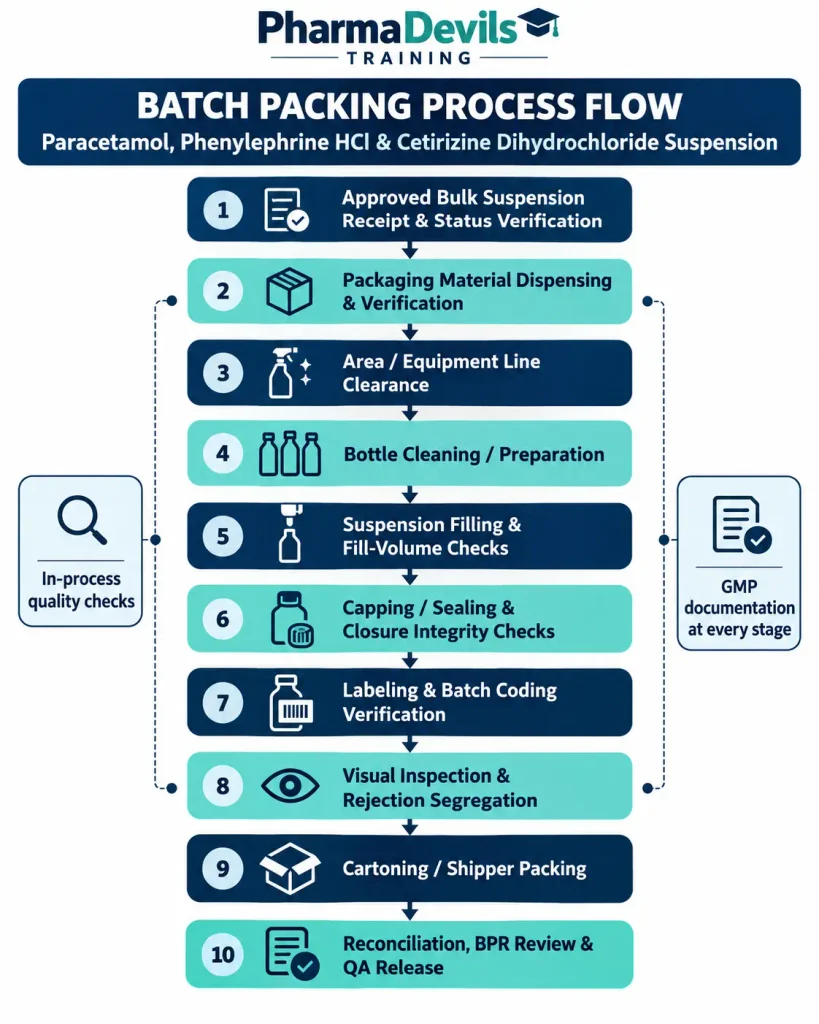
The process begins with the receipt and verification of approved bulk suspension, followed by packaging material dispensing and verification against authorized specifications. Line clearance is performed to ensure that the packaging area and equipment are clean and free from materials belonging to previous batches. Subsequently, bottles undergo cleaning or preparation before the suspension is filled under controlled conditions. Critical in-process checks, including filling volume, container integrity, and sealing effectiveness, are conducted to maintain packaging quality. The filled bottles proceed through capping, labeling, and batch coding operations, where product information, manufacturing dates, expiry dates, and batch identification details are verified. Visual inspection ensures the identification and segregation of defective containers. Accepted bottles undergo secondary packaging, cartoning, and shipper packing according to approved specifications. Finally, packaging material reconciliation, yield verification, and Batch Packing Record review are completed. Quality Assurance evaluates the documentation, deviations, and inspection results before authorizing batch release, ensuring compliance with established pharmaceutical quality standards and regulatory requirements.
3. Description of Critical Process Parameters (CPP) and Critical Quality Attributes (CQA) for Paracetamol, Phenylephrine HCl & Cetirizine Dihydrochloride Suspension
Critical Process Parameters (CPPs) and Critical Quality Attributes (CQAs) play an essential role in ensuring the quality, safety, consistency, and regulatory compliance of Paracetamol, Phenylephrine Hydrochloride, and Cetirizine Dihydrochloride Suspension during pharmaceutical packaging operations. Critical Process Parameters represent operating conditions that may significantly influence product quality. Important packaging parameters include filling volume settings, filling machine speed, bulk suspension agitation, capping torque, sealing conditions, labeling accuracy, and batch coding controls. These parameters require appropriate monitoring and control to minimize packaging defects and ensure consistent performance.
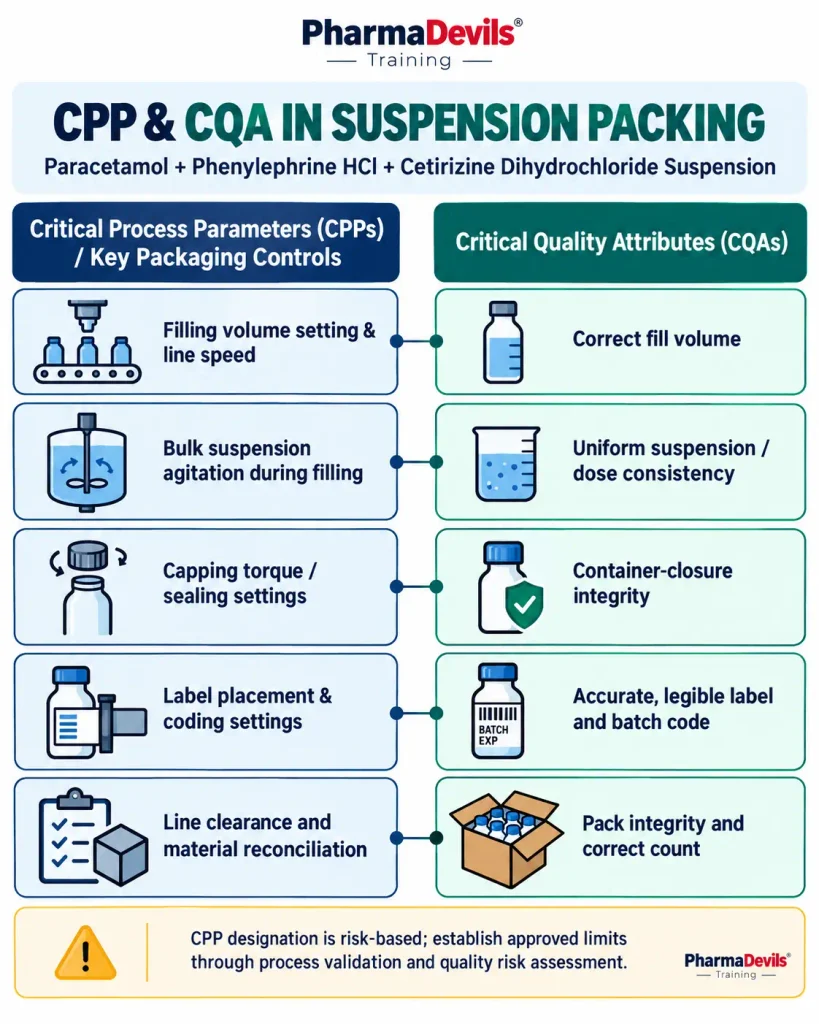
Critical Quality Attributes are measurable product characteristics that must remain within predefined acceptance criteria. Important CQAs include accurate fill volume, suspension uniformity, dose consistency, container-closure integrity, correct labeling, legible batch coding, and packaging integrity. In-process quality control checks are performed at defined intervals to verify compliance with approved specifications. Any deviations or nonconformities must be documented, investigated, and addressed through appropriate corrective and preventive actions (CAPA). Effective monitoring of CPPs and CQAs supports process validation, quality risk management, batch traceability, and compliance with Good Manufacturing Practices (GMP). A scientifically justified control strategy ensures that finished pharmaceutical products consistently meet established quality standards before final batch release and distribution.